


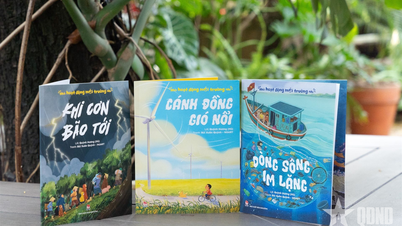
Selected from thousands of outstanding publications in the publishing world, and meticulously evaluated through multiple rounds of judging by a panel of experts and researchers, the awarded works partly reflect the face of intellectual life spanning many fields from history, archaeology, culture, natural sciences to education , children's literature, medicine, maritime affairs, and socio-cultural issues.
After receiving the award, where do the books go?
As of the 8th National Book Award ceremony, held on March 8, 2026, the award has honored approximately 288 valuable books, book sets, and published works. After nearly a decade of establishment, the National Book Award has gradually become the most important official award in the Vietnamese publishing industry.
However, the National Book Award still leans heavily towards the function of "honoring," while its social impact remains quite limited.
The reality is that information about books seems to surge during the award ceremony and then quickly fade away amidst new waves of information. The long-term lifespan of publications that win the National Book Award depends entirely on the communication capabilities of the publishing houses.
There is virtually no involvement of any state institution in the preservation and dissemination of these publications, and even information about the works is not systematically stored on any common platform.
The path to bringing the value of books' content into life seems very long, and I wonder: how many of these works are included in the public library system, how many students, researchers, not to mention people in remote villages and provinces have the opportunity to know about and access them, and how many books are introduced and encouraged to become a part of life?
And clearly, the National Book Award has hardly become part of the official reference reading catalog in schools. These are the questions that need to be answered if the National Book Award is to become a genuine cultural institution that contributes and has lasting vitality.
Public libraries are an important institution in building and supporting a community reading culture, but in reality, this system still has many gaps.
In particular, the public library system lacks a common national "core knowledge catalog" to guide book selection. Due to the lack of value standards and a sufficiently robust quality assessment mechanism, many libraries still acquire books based on seasonality or short-term market demand.
This has resulted in significant disparities in the quality of book collections across localities and a lack of foundational works on history, science , civics, or modern thinking. To build a truly learning society, Vietnam needs a national core book catalog for public and school libraries as part of a shared knowledge infrastructure.
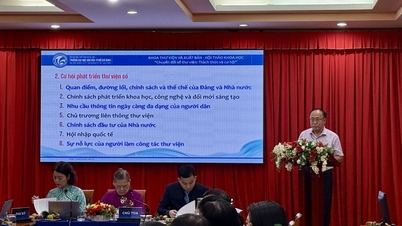
In this context, establishing a "National Book Collection" within the public library system could be a small step, but one with great significance.

Directive 04-CT/TW and new levers
All works that have won the National Book Award from the first time to the present can be compiled into a standardized collection. From there, a mechanism can be established to distribute these books to: provincial libraries, commune-level cultural institutions, community learning centers, school libraries, and public reading spaces.
At the provincial level, public libraries can build comprehensive collections, updated annually, accompanied by display spaces, QR codes for searching, digital data, reading promotion activities, or thematic seminars.
At the commune level, it's not necessary to have all nearly 300 books. Core categories can be selected according to groups. The important thing is to transform the National Book Award from an annual event into a living source of knowledge.
If well organized, the National Book Collection can become a foundational reading catalog for the community, a standard knowledge collection for libraries, a tool to support schools, data for digital libraries, and a platform for reading programs. This will gradually help to form a common and consistent core knowledge base.
From a policy perspective, this idea aligns quite well with the spirit of Directive No. 04-CT/TW dated March 17, 2025, of the Party Central Committee on strengthening the Party's leadership over publishing activities in the new situation. In this directive, the Party Central Committee emphasizes the requirements of developing a reading culture, improving publishing quality, building a learning society, and "elevating the National Book Award."
Clearly, having each National Book Award-winning publication commissioned for printing and inclusion in the library system will benefit and motivate all parties: Readers from local areas to cities will benefit from access to a curated and evaluated book collection, whose value has been affirmed through rounds of judging by the award committee; authors and publishing houses will be further motivated because there is no greater honor than having their books commissioned, read, and their value promoted in social life. Libraries, with their existing budgets, can acquire a valuable book collection as a core component of their system.
This is especially important given that young people are increasingly drawn to short content and lack the ability to read deeply. A society that loses its capacity for deep reading will also gradually lose its capacity for deep thinking.
In recent years, Vietnam has talked a lot about the knowledge economy, digital transformation, and cultural industries. However, it will be very difficult to build a creative society without a foundation of knowledge, in which the habit of reading valuable content plays a crucial role.
And it would also be very difficult to establish a sustainable reading culture if the most valuable books in the nation's publishing life did not reach the community.
If roads, bridges, and digital infrastructure are the foundation of economic growth, then books, libraries, and reading systems are the soft infrastructure of a learning society.
Source: https://baodanang.vn/giai-sach-quoc-gia-khong-nen-dung-o-vinh-danh-3338787.html























![[Video] Sunset at Lap An Lagoon – Where the sun sets over the fishing nets](https://vphoto.vietnam.vn/thumb/340x192/vietnam/resource/IMAGE/2026/05/31/1780192137701_beach-landscape-sea-water-nature-grass-745871-pxhere-com.jpeg)




![[Photo] The General Secretary, President and his wife lay flowers at the Ho Chi Minh Monument in Manila.](https://vphoto.vietnam.vn/thumb/1200x675/vietnam/resource/IMAGE/2026/05/31/1780219759477_anh-man-hinh-2026-05-31-luc-16-29-07.png)






























































Comment (0)