

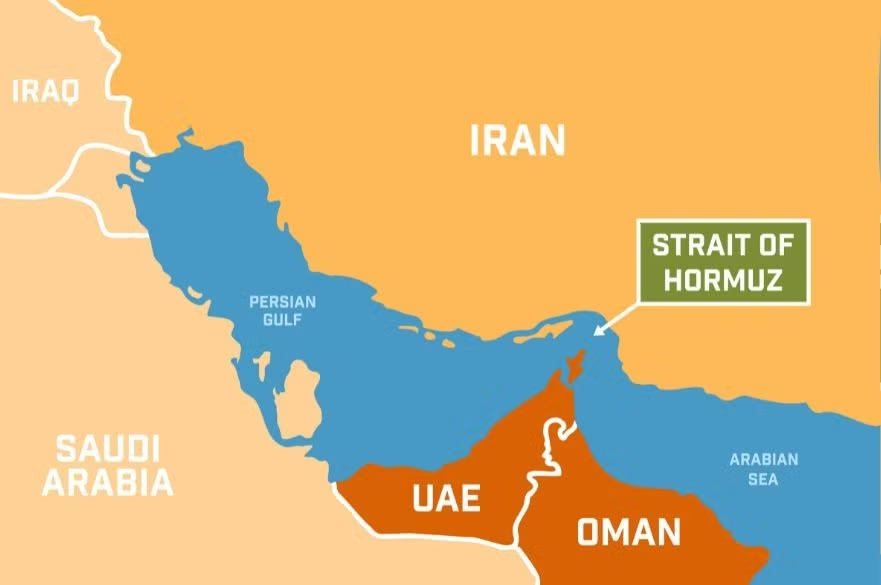
Tensions continue to rise in the Strait of Hormuz.
One of the notable recent developments is Iran's establishment of the Persian Gulf Waterway Authority (PGSA), an agency responsible for managing maritime activities in waters under Tehran's control, including collecting vessel data, issuing permits, coordinating shipping routes, and collecting maritime safety fees. Iran's approach views this as a measure to enhance management, ensure security, and maintain navigation in a region facing numerous instability risks.
However, Washington viewed this move from a completely different perspective. The US administration believed that the mechanism established by Tehran risked setting a precedent for controlling and commercializing traffic on an international shipping route of global strategic importance. Therefore, shortly after the PGSA was established, the US Treasury Department added it to its sanctions list.
This move is not simply a measure to pressure a single Iranian regulatory agency, but extends to a deterrent mechanism targeting the entire maritime transport ecosystem related to the Strait of Hormuz. Under US regulations, any financial transactions, services, or support related to the PGSA are subject to scrutiny. This means that shipowners, insurance companies, banks, traders, or intermediaries who pay fees to this agency risk facing secondary sanctions.
The impact of this decision is particularly noteworthy given the extraterritorial nature of the U.S. sanctions system. In practice, the vast majority of international payments still use the U.S. dollar or pass through banks connected to the U.S. financial system. This means that a seemingly purely commercial transaction between a foreign business and an Iranian regulatory agency could still fall under Washington's scrutiny.
Not only direct payments, but also indirect activities such as marine insurance, brokerage services, routing assistance, data provision, or logistics services related to PGSA operations may become subject to review. This significantly increases compliance costs for international shipping companies operating in the Persian Gulf region.
Besides Iran, Oman is also being drawn into a new spiral of tension. With its unique geographical location, where a portion of the sea near the Strait of Hormuz lies within Oman's Musandam province, the country has long played a mediating role in balancing the waters between various parties in the region. However, the possibility of Muscat participating in or supporting some maritime coordination mechanisms related to the Strait of Hormuz has met with strong opposition from Washington.
Recent warnings from U.S. officials indicate that Washington not only opposes the fees imposed by Iran, but also wants to prevent any attempts to establish a payment or maritime management mechanism that could generate revenue for Tehran. This reflects the reality that the current confrontation has moved beyond conventional military matters into the financial, legal, and global logistics control spheres.
Global trade faces a dilemma.
A direct consequence of the US-Iran confrontation is that shipping companies are increasingly facing a more complex and risky operating environment.
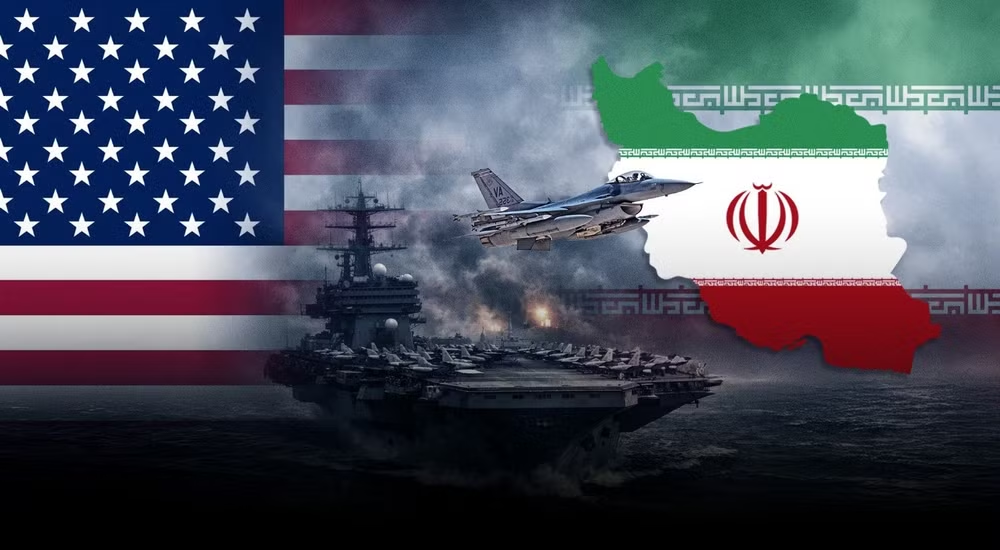
Under normal circumstances, compliance with local maritime regulations is a technical requirement to ensure the safety of vessels. However, in the current Hormuz situation, shipowners are facing a dilemma. Refusing to cooperate with Iran could expose ships to security risks on the ground, such as inspections, diversions, warnings, or other hazards arising from the conflict environment. Conversely, complying with requirements related to licensing, data sharing, or payment of fees under Iran's system could lead to US sanctions.
The difficulties extend beyond the level of shipping companies. International banks are now forced to expand their risk control processes, not only verifying the origin of goods but also scrutinizing the entire shipping route, service providers, and payment terms. Terms once commonly used in maritime transactions, such as "port services," "maritime assistance," "agency fees," or "transportation safety guarantees," can now serve as warning signals during the assessment process of financial institutions.
Similarly, the marine insurance industry is also having to adjust contract terms to minimize legal risks. Many experts predict that future insurance contracts will require a higher degree of transparency regarding ship routes, service providers, and payments related to operations in the Strait of Hormuz.
Against this backdrop, shipping traffic through this strategic waterway has shown a significant decline compared to pre-crisis levels. Previously, approximately 125-140 ships passed through the Strait of Hormuz daily; now, traffic is only recovering gradually, albeit on a significantly smaller scale. Although some large oil and liquefied natural gas tankers continue to operate, most international shipping companies maintain a cautious attitude and continuously reassess their risk levels.
Of concern is that the combination of military tensions and sanctions pressure could create a ripple effect on the global energy market. The Hormuz remains a vital transit route for oil and gas exports from many Gulf nations. Any prolonged disruption there has the potential to impact energy prices, transportation costs, and international supply chains.
From a broader perspective, current developments reflect a growing trend in global geopolitical competition: economic and financial tools are being used as part of a pressure strategy. Instead of relying solely on military power, parties are increasingly leveraging international payment systems, insurance, transportation, and legal regulations to expand their influence and gain strategic advantages.
In the short term, it is unlikely that tensions around the Strait of Hormuz will be resolved anytime soon, as both Washington and Tehran consider it a strategically important space. However, what is certain is that the international shipping community will continue to operate in an environment of great uncertainty, where the line between ensuring maritime safety and the risk of violating sanctions regimes is becoming increasingly blurred. Therefore, the competition in Hormuz is not just an issue between the US and Iran, but also a test of the adaptability of global trade to increasingly complex geopolitical shifts.
Keywords:
Source: https://congluan.vn/eo-bien-hormuz-tu-cuoc-chien-quan-su-den-phap-ly-post348151.html








![[Weekend Podcast] World Cup 2026: When the dream of playing football becomes a game for those with thick wallets](https://vphoto.vietnam.vn/thumb/402x226/vietnam/resource/IMAGE/2026/05/31/1780220467442_anh-thumb-podcast-2.png)







![[Video] Sunset at Lap An Lagoon – Where the sun sets over the fishing nets](https://vphoto.vietnam.vn/thumb/340x192/vietnam/resource/IMAGE/2026/05/31/1780192137701_beach-landscape-sea-water-nature-grass-745871-pxhere-com.jpeg)




![[Photo] Solemn bathing ceremony and Buddha procession in Hue](https://vphoto.vietnam.vn/thumb/1200x675/vietnam/resource/IMAGE/2026/05/31/1780228263543_1-jpg.webp)


































![[Photo] Admire the coral "masterpiece" amidst the million-year-old heritage of Dak Lak province.](https://vphoto.vietnam.vn/thumb/402x226/vietnam/resource/IMAGE/2026/05/31/1780221235105_anh-man-hinh-2026-05-31-luc-16-53-27.png)


































Comment (0)