

That craftsman's name is Nguyen Duc Lang, who has dedicated his life to protecting the national flag with unwavering faith and a love for his country that has not faded with time.
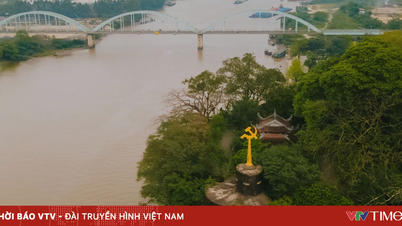
The red flag amidst the silent demarcation line.
Born in 1937, Mr. Lang grew up in the Cam Lo region (Quang Tri province), then moved with his father to live near Hien Luong Bridge, which later became the dividing line between the country according to the 1954 Geneva Agreement. In 1956, when the revolutionary government decided to erect a flagpole on the north bank of the Ben Hai River, the red flag with a yellow star flying atop that monument became a sacred symbol of sovereignty and the aspiration for national reunification.
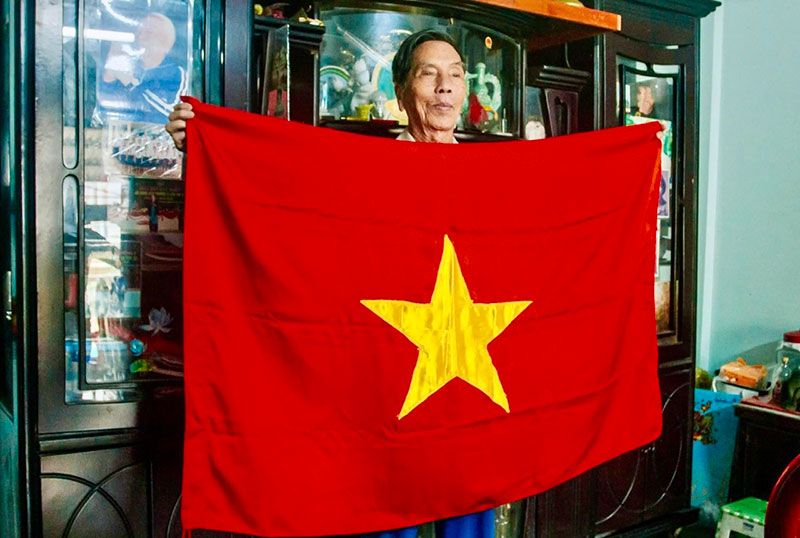
But few people know that those flags were sewn by the hands of a humble craftsman, Mr. Nguyen Duc Lang. When he was assigned this task, he was just over 19 years old, the lead tailor in a small sewing workshop serving the needs of the people. "Back then, I thought holding a needle was also a contribution, as long as it was something useful for the country. I told myself, if I couldn't go to war like my friends, I would sew the biggest, most beautiful flag, and hang it in the most sacred place, so that people in the South and North could all see it," Mr. Lang recounted.
Hien Luong - Ben Hai became a silent but fierce point of confrontation between our side and the enemy. In particular, the "flag war" was protracted and intensely tense. Each side tried to erect a taller flagpole and sew a larger, more vibrant flag. And whenever the other side changed the height of their flagpole, the North would immediately respond with a taller, larger, and more beautiful flag, as a declaration of sovereignty. "Once, I had to stay up all night sewing a flag to be ready for hanging early in the morning. One day, it was torn by a storm right after I finished hanging it, and I had to replace it immediately. The national flag was not allowed to be torn, not even a small corner. Because it was the face of the country, the pride of the nation," Mr. Lang recalled with emotion.
His needlework not only connected pieces of fabric, but also linked the faith and hope of millions of people from both regions, especially the people of the South, whenever they looked across to the North and saw the red flag with a yellow star still proudly flying in the sky.
A lifetime dedicated to upholding the national flag with unwavering faith.
Time passed by. Mr. Lang sewed countless flags. Each one was meticulously hand-stitched, every thread and color checked carefully. For him, it wasn't just a responsibility, but a belief and an honor.
The most vivid memory for him is the times they replaced the flag on stormy nights. He would load the flagpole onto his bicycle, wrap the flag in his shirt, and then, along with the armed border police officers, follow the slippery muddy path to the flagpole, hoisting the new flag to replace the torn one. There were no trumpets, no anthems, only the sound of the wind and his own heart pounding with emotion. "In the darkness of that night, I only thought that the people of the South would see their flag again tomorrow. They would know that their homeland had never given up," he recounted, his eyes still welling up with tears.
After the country was reunified, he continued sewing flags for major celebrations. The war is long over, but Hien Luong Bridge remains a sacred symbol of the aspiration for independence, freedom, and reunification. The flag hoisted on the monument still needs to be the most beautiful and vibrant. Even now, at his advanced age and with declining health, Mr. Lang still cherishes the craft of flag making as if it were an integral part of his life.
In the afternoon, sitting and chatting with guests under the eaves of his small house in Ward 9, Precinct 5 (Dong Ha), Mr. Lang occasionally glanced north towards the Ben Hai River and Hien Luong Bridge. He thoughtfully shared, "Now I sew slower, but I still maintain the habit of carefully selecting fabric, measuring every inch, and sewing each stitch neatly. The flag isn't just for hanging; it's the sacred soul of the land," he said. I noticed that whenever he recounted the old days, his eyes always lit up. Each story, each memory, unfolded like a tapestry woven with needle and thread and the vibrant red of the national flag.
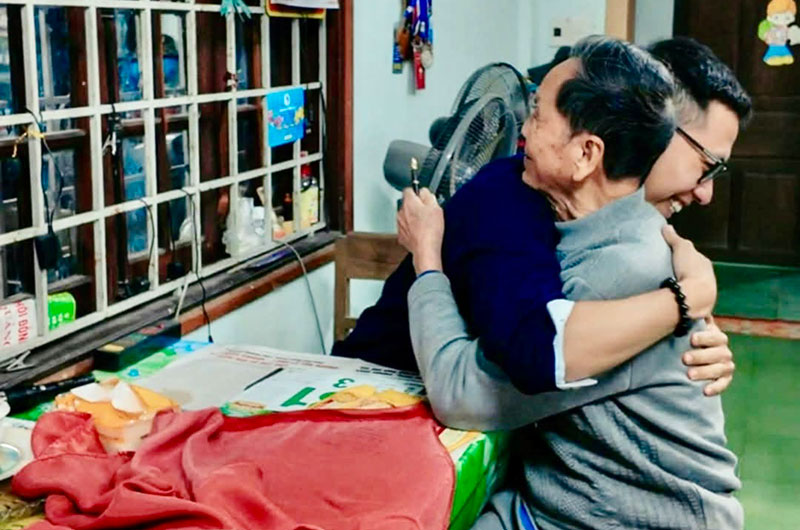
Over the years, Mr. Lang has also been delighted by the occasional visits from young people who ask about his flag-making skills and the years of tenacious fighting on the dividing line of the country. "Just recently, Tien from Ca Mau, who was traveling from the North, stopped by Dong Ha to visit me," he recounted, then showed me some commemorative photos. In them, a young man embraced an old man warmly and affectionately. The young man's gesture and feelings towards him were perhaps not only due to understanding, but also to express boundless gratitude. Concluding their conversation, there was another beautiful image. The old man gently opened a wooden chest, took out a flag he had sewn himself, its edges worn by the years, and happily signed it for the young man! Two generations, one belief!
Source: https://cand.com.vn/Tieu-diem-van-hoa/gap-nguoi-giu-co-to-quoc-bang-niem-tin-son-sat-i766293/

![[Photo] General Secretary and President To Lam presides over a meeting on preparations for the review of one year of operation of the three-tiered government system.](https://vphoto.vietnam.vn/thumb/1200x675/vietnam/resource/IMAGE/2026/06/02/1780391821195_a1-bnd-4595-9717-jpg.webp)














































Comment (0)