

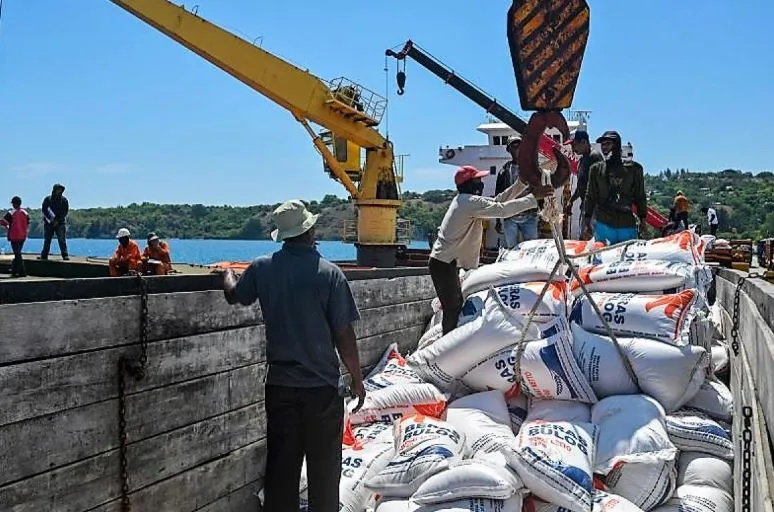
Workers unload sacks of rice imported from Thailand from a cargo ship at Malahayati port in Krueng Raya, Aceh province, Indonesia. Photo: AFP
Thai white rice export prices, the benchmark price for Asian rice, rose by as much as 20% in May, marking the sharpest increase since 2008.
According to the latest data from the Thai Exporters Association, the price of 5% broken white rice from Thailand was offered at US$478 per ton on May 27th.
On the Chicago Mercantile Exchange (USA), the price of rice futures contracts also increased by about 15% in the same month.
Bin Hui Ong, a commodities analyst at BMI (part of Fitch Solutions), believes the upward trend in rice prices will continue.
Earlier, BMI raised its forecast for Chicago-based rice futures prices. According to Bin Hui Ong, the El Niño weather phenomenon is predicted to occur in the near future. This weather pattern could cause many areas in Asia to face hotter and drier weather, adding further upward pressure on rice prices.
Meanwhile, fuel and fertilizer supplies remain disrupted due to the near paralysis of shipping through the Strait of Hormuz. This leaves farmers in many Asian countries who depend on imports facing increasingly expensive input costs.
This is a factor that can directly impact rice production, a staple food that plays a crucial role in the region's food security.
Countries like Thailand, Vietnam, and India not only consume large quantities of rice domestically but are also leading exporters worldwide . Therefore, any decline in production in this region could impact global supply.
As the main rice planting season begins in many parts of Asia, a significant number of farmers have been forced to postpone or reduce their planting area due to rapidly rising production costs.
Rice is a crop that requires a large amount of fertilizer, while irrigation systems serving rice fields mainly use diesel fuel. This makes the rice production industry particularly sensitive to fluctuations in energy and agricultural input prices.
According to the International Rice Research Institute (IRRI), prices of nitrogen-containing fertilizers in Thailand, Cambodia, and the Philippines have increased by 40-50% since the outbreak of hostilities in Iran in late February.
Although these countries still maintain sufficient rice reserves for the period from March to May, the risk of shortages may emerge in the near future if the flow of fertilizer trade does not return to normal soon.
Alisher Mirzabaev, a policy and climate change analyst at IRRI, warned that prolonged disruptions to fertilizer supplies could seriously impact rice yields in the region.
In addition, rice production in Asia faces risks from extreme weather. The Philippines recently warned that a strong El Niño event could reduce rice yields by up to 700,000 tons, equivalent to about 3.5% of the country's annual production target.
However, some experts believe that the upward trend in international rice prices may be curbed by relatively high inventory levels, especially in India, the world's largest rice producer. In addition, global demand remains relatively weak.
Peter Clubb, a market analyst at the International Grains Council (IGC), believes that abundant rice reserves could help mitigate some of the upward price pressure in the short term. However, the market outlook remains heavily dependent on weather patterns and production costs in the coming months.
According to Bloomberg
Source: https://money.vtv.vn/gia-gao-chau-a-tang-manh-nhat-gan-20-nam-109260531205227488.htm

![[Photo] General Secretary and President To Lam presides over a meeting on preparations for the review of one year of operation of the three-tiered government system.](https://vphoto.vietnam.vn/thumb/1200x675/vietnam/resource/IMAGE/2026/06/02/1780391821195_a1-bnd-4595-9717-jpg.webp)

















































































Comment (0)