

After months of decline, natural gas prices in Europe have risen by more than 50% this month, evoking fears of last year's energy crisis.
Data from commodity price research firm ICIS shows that European gas futures prices have risen 52% since the beginning of this month, reaching 35 euros ($38) per megawatt-hour on June 16. Analysts told CNN that the price reversal was mainly due to longer-than-expected maintenance at major gas plants in Norway.
Natural gas prices in Europe remain significantly lower than they were last summer, when the region was embroiled in an energy war with Russia following the conflict in Ukraine. However, "the recent price increase shows how sensitive European markets are to disruption," commented Bill Weatherburn, an economist at Capital Economics.
Earlier this week, Gassco – the operator of Norway's gas supply system – announced that the planned closure of one of its gas processing plants would be extended until July 15. Previously, the plant was scheduled to resume operations on June 21. Two other gas plants will remain closed indefinitely to address "processing capacity issues".
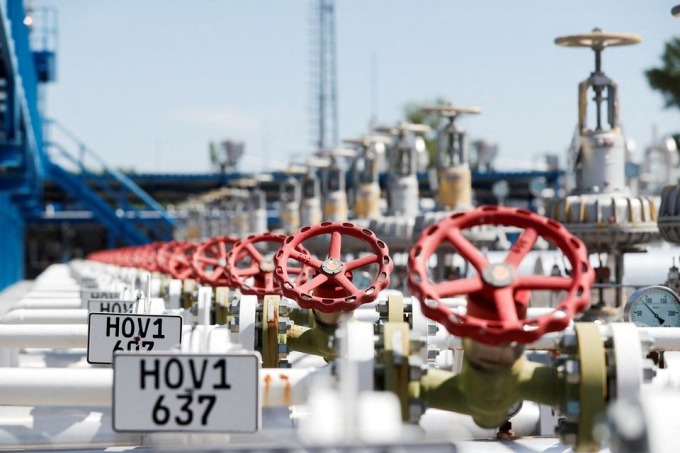
Gas valves at a storage facility in Hungary. Photo: Reuters
Last year, Norway replaced Russia as the European Union's (EU) largest source of natural gas imports, accounting for over 24% of the market share. Meanwhile, Russian pipeline gas accounted for only 15%.
Europe is also facing the risk of losing another major source of natural gas. Gas prices surged on June 15th following news that the Netherlands plans to permanently close the Groningen gas field in October, a year earlier than planned. Yesterday, gas prices even reached nearly 50 euros per megawatt-hour before falling back down. This is double the level at the beginning of the month.
According to CNN, a Dutch government spokesperson said they have not yet decided when to close the Groningnen gas field. Once a major supplier of natural gas to Europe, the Netherlands has reduced production over the past decade due to earthquake risks. Groningnen is one of the world's largest gas fields, but currently supplies only a fraction of Europe's needs.
"The European gas market – and by extension the global gas market – is certainly still facing the risk of undersupply," Tom Marzec-Manser, Director of Gas Analysis at ICIS, told CNN.
In August 2022, gas prices in Europe reached a record high of 340 euros per megawatt-hour, as countries raced to stockpile before winter. Currently, these storage facilities remain at 73% capacity – higher than the five-year average of 56%, according to data from the European Gas Manufacturers Association.
"Last summer's panic can't happen again," Massimo Di Odoardo, a gas analyst at consulting firm Wood Mackenzie, told CNN . Record gas inventories in Japan and South Korea, coupled with weaker-than-expected Chinese economic growth, also reduce the likelihood of Europe having to join a liquefied natural gas (LNG) battle with Asia this summer.
Nevertheless, investor confidence remains shaken. "Europe still faces the reality that there is very little Russian gas available here. Therefore, any unannounced disruption could cause prices to skyrocket," concluded Henning Gloystein, Director of Resources, Climate, and Energy at Eurasia Group.
Ha Thu (according to CNN)
Source link
































![[Image] Hanoi's urban life under the challenge of a "scorching hot" environment](https://vphoto.vietnam.vn/thumb/1200x675/vietnam/resource/IMAGE/2026/05/25/1779706979265_nang-nong-t5-2026-minh-duy-7-4636-jpg.webp)































































Comment (0)