

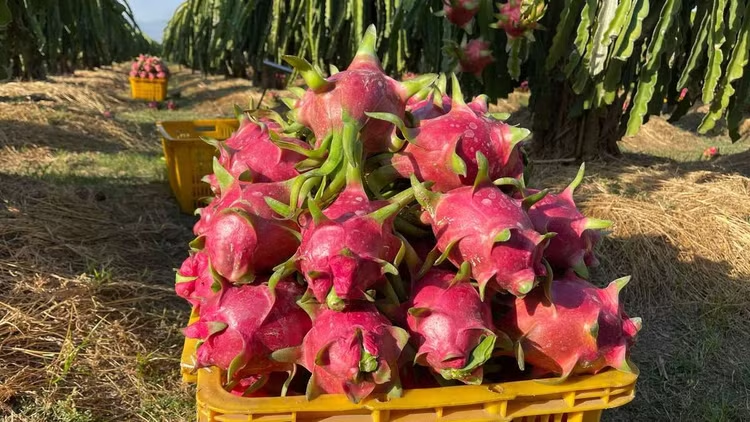
Dragon fruit prices in many southern localities are at their lowest level in years, fluctuating between only 2,000 and 5,000 VND/kg depending on the variety. This price not only leaves growers with almost no profit but also puts many farmers in a situation where harvesting results in losses, while leaving the fruit on the trees also causes damage.
In major dragon fruit-growing regions like Binh Thuan, Long An, and Tien Giang, white-fleshed dragon fruit is commonly purchased by traders at 2,000-3,000 VND/kg. Meanwhile, red-fleshed dragon fruit fetches a higher price, but only fluctuates between 4,000-5,000 VND/kg. Compared to favorable times, current prices have dropped by 70-80%, causing distress to many farmers.
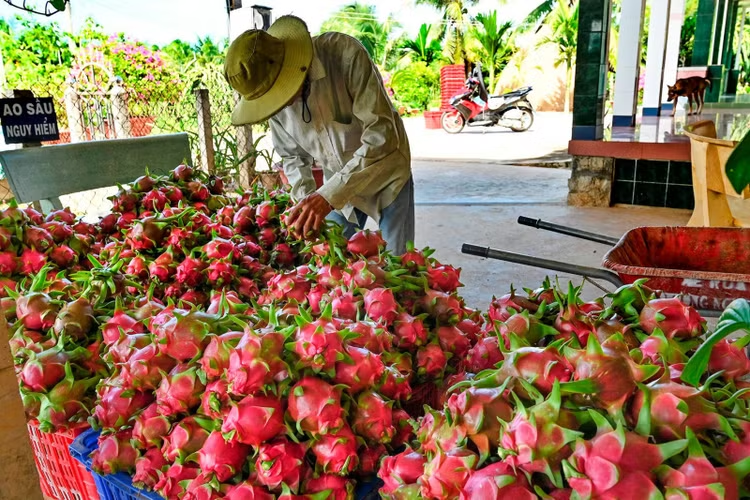
Mr. Nguyen Van Hoa, the owner of a nearly 2-hectare dragon fruit orchard in Binh Thuan, said that current prices are much lower than the actual production costs. According to him, to produce one kilogram of marketable dragon fruit, farmers have to invest in electricity for flowering, fertilizers, pesticides, irrigation systems, and labor for care. The total average production cost ranges from 6,000 to 8,000 VND/kg.
"Selling at 2,000 - 3,000 VND/kg would definitely result in losses. Many households just hope to sell their produce to recover some of their capital instead of letting the fruit spoil in the orchard," Mr. Hoa shared.
It's not just Binh Thuan; many orchards in Long An and Tien Giang are facing a similar situation. Despite the low prices, farmers still have to harvest because leaving the fruit to ripen for too long on the tree will reduce its quality and affect the yield of subsequent crops. Many households are accepting selling below cost to minimize losses.
According to fruit traders, the reason for the sharp drop in dragon fruit prices is the significant increase in supply while consumption has not improved considerably. Many dragon fruit growing areas are entering their harvest season simultaneously, leading to a rapid increase in the amount of fruit on the market and putting pressure on prices.
Conversely, the domestic market is not yet able to absorb the large volume of production. Export activities also face considerable difficulties as many importing markets are increasingly tightening requirements regarding quality, traceability, and pesticide residue levels. This has resulted in a smaller quantity of dragon fruit meeting export standards than before.
In addition, competition from many other summer fruits such as mangoes, durians, rambutans, and jackfruit has also led to a decline in demand for dragon fruit. With large quantities of produce but limited outlets, the purchase price at the farm continues to be driven down to low levels.
The drop in dragon fruit prices is not a new story, but it clearly highlights shortcomings in production and consumption organization. Over-reliance on a few traditional export markets makes this industry vulnerable to impacts when demand decreases or import policies change.
To mitigate the problem of "bumper harvests leading to price drops," experts suggest promoting the development of standardized raw material areas, expanding linkages between farmers and businesses, and opening new markets. Additionally, investing in deep processing such as juicing, drying, or value-added products will contribute to improved economic efficiency and reduce pressure on the consumption of fresh fruit.
With agricultural input costs remaining high, the price of dragon fruit, now only a few thousand dong per kilogram, is putting significant pressure on the livelihoods of growers. If the market does not improve soon, many farmers may have to reduce their acreage or switch to other crops to minimize risks, affecting the sustainable development of one of Vietnam's key export fruits.
Source: https://khoahocdoisong.vn/gia-thanh-long-giam-sau-nong-dan-doi-mat-lo-nang-post2149101349.html

![[Photo] General Secretary and President To Lam presides over the meeting to approve the draft report on the results of the second inspection by the Politburo of the Standing Committee of the Hanoi City Party Committee.](https://vphoto.vietnam.vn/thumb/1200x675/vietnam/resource/IMAGE/2026/05/26/1779789811432_a2-bnd-4430-9620-jpg.webp)













![[GALLERY] Ubisoft suffers record losses, cancels 7 games, shocking the gaming industry.](https://vphoto.vietnam.vn/thumb/402x226/vietnam/resource/IMAGE/2026/05/26/1779805711288_uni-2-png.webp)
![[GALLERY] USB-C AA batteries are causing a sensation because they're so convenient for tech enthusiasts.](https://vphoto.vietnam.vn/thumb/402x226/vietnam/resource/IMAGE/2026/05/26/1779798818575_p-png.webp)







































































Comment (0)