

This leads to the requirement that teachers must have a thorough understanding of texts that students have never studied. According to some teachers, selecting the "perfect" source material, as traditionally understood, is becoming increasingly scarce and difficult. This raises the question: Is it permissible for teachers to create their own source material for literature tests to avoid duplication?

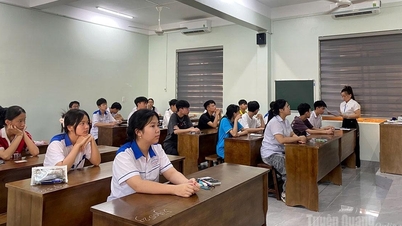
11th grade students during a literature class according to the new General Education Program.
WHEN TEACHERS ARE ALSO CREATORS
It's a common practice for teachers to use texts by reputable poets, writers, and authors. Many teachers question whether, if someone has a talent for writing and has published many collections of poems, short stories, and good articles of their own, they should be allowed to use this material in tests.
Some teachers believe that creating their own test materials stimulates greater creativity in teaching literature. Students will find the test more interesting if the text is well-written and meaningful. Teachers also temporarily solve part of the problem of selecting materials for the test. With their own materials, teachers will also have a firmer grasp of the text's content, making it easier to create accurate questions and answer keys.
The argument that studying literature requires knowledge of literary authors, and that the works of those authors should be included in tests, is not entirely correct. In reality, based on observation, many current tests use very new material, unfamiliar authors, and unreliable sources, often taken from social media.
Meanwhile, in practice, it has been shown that for convenience in establishing the exam topic and formulating questions, many texts in important exams are created by the exam-setting department itself. For example, the 2023-2024 Ho Chi Minh City entrance exam for 10th grade literature included a text created by the exam setters with the author being "My Teacher".
Even in the new 10th and 11th grade Vietnamese language and literature textbooks, there are many texts that the authors themselves created. For example, the essay "Conception of Idols" (Vietnamese Language and Literature 10, Creative Horizon series), or the essay "Some Features of Nam Cao's Narrative Art in the Short Story 'The Superfluous Life'" (Vietnamese Language and Literature 11, Connecting Knowledge with Life series). Searching for external sources would likely not perfectly meet the requirements of the lesson.
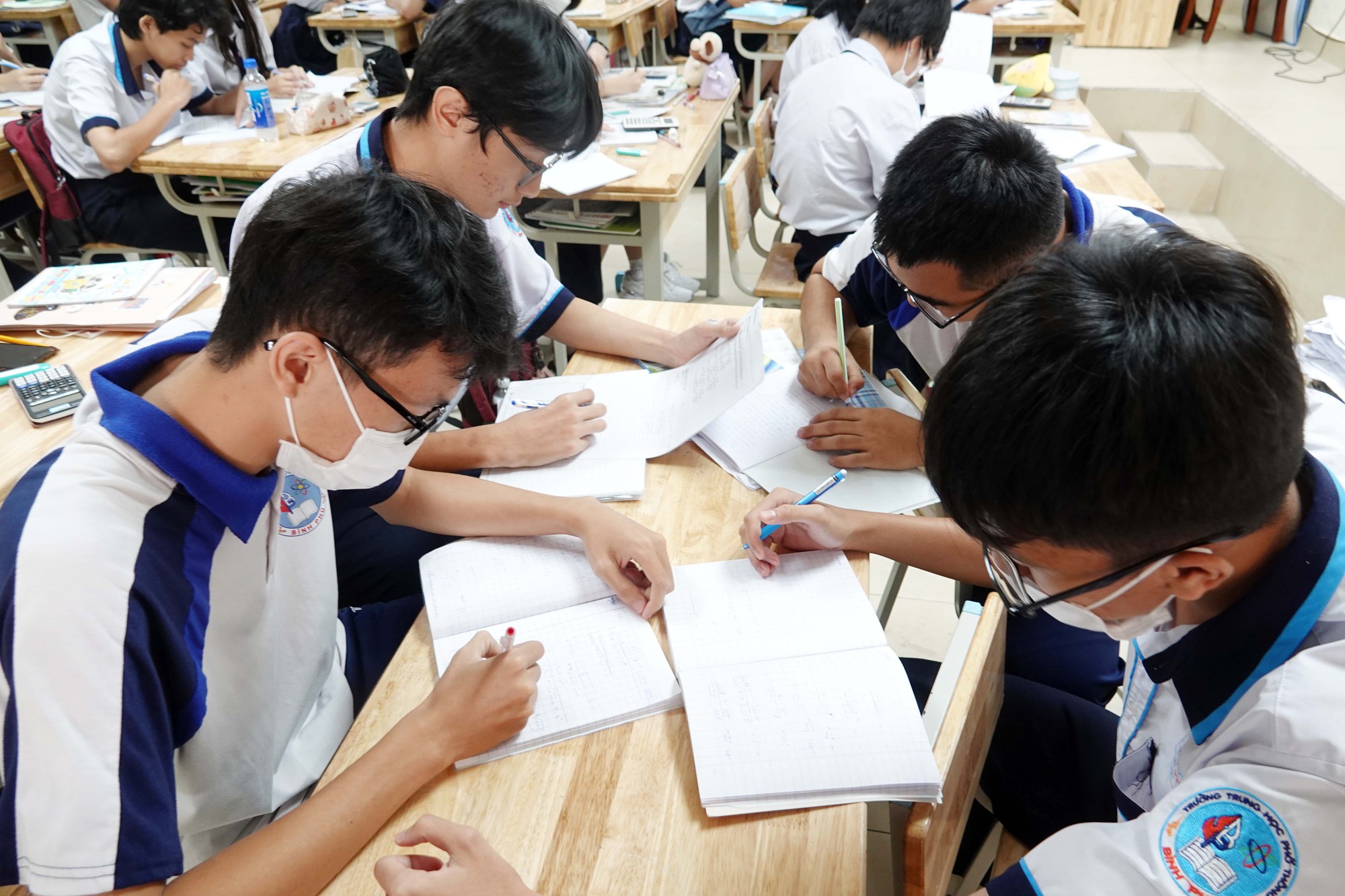
The spirit of competency-based assessment in the Vietnamese language and literature subject under the new general education program is to avoid reusing texts already taught to students in test questions.
DO NOT REUSE TEACHING MATERIALS TO CREATE TEST QUESTIONS
According to Master Tran Tien Thanh, a specialist in Vietnamese language and literature at the Ho Chi Minh City Department of Education and Training, there are legal grounds for "using new materials outside of textbooks" in testing and evaluating Vietnamese language and literature.
Specifically, the 2018 Literature curriculum (pages 86-87) provides guidance on evaluating educational outcomes: "In evaluating end-of-year and end-of-level learning outcomes, it is necessary to innovate the evaluation methods (exam structure, question formulation, difficulty level analysis, etc.); use and exploit linguistic materials to ensure that the assessment of students' abilities is met, overcoming the situation where students only memorize lessons or copy pre-existing materials; avoid reusing previously studied texts to accurately assess reading comprehension and the ability to analyze and appreciate literary works."
Furthermore, Official Document No. 3175/BGDĐT-GDTrH dated July 21, 2022, on guiding the reform of teaching methods and assessment in the Vietnamese language subject, clearly states: "In assessing learning outcomes at the end of the semester, the end of the school year, and the end of the school level, avoid reusing texts already studied in textbooks as materials for constructing reading comprehension and writing tests to accurately assess students' abilities and overcome the situation where students only memorize lessons or copy the content of pre-existing materials."
Thus, according to Master Thanh, the spirit of competency-based assessment (specifically, "reading comprehension" and "writing" skills) is to avoid reusing texts already taught to students for test questions. Students need to apply the knowledge and skills they have learned and practiced to "read and understand," "analyze, and appreciate" a new text.
We also see that the literature exam for the high school graduation exam and the entrance exam for grade 10 in some provinces and cities (even though following the 2006 curriculum) have used texts outside the textbook for the "reading comprehension" section to assess students' reading comprehension abilities. This is a step towards reforming testing in line with the competency-based approach to align with the new curriculum. The types of texts selected for the exam are also diverse, including literary texts, informational texts, and argumentative texts. Thus, according to Mr. Tran Tien Thanh, selecting new materials for the "reading comprehension" section of exams and tests is not a completely new or surprising requirement; it is a requirement we have been implementing for many years.
In some cases, for students who read widely, extensively, and diligently practice reading comprehension skills, the texts chosen by the teacher for the exam may be ones they have already read or are familiar with. This is a coincidental situation.
"Therefore, what needs to be done is for teachers not to repeat texts that they have already taught or given to students for practice. As for texts that students read and learn on their own from various sources, it is difficult for teachers to know all of them to avoid them when creating exam questions," Mr. Thanh emphasized.
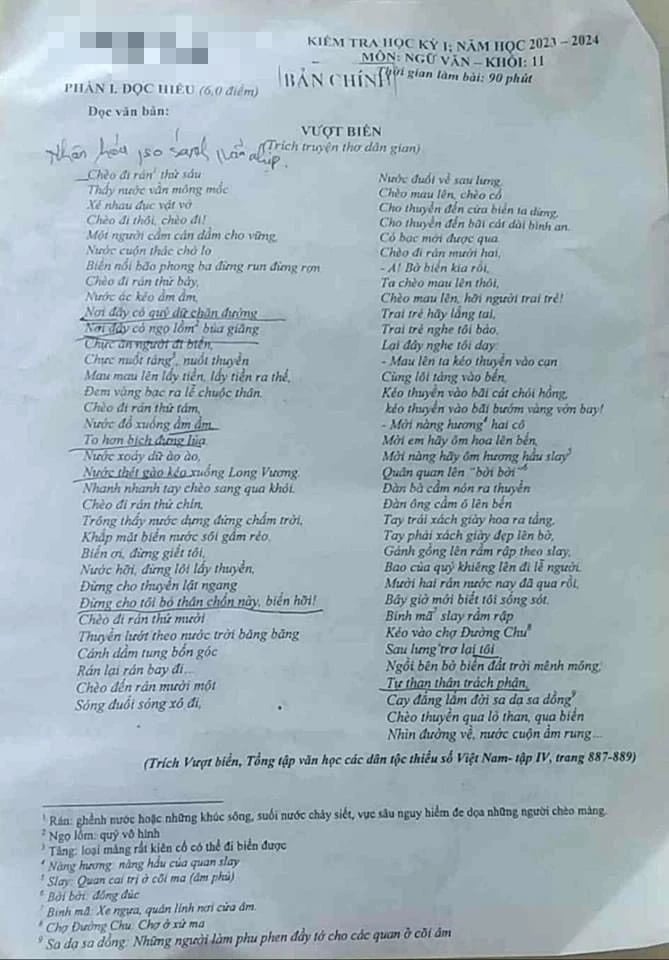
A first-semester literature exam for 11th-grade students at a school in Ho Chi Minh City has sparked controversy due to the inclusion of an excerpt of 70 lines of poetry.
CRITERIA FOR SELECTING DATA
According to Master Tran Tien Thanh, the criteria for selecting texts are based on and referencing texts in textbooks; building a question bank and a shared source of texts for creating exam questions; and selecting texts that are linked to text processing such as abridgement, summaries, footnotes, adding annotations, and providing contextual information (if needed)... to support students in reading comprehension. Attention should be paid to difficulty level, length, and the suitability between the time allotted for the exam, the texts, and the requirements. Texts may be short but difficult, while longer texts may be easy due to their relevance to grammatical structure, vocabulary, terminology, and content (familiar or new, in-depth).
Regarding some teachers wanting to create their own test materials, according to Master Tran Tien Thanh, teachers may believe that the materials they write (informational texts; argumentative texts; poems, stories) fully meet all the requirements in terms of ideology, aesthetic value, educational value, and genre characteristics. However, for objectivity, these materials need to be independently evaluated and critiqued before being used to create test questions.
"Teachers can send informational texts, argumentative essays, poems, and stories they have written to publishers, newspapers, and radio stations for evaluation, publication, or to experts for assessment and critique. These are effective channels and methods for evaluating the value of the materials teachers create themselves. Only after establishing a data repository that meets the requirements can we select and use them to create exam questions. Using materials that have not gone through these screening, evaluation, and critique channels to create exam questions is unscientific and carries many risks of errors. In reality, using materials from books and newspapers by reputable authors is more convenient and effective than teachers creating their own materials," emphasized Master Tran Tien Thanh.
From December 18th to 30th, high school students in Ho Chi Minh City will begin their semester exams for the 2023-2024 school year. School principals stated that the exam questions will be compiled according to the 2018 General Education Program guidelines, emphasizing the application of knowledge to solve specific problems and practical situations.
Literature exams often attract the attention of both students and teachers. According to the 2018 General Education Program regulations, the reading comprehension materials must be texts outside of the textbook.
On December 18th, on a forum for high school and university students in Ho Chi Minh City, a considerable number of students and teachers expressed their agreement with the 10th-grade literature exam at Nguyen Thuong Hien High School (Tan Binh District). Teacher Phan The Hoai from Binh Hung Hoa High School (Binh Tan District) commented that the exam's text was informative and relevant to students.
Bich Thanh
Source link


![[Photo] Ba Lang An Lighthouse - the "eye of the sea" amidst the "rock museum" of Quang Ngai province.](https://vphoto.vietnam.vn/thumb/1200x675/vietnam/resource/IMAGE/2026/05/29/1780038698840_anh-man-hinh-2026-05-29-luc-14-10-42.png)
![[Image] Pleasant weather helps students enter the 10th grade entrance exam with confidence.](https://vphoto.vietnam.vn/thumb/1200x675/vietnam/resource/IMAGE/2026/05/29/1780034401612_ngay-1-thi-lop-10-minh-duy-8-5009-jpg.webp)








































































Comment (0)