

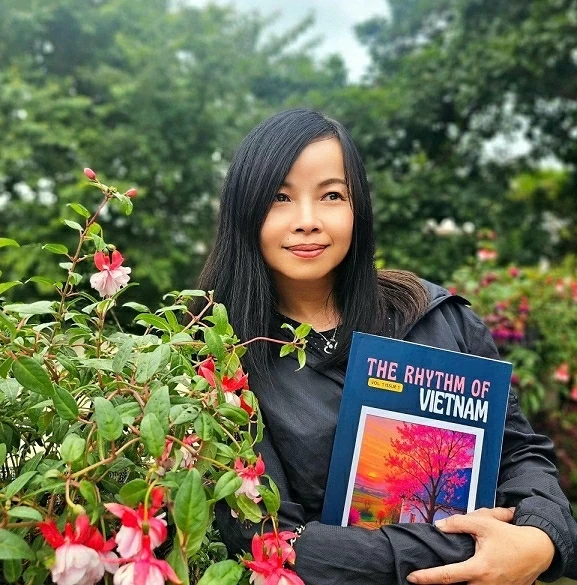
 |
| Poet and translator Vo Thi Nhu Mai. (Photo courtesy of the interviewee) |
Where does your inspiration usually come from?
My poems are written from very simple things. My deepest inspiration comes from nostalgia for myself, my culture, and my community. I am a Vietnamese person who has traveled extensively, but I always carry within me the everyday life, the landscapes, the voices of my parents, the windy highlands, the bustling streets, childhood memories, and moments of adulthood with family and friends.
Our country has gone through many wars. These historical imprints are deeply etched in the national consciousness. From the pain and sorrow that war leaves behind, people have come to appreciate the value of peace even more, a value that permeates thought, literature, art, and the way we treat each other.
Living in Australia has given me a different level of inspiration. The experience of migration has helped me pay closer attention to small details, listen more carefully, and recognize the beauty of diversity in a multicultural country that brings together communities from many different nations.
Nature, especially the ocean and the expansive skies of Western Australia, often enters my poetry as a space to be grateful for where I was born and to appreciate where I live.
Furthermore, human connection is also a vital source of nourishment. Conversations with students in the classroom, dialogues with poets from various continents, or even moments alone with fellow poets and writers—all contribute to shaping my poetry. Poetry begins when something moves me and I sincerely seek to listen.
Does the newly written poem "Seeds of Peace in Every Soul" reflect your personal philosophy of life?
The poem reflects my belief that peace is first and foremost an inner responsibility. I believe every human being possesses within themselves the capacity for compassion, empathy, and non-violence, even if these qualities are sometimes obscured by fear, hurt, or misunderstanding.
In families, communities, countries, and more broadly on this planet, each person needs to slow down, observe, be calm, understand, be gentle, and be courteous. Peace begins with how we treat each other in daily life: listening, being patient, and showing empathy—that is also the message of this poem.
My philosophy of life is shaped by Eastern thought combined with the experiences of a woman in her 50s. Peace is like a seed that needs to be nurtured slowly with mindfulness and care. When writing this poem, I thought that world peace must begin with inner peace within each person.
Literature cannot stop war, but it can soften hearts. If a poem can evoke even a moment of reflection or a gesture of kindness, then its mission is accomplished.
The world is constantly evolving amidst complex developments. Bloodshed, conflict, resentment, hatred, exploitation, and intimidation continue unabated. But what we can do, we should definitely do: Treat our family, loved ones, colleagues, and friends with kindness.
It's not just about kindness, but also about the ability to protect, remind, and nurture love. Poetry restores the complexity of life, reminding us that human experience cannot be reduced to rigid opposites.
By capturing both pain and hope, loss and love, poetry resists simplification – the source of much conflict. More importantly, poetry humanizes pain: instead of emotionless numbers, it restores faces, voices, and emotions to people. From this, empathy is awakened, diminishing the tendency to hurt and fostering a sense of mutual protection.
Working in a multicultural environment, how do you blend Vietnamese and Australian cultures in your poetry?
I didn't intentionally combine the two cultures. I let both coexist naturally within me. Vietnamese culture nurtured my inner world, values, emotional depth, and poetic imagery, while Australian culture influenced my openness, sense of space, and spirit of freedom.
In poetry, this intermingling often manifests itself subtly: a sky of Vietnamese memories emerges beneath the clouds of Australia, or an Eastern-spirited contemplation is set within a Western landscape.
The encounter was harmonious because both were living realities. I believe that cultural harmony in literature should occur naturally. When writers are honest with their life experiences, cultural dialogue naturally develops.
What role does the Vietnamese language play in your life and creative journey?
Vietnamese is my emotional homeland. Even though I've lived far from home for many years, my deepest emotions are still formed in Vietnamese. My mother tongue carries cultural nuances, musicality, and layers of emotion that no other language can fully replace.
When writing in Vietnamese, I feel connected to many generations before me—poets, mothers, farmers, storytellers, people who have preserved the language through their own lives.
Vietnamese allows me to express tenderness, nostalgia, and subtle emotional nuances in a pleasant way. At the same time, writing bilingually teaches me humility.
Translating poetry has made me realize the beauty and fragility of language. Vietnamese keeps me grounded, while English helps my poetry reach further. The two languages dialogue with each other, rather than separating.
 |
| Poet and translator Vo Thi Nhu Mai and her international friends. (Photo: Provided by the interviewee) |
In your opinion, what is the biggest challenge for Vietnamese writers and poets when participating in the international literary scene today?
A major challenge is the language barrier. Many valuable and excellent Vietnamese works remain largely unknown due to a lack of translation opportunities. Translation requires cultural empathy and sustained support.
In addition, there is the issue of presence. Writers and poets from smaller literary markets often find it difficult to find a place in a global system dominated by major languages. There is also the challenge of breaking free from pre-existing stereotypes, given the diversity of Vietnamese literature.
However, I see these as an invitation. Through collaboration, translation projects, and cultural dialogue, Vietnamese writers and poets can absolutely assert their position in world literature.
How can Vietnamese culture reach a global audience, madam?
All understanding begins with storytelling. Vietnamese culture needs to be shared through literature, education, music , and art as a vibrant, ever-evolving entity.
Translation plays a crucial role. Fair translation projects, placing Vietnamese alongside other languages, foster genuine dialogue. International festivals, academic exchanges, and community initiatives also help build lasting connections.
Most importantly, it's about respect. When cultures meet on equal footing, understanding deepens. That's the spirit I hope Vietnamese cultural figures will uphold in their international activities.
| Poet and translator Vo Thi Nhu Mai, born in 1976 in Lam Dong province, is known for several works such as *Tản mạn* (Literature Publishing House, 2010), *Bên kia tít táp đại dương* (Literature Publishing House, 2011), *Vườn cổ tích* (Vietnam Writers Association Publishing House, 2015)... From 2004 to the present, in addition to her work as a primary school teacher in Western Australia, she has enjoyed translating Vietnamese poetry into English. |
Source: https://baoquocte.vn/gieo-hat-mam-hoa-binh-vao-moi-tam-hon-370633.html


















![[Photo] Reception to welcome General Secretary and President To Lam and his wife on their State visit to the Philippines](https://vphoto.vietnam.vn/thumb/1200x675/vietnam/resource/IMAGE/2026/06/01/1780295488620_vna-potal-chieu-dai-chao-mung-tong-bi-thu-chu-tich-nuoc-to-lam-va-phu-nhan-tham-cap-nha-nuoc-toi-philippines-8798060-7855-jpg.webp)











































Comment (0)