

Technological self-reliance for shared development.
A highlight of the Vietnam-Singapore Technology Connectivity Forum was the vivid presentation of AI models, smart logistics, and real-time data-driven governance through various technology demonstration platforms. These were not merely achievements but demonstrated a reality in the digital age, where technology is becoming the new measure of governance capacity and national competitiveness.
The forum's hall, with a capacity of approximately 1,000 seats, was packed to capacity that day. The presence of not only policymakers and researchers but also leading technology corporations from the region demonstrated its exceptional appeal. The forum's theme was highly practical and deeply engaging: "From Strategic Partnerships to Industrial Platforms, Innovation, and Sustainable Development of the Next Generation." With a spirit of urgency and efficiency, the presentations directly addressed pressing issues such as: How to train sufficient AI human resources; how to commercialize scientific research; and how to connect universities, research institutions, and businesses to avoid falling behind in the technology race?
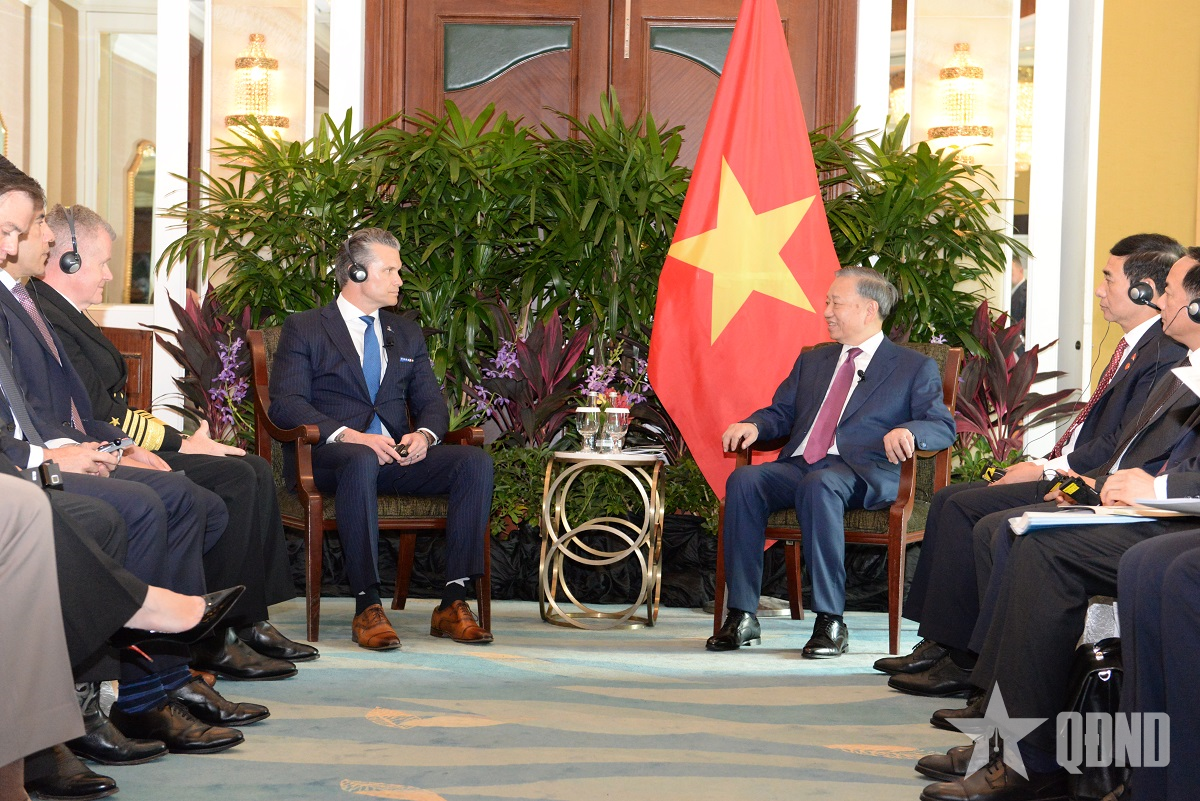 |
| General Secretary and President To Lam received US Secretary of War Pete Hegseth. |
Amidst the lively discussions, the presence and speech of General Secretary and President To Lam made a significant impact and received enthusiastic support. The message the General Secretary and President sent to the forum was also very specific: Technological self-reliance does not mean isolation, but must be built on a foundation of open cooperation, knowledge sharing, and joint development of technological capabilities. The General Secretary and President encouraged the spirit of technological connection, aiming towards the formation of a new cooperation model – where the State acts as a facilitator, pioneering scientists and leading businesses participate in joint research, development, and production. From the "three-party" model within a single nation, the General Secretary and President suggested that we need to gradually form a "three-party model of two countries."
The remarks by the General Secretary and President were highly praised by the foreign media, who considered them a very new approach. This stems from the fact that Vietnam views Singapore as a leading technology and innovation hub in the region. Meanwhile, Vietnam has a large market, a young workforce, a rapid pace of digital transformation, and a broad demand for technology applications. The two economies share a common need to move up the value chain together.
In fact, the consistent viewpoint of the General Secretary and President was hinted at during his visit to Singapore in 2025. A year earlier, in a policy speech at the Lee Kuan Yew School of Public Policy, the General Secretary and President (then General Secretary) focused on linking research institutions, universities, and businesses, training scientific and technological personnel, technology transfer, and the commercialization of research. A year later, at a technology forum, these contents were no longer just guidelines but were being promoted through cooperation mechanisms, networking programs, and concrete projects.
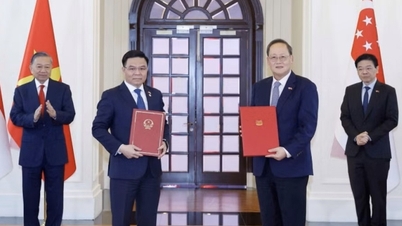
That spirit was evident at the forum, in the presence of General Secretary and President To Lam and high-ranking leaders of both countries, where a series of cooperation documents between Vietnam and Singapore were signed in the fields of science and technology. This demonstrates a spirit of urgent and substantive cooperation, transforming policies and guidelines into action.
In reality, scientific and technological cooperation between the two countries has already achieved some results; however, compared to the potential and advantages, there are still gaps. That is why, during the meeting with major Singaporean corporations, the General Secretary and President emphasized technology transfer, human resource training, and the establishment of research centers. In particular, after visiting the Singapore Railway Testing Center and the model factory for advanced production technology, the General Secretary and President stressed a very practical, constructive mindset: If only safety is chosen, there will be no breakthroughs. The State shares the initial risks, businesses boldly innovate, and scientists are closely linked to the production needs and productivity of the economy. The goal is to make scientific and technological cooperation a new driving force for development.
Vietnam's mark at Shangri-La
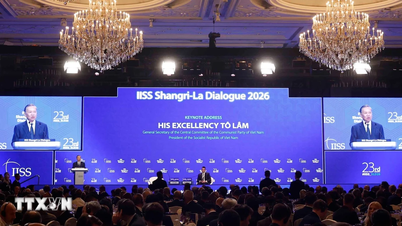
It's difficult to fully describe the intense atmosphere during the 23rd Shangri-La Dialogue in Singapore. The Shangri-La Hotel became the center of attention with over 400 high-level delegates, along with numerous scholars, experts, and international journalists from dozens of countries. The main hall of the Shangri-La Dialogue was designed as an open-air auditorium, with rows of seats arranged in an arc facing the central stage, creating a sense of face-to-face dialogue rather than the distance typically seen in conventional conferences.
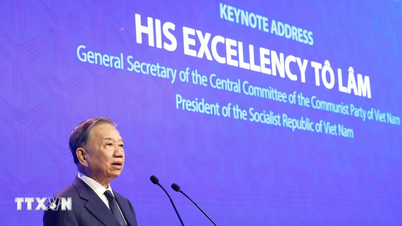
In the context of a world undergoing profound changes, the presence of General Secretary and President To Lam, along with his keynote address at the opening session, holds special significance. It demonstrates that Vietnam is not only participating to present its position but also proactively contributing its own approach to major regional issues.
The theme chosen by the General Secretary and President is: "Proactively building peace, stability, and development in a volatile world." This partly reflects Vietnam's own development journey. It is the voice of a nation that has experienced war, deeply understands the value of peace, and is entering a new phase of development with the desire to contribute more responsibly to regional stability.
From the very beginning of his speech, the General Secretary and President raised a very thorny issue: the world is "more interconnected but more vulnerable; technology is more advanced but the risk of abuse is greater." From there, the General Secretary and President pointed out three fundamental crises that are impacting each other: the crisis of international order, the crisis of the development model, and the crisis of strategic trust. However, instead of being pessimistic, Vietnam's message offered a positive direction by affirming: "Precisely because it is a place where challenges converge, the Asia-Pacific must also be the source of solutions." The solutions Vietnam presented to Shangri-La were consistent and practical, emphasizing the need to make rules and dialogue effective tools; placing human security and social resilience at the heart of sustainable security.
A highlight of the speech, highly praised by international media, was its timely perspective on security in the digital age. The General Secretary and President warned about the negative aspects of advanced technologies. AI, Big Data, and quantum computing, while expanding development capabilities, can be abused for cyberattacks, information manipulation, and automated conflict. When technology outpaces human laws and control, strategic stability becomes more fragile. These points resonated with the common concerns of international lawmakers.
Media outlets around the world highly praised the opening remarks by General Secretary and President To Lam. A Bloomberg article reported that Vietnam's international standing is steadily improving, as one of Asia's fastest-growing economies and a major exporter to the US, while also balancing relations with major powers and contributing to regional peace, stability, and development.
While the opening remarks by the General Secretary and President revealed Vietnam's perspective on the world, the subsequent Q&A session helped the audience better understand how Vietnam would act. Questions were raised about institutional reform, Vietnam's role in ASEAN, and AI governance. The General Secretary and President affirmed that strong domestic reforms would help Vietnam more effectively implement its independent and self-reliant foreign policy and become a more reliable partner in the region. Regarding AI, the General Secretary and President emphasized that as technology develops, human responsibility must become clearer, and innovation must go hand in hand with human safety and benefit.
From the Technology Connectivity Forum to the Shangri-La Dialogue, a consistent message can be seen throughout General Secretary and President To Lam's visit to Singapore: In a volatile world, Vietnam chooses a path of development based on knowledge, science, technology, cooperation, and international responsibility. This is also how Vietnam enhances its position while contributing more to the peace, stability, and prosperity of the region.
Text and photos: PHAM KIEN (from Singapore)
Source: https://www.qdnd.vn/chinh-polit/cac-van-de/cuoc-kien-tao-hoa-binh-va-thinh-vuong-1042064



![[Video] Sunset at Lap An Lagoon – Where the sun sets over the fishing nets](https://vphoto.vietnam.vn/thumb/1200x675/vietnam/resource/IMAGE/2026/05/31/1780192137701_beach-landscape-sea-water-nature-grass-745871-pxhere-com.jpeg)










![[Video] Sunset at Lap An Lagoon – Where the sun sets over the fishing nets](https://vphoto.vietnam.vn/thumb/800x450/vietnam/resource/IMAGE/2026/05/31/1780192137701_beach-landscape-sea-water-nature-grass-745871-pxhere-com.jpeg)



































![[Video] Sunset at Lap An Lagoon – Where the sun sets over the fishing nets](https://vphoto.vietnam.vn/thumb/402x226/vietnam/resource/IMAGE/2026/05/31/1780192137701_beach-landscape-sea-water-nature-grass-745871-pxhere-com.jpeg)


























Comment (0)