

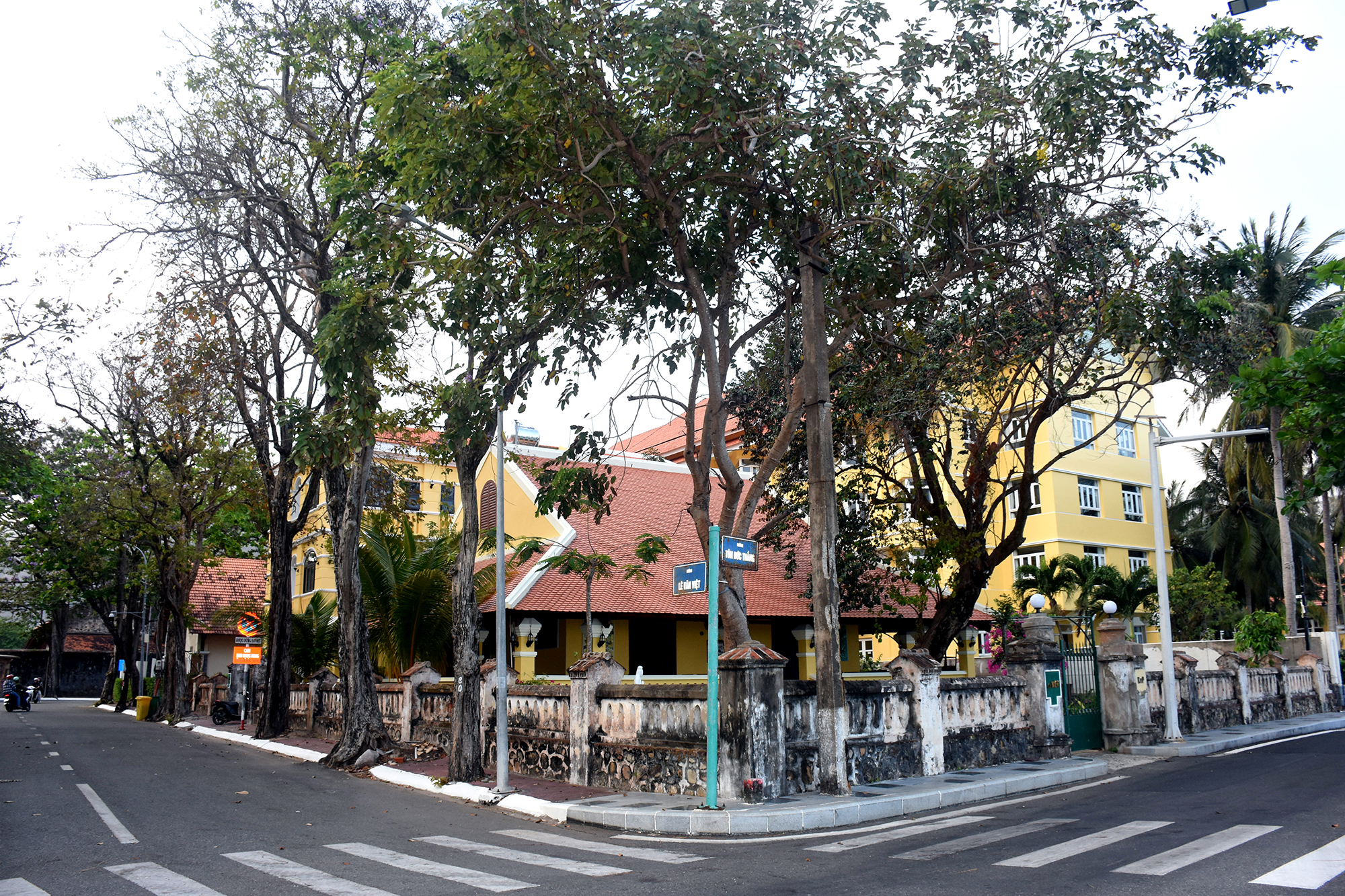
The ancient architectural structures along Ton Duc Thang Street create a unique beauty in Con Dao. |
Ancient urban landmarks
Le Duan Street is only about 500 meters long, but it boasts dozens of ancient architectural structures. The house of Mrs. Nguyen Thi Anh Thu, one of the first families to settle in Con Dao after liberation, still retains its mossy, antique charm. The house, measuring 87 square meters, is a two-story building with a sloping, tiled roof. “After liberation, my husband and I moved here from Can Tho and the district allocated us a house in this row of old houses on Le Duan Street to live in,” Mrs. Anh Thu added.
According to Ms. Thu, the row of houses on Le Duan Street was originally built by the French to serve as a distribution center for goods and food for French soldiers. After Con Dao was liberated, these houses were preserved and allocated as housing for people from other places who came to live on Con Dao, or for those who had fought on Con Dao and volunteered to stay on this land. “After nearly 50 years, the house has many leaks, but in compliance with the Con Dao district's request to preserve the old house, my family only renovated some of the interior for convenience, but the exterior structure of the old house has not lost its original character. With its French architecture, it's cool in the summer and cozy in the winter. To date, my family has lived in this house for three generations,” Ms. Thu said.
Opposite Mrs. Thu's house is the Governor's Residence, a popular tourist attraction. According to Ms. Pham Thi Tam, Deputy Director of the Provincial Museum and Library, the Governor's Residence was started in 1862 and completed in 1876. It has served 53 governors over 113 years, including 39 during the French colonial period and 14 during the American occupation. The Governor's Residence covers an area of approximately 1.86 hectares, encompassing the main building, auxiliary buildings, and a garden.
According to Ms. Pham Thi Tam, Con Dao district not only has evidence of the colonial prison system, but also traces of urban life during the French colonial and American-backed periods.
Attracting tourists
According to Mr. Phan Trong Hien, Chairman of the People's Committee of Con Dao District, in 1862, along with the establishment of Con Dao Prison, the construction of detention camps and guard posts, the French colonialists also built other offices and service facilities such as the Telegraph Office, the Wind Wire Office, the Hospital, the Treasury Office, the Office of the Inspectorate, and houses for civil servants of the colonial government… Currently, the grounds of the old town in Con Dao still have 52 architectural works located along Le Duan, Nguyen Hue, and Ton Duc Thang streets… “These ancient buildings have been converted to residential houses, hotels, and offices of organizations, but they are still preserved intact. Preserving these structures is the result of the joint efforts of the government and the local people,” Mr. Hien informed.
According to the People's Committee of Con Dao District, the Con Dao Old Town is located in Zone 2 of the protected area of the historical site, as per Decision No. 2163/QD-TTg of the Prime Minister on approving the Adjustment of the Master Plan for the Preservation, Restoration, and Promotion of the Value of the Con Dao Special National Historical Site. Historical structures whose purpose of use has been changed must adhere to the principle of not altering the architectural form and external landscape. Interior renovations may be carried out to suit the new function as required, but such repairs must be authorized by the Ministry of Culture, Sports and Tourism.
Text and photos: QUANG VU
Source: https://baobariavungtau.com.vn/kinh-te/202504/gin-giu-cong-trinh-kien-truc-co-o-con-dao-1038843/
![[Photo] Prime Minister Pham Minh Chinh presides over a meeting on private sector economic development.](/_next/image?url=https%3A%2F%2Fvphoto.vietnam.vn%2Fthumb%2F1200x675%2Fvietnam%2Fresource%2FIMAGE%2F2025%2F12%2F20%2F1766237501876_thiet-ke-chua-co-ten-40-png.webp&w=3840&q=75)









































































![[Infographic] Controlling rabies in pet dogs and cats](https://vphoto.vietnam.vn/thumb/402x226/vietnam/resource/IMAGE/2025/12/21/1766288809667_infographic-kiem-soat-benh-dai-tren-dan-cho-meo-nuoi20251221091138.webp)



















Comment (0)