

 |
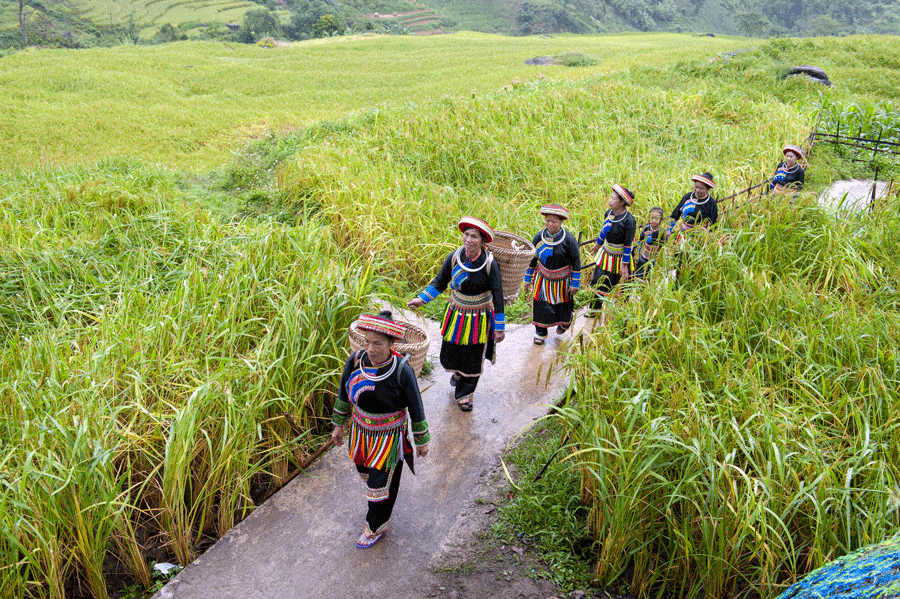
| Mong ethnic women in Thai Nguyen . |
From a young age, Hmong girls are taught embroidery and sewing by their grandmothers and mothers. Meticulously handcrafted costumes are made for wearing during festivals, New Year celebrations, spring festivals, and other important family events.
Although modern life has brought many new fashion trends, Hmong women still retain the core characteristics of their traditional clothing.
Ms. Ly Thi Cong, from Dong Giong village, Dan Tien commune, shared: "It takes 2 to 3 months to completely embroider a Hmong traditional costume. The most difficult parts are the shoulder pads, the front placket, and the belt wrapped around the waist. As a Hmong woman, I always try to learn how to embroider beautiful costumes and pass the craft on to my children and grandchildren. Before getting married, Hmong girls often embroider their own wedding attire."
A complete traditional outfit of Hmong women typically includes a V-neck blouse, a pleated flared skirt, a bodice, a belt, leggings, and a headscarf. The distinctive feature lies in the elaborate, harmoniously colored hand-embroidered patterns. The blouse has a V-neck, with two hand-embroidered strips of fabric trimmed on the front; the back features a balanced and delicate rectangular pattern. The sleeves are decorated with multicolored borders extending to the wrists.
In Hmong women's traditional clothing, the waist belt and the bodice are distinctive features. The embroiderer must use small, even, and dense stitches to create sharp patterns. While the shoulder pads and placket mainly use simple lines, the bodice is more elaborately designed with many creative motifs.
The vibrant, colorful dresses not only highlight the beauty of Hmong women but also reflect the diligence, meticulousness, and rich imagination of those who create them. They are the culmination of handcrafted labor and cultural identity preserved through generations.
 |
| Industrial embroidery machines in the production of traditional costumes. |
Besides preserving traditional crafts, many people have also turned the craft of making ethnic costumes into a way to develop their economy . Ms. Dao Thi Phuong is one of the pioneers in Dan Tien, making Mong women's costumes for the market.
Ms. Phuong said: "I started sewing traditional ethnic costumes in 2020. Compared to farming, sewing ethnic costumes is less strenuous and provides a more stable income. Currently, I sew both traditional and modern costumes, earning about 100 million VND per year."
In the past, flax cultivation, yarn spinning, and weaving were closely intertwined with the lives of the Hmong people. To complete a traditional costume, a woman had to go through many stages such as growing flax, spinning yarn, weaving fabric, applying beeswax patterns, dyeing with indigo, and then cutting, sewing, and embroidering patterns.
Some outfits take years to complete. In the flow of modern life, the traditional clothing of Hmong women has also undergone many changes to suit the needs of use.
However, despite innovations in materials and designs, the core value remains in the unique patterns, colors, and styles that reflect the ethnic identity. Preserving and passing on the traditional embroidery and sewing skills of the Hmong people contributes to the preservation of their cultural heritage and helps the younger generation better understand their ethnic roots.
Source: https://baothainguyen.vn/van-hoa/202606/gin-giu-trang-phuc-truyen-thongcua-phu-nu-dan-toc-mong-9ff72c7/

























































Comment (0)