

 |
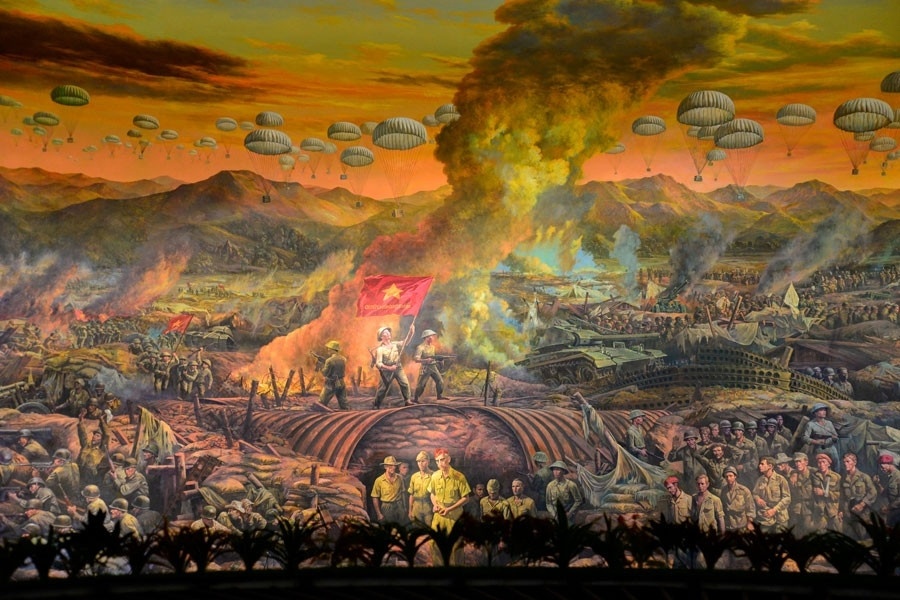
Panoramic painting depicting the Battle of Dien Bien Phu, specifically the scene of capturing the French general. |
For decades following the defeat at Dien Bien Phu, French historians gradually re-examined the battle. Through declassified documents and interviews with veterans, they pointed out that this was a systemic failure of the entire colonial war machine in the face of the Vietnamese people's will for independence.
Strategic mistakes and the failure of the French colonial wars.
Two books, "Memories of Dien Bien Phu - Witnesses Speak Out" by Pierre Journoud and Hugues Tertrais, and "Dien Bien Phu, March 13 - May 7, 1954" by Ivan Cadeau, translated and published in Vietnam, have contributed to a clearer understanding of the underlying causes of this defeat.
In the works of Pierre Journoud and Hugues Tertrais, through the accounts of more than 1,000 French veterans, Dien Bien Phu emerges as a tragedy of an army thrust into a colonial war with an overconfidence in its military superiority. The French command built the Dien Bien Phu complex as a fortress believed to be capable of crushing the main Viet Minh forces with its powerful firepower, air force, and modern defense system.
The fundamental mistake lay in the French army's underestimation of the Viet Minh's ability to organize a people's war. They believed that the enemy lacked the logistical capacity to haul large artillery across the high mountains, could not sustain long-term supplies, and was unlikely to be able to launch a large-scale operation in the mountainous Northwest region. However, the reality of the battlefield completely reversed all those predictions.
The Viet Minh mobilized manpower and resources on a large scale, building a well-organized transportation system, trenches, and artillery positions, transforming seemingly impossible elements into the foundation for victory. From this, the two authors argue that this defeat stemmed not only from tactical errors but also reflected the backwardness of colonial military thinking – which relied too heavily on technological superiority and failed to grasp the essence of national liberation warfare.
The accounts of veterans also reveal that this war gradually became a psychological crisis for many French soldiers. Many came to Indochina with the intention of serving their country, but ultimately realized they were fighting to maintain a decaying colonial structure. Therefore, from the perspective of French researchers, Dien Bien Phu was also a failure of a political and military model no longer suited to the historical dynamics of the post-war era.
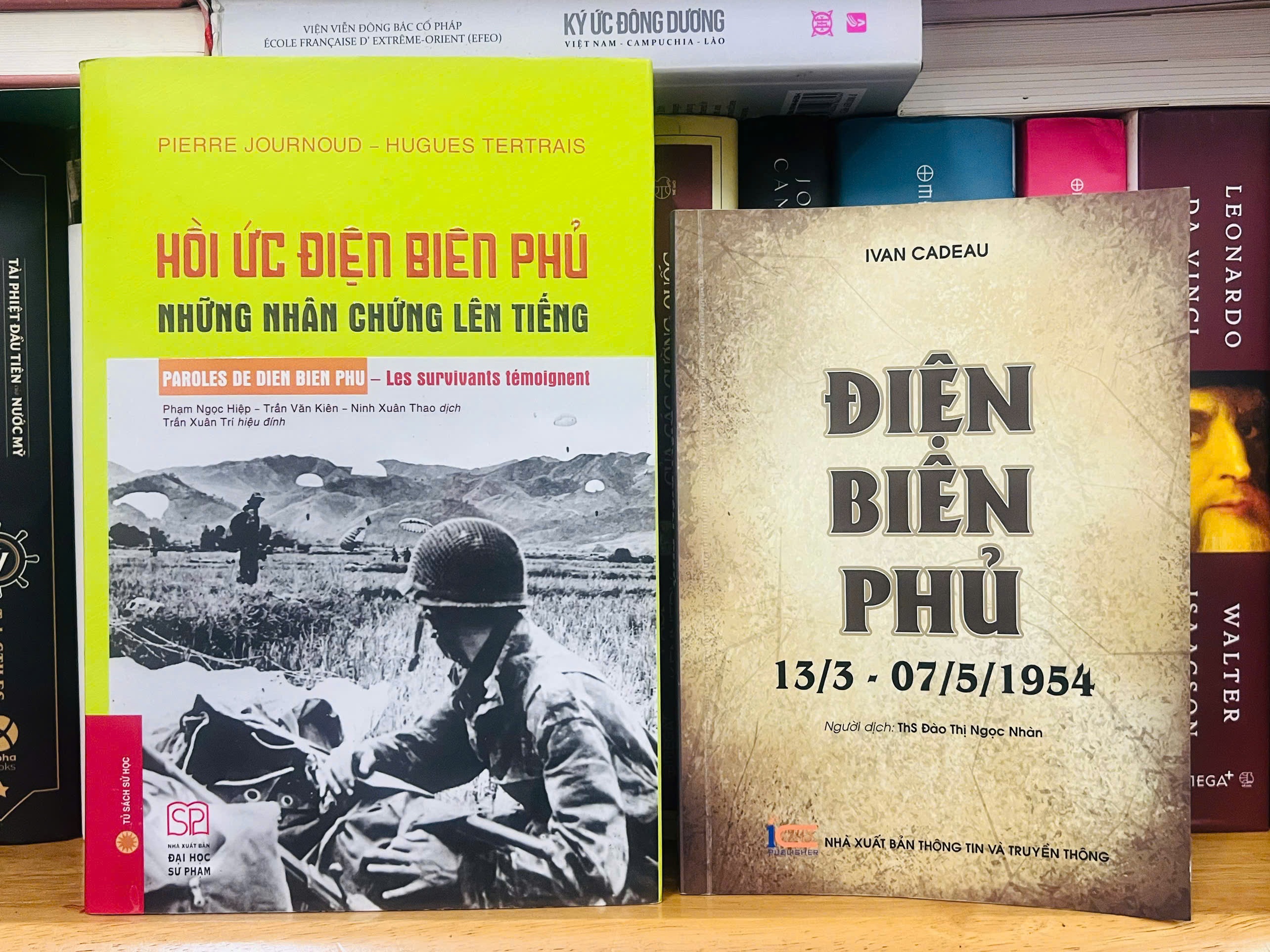 |
The book "Memoirs of Dien Bien Phu - Witnesses Speak Out" and "Dien Bien Phu, March 13–May 7, 1954. " Photo: MP |
The power of the will for national independence
While Journoud and Tertrais emphasized human memory and experience, Ivan Cadeau approached Dien Bien Phu from the perspective of in-depth military research.
In his book, "Dien Bien Phu: March 13 - May 7, 1954 ," part of a collection of studies on major campaigns published by Tallandier (France), he recreates the entire 56 days and nights of the campaign from the perspective of the French army.
Unlike typical memoirs, Cadeau utilizes the vast archival system of the French Ministry of Defence, including operational records of participating units, personal documents of General Henri Navarre and General Paul Ely, and the files of the Commission investigating the Dien Bien Phu defeat, declassified in 2005. This source material allows him to reconstruct the campaign with high detail and place it within the decision-making logic of the French command.
From Cadeau's perspective, Dien Bien Phu was not just a military defeat, but became a classic case study in French historiography, raising the central question: Why did a modern army fail against an opponent with fewer weapons but superior organization and fighting spirit?
He emphasized the strategic turning point for the Viet Minh when General Vo Nguyen Giap shifted from a "quick attack, quick victory" strategy to a "steady attack, steady advance" strategy. This adjustment helped avoid the risk of a general offensive when conditions were not yet favorable, while simultaneously shifting to a strategy of encirclement, division, tightening supply lines, and gradually weakening the enemy's fortified positions.
Meanwhile, the French forces were isolated in the basin, relying on an airlift that was quickly rendered ineffective.
Cadeau also pointed out General Navarre's strategic mistake in dispersing forces across multiple battlefields in Indochina, weakening his ability to concentrate them at Dien Bien Phu. The plan to make it the final decisive battle thus fell into a disadvantage.
From the perspective of French historians, Dien Bien Phu was not just a failed campaign, but reflected the bankruptcy of a military model based on superior firepower and technology as tools for maintaining power.
The Viet Minh's victory demonstrated the power of people's war, flexible organizational capabilities, and a national will for independence that transcended traditional military frameworks.
Dien Bien Phu thus became a historical milestone, not only ending the French military presence in Indochina, but also marking the historical limit of the colonial model in the era of national liberation.
Source: https://znews.vn/gioi-su-hoc-phap-giai-ma-tran-dien-bien-phu-post1648447.html


![[Photo] Standing Committee member of the Party Central Committee Tran Cam Tu working with the Central Inspection Committee](https://vphoto.vietnam.vn/thumb/1200x675/vietnam/resource/IMAGE/2026/05/28/1779969579668_ndo_br_bnd-2495-jpg.webp)

















































































Comment (0)