


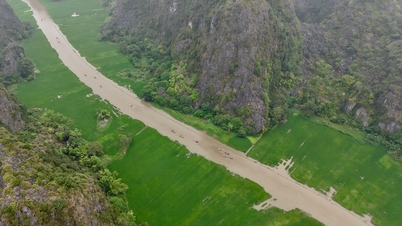
In Hoa Lu (Ninh Binh), a place densely packed with historical sites and scenic spots, daytime visitor numbers are always high. However, like many other places, as evening falls, most tourists leave, leaving a significant void in the service economy . The recent appearance of the "Hero of the Reed Flag" live performance show, organized by the Vietnam Circus Federation in collaboration with the local unit, opens up another avenue: extending the length of stay through nighttime cultural experiences.
The performance space is set amidst a real landscape, with mountains, water, and historical relics as a backdrop. History is no longer confined to books or explanatory panels, but unfolds through light, music , and human movement. The story of Dinh Bo Linh, from a young buffalo herder to a rebel leader, is not told in lengthy words, but through form, rhythm, and emotion. In this way, history is not just about "knowing," but about "feeling."
More importantly, such a program doesn't stand alone. It triggers a chain of accompanying services: accommodation, food, transportation, and shopping. Tourists staying an extra night means increased consumption, and the opportunity to spread benefits to the local community becomes clearer. The night economy, therefore, is not an abstract concept, but begins with concrete experiences like these.
This story isn't unique to Ninh Binh. In Quoc Oai (Hanoi), the "Quintessence of Northern Vietnam" live performance show has been running for many years and has become a brand attracting tourists from near and far. Set on the water at the foot of Thầy Pagoda, the show doesn't follow a linear historical narrative, but instead recreates the spirit of Northern Vietnam through various cultural layers: poetry, beliefs, scholarship, and festivals.
A notable aspect is the participation of nearly 200 local actors. They are the cultural subjects, bringing to the stage what is inherently part of their lives. When the storyteller is also a participant in the story, authenticity is enhanced, and the audience is easily drawn into a space that is both real and mystical. Many viewers go from surprise to emotion, and linger when the performance ends, as if reluctant to leave their seats.
From a development perspective, this is a noteworthy model: the collaboration between local communities and art organizations to create in-depth tourism products. Local communities provide the space, cultural materials, and community; art organizations bring innovative staging approaches, technology, and storytelling. When these two elements meet, heritage no longer stands still, but becomes an integral part of contemporary life.
Of course, simply setting up a large stage doesn't guarantee a successful nighttime economy. The core issue remains the quality of the experience: whether the story is emotionally resonant enough, and whether the presentation is innovative enough to captivate the audience. A live performance only truly proves its value when it makes viewers feel that their time spent there is worthwhile.
Looking at live performances like "Hero of the Reed Flag" and "The Quintessence of Northern Vietnam," a clear direction is emerging. When history and culture are retold through the language of art, they are not only preserved but also generate economic value. And when tourists have a reason to stay after sunset, the night economy is no longer a void but becomes a natural extension of the exploration journey.
Perhaps, what these programs achieve is not just retaining tourists. They also preserve a rhythm of life – where the past and present meet in the light of a night performance, and from there, a different path for tourism gradually takes shape.
Source: https://daidoanket.vn/giu-chan-du-khach-sau-hoang-hon.html




















































































Comment (0)