


Many localities are considering reducing exam pressure.
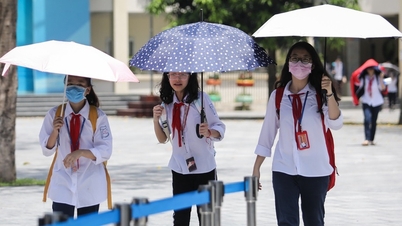
For many years, the 10th grade entrance exam has been considered one of the most stressful exams for high school students, especially in large cities. Many students have to attend intensive extra classes from an early age to compete for a place at a public high school.
Following the news that Ho Chi Minh City plans to abolish the 10th grade high school entrance exam from 2027, Ms. Nguyen Thu Ha (Di An ward, Ho Chi Minh City) expressed her agreement, believing that this could help reduce academic pressure on students. Although her child is only in 6th grade, her family is already concerned about the 10th grade entrance exam in the coming years. “Currently, many students have almost a full week of school, and still have to attend extra classes in the evenings. If the pressure of exams is reduced, children will have a more relaxed school life, and parents will also have less pressure in terms of time and money,” Ms. Ha shared.
National Assembly representative Nguyen Thi Viet Nga believes that the policy of abolishing the 10th-grade entrance exam is in line with the direction of educational reform and deserves support, especially in large cities like Hanoi and Ho Chi Minh City. According to her, admission based on the learning process aligns with the spirit of comprehensive assessment instead of relying solely on a single exam. At the same time, reducing exam pressure will also help curb the widespread practice of private tutoring and the "race for high scores" at the secondary school level.
Admissions based on years of academic performance help students avoid prolonged stress and encourage them to study all subjects evenly instead of focusing solely on exam subjects. This approach aligns with the trend of comprehensively assessing abilities rather than relying solely on the results of a single exam. However, to effectively reduce the number of exams, a comprehensive investment in infrastructure and teaching staff is necessary. Most importantly, it's crucial to expand school sizes, recruit more teachers, and ensure sufficient places for students. If public schools still face a shortage of places, abolishing exams could shift the pressure to other forms of education.
Concerns about unfairness if the exam is abolished.
Despite receiving much support, the shift to admissions based on selection criteria has also raised concerns among many teachers and parents regarding fairness among junior high schools.
According to Mr. Le Trung Kien, Principal of Nguyen Gia Thieu High School (Long Bien, Hanoi ), the transition from entrance exams to admissions based on academic records needs careful consideration to ensure transparency and fairness in enrollment. Previously, Hanoi applied a system of admissions based on academic transcripts, but its effectiveness was only evident in the initial stages. Later, high academic scores in many places tended to increase, making it difficult to assess students' true abilities.
In reality, there have been reports of "beautifying" report cards and altering grades in some primary, secondary, and high schools. The main reason stems from the pressure to get into top universities at these levels. Schools want to improve the percentage of students admitted to university and overall academic performance, while parents and students are pressured to have "beautiful report cards" for admission. This situation reduces fairness in the admissions process compared to aptitude tests or high school graduation exams.
Furthermore, the comparison of academic transcript scores and high school graduation exam scores published by the Ministry of Education and Training in recent years shows a significant discrepancy. Academic transcript scores are often higher than exam scores by 0.12 to 2.26 points depending on the subject. In addition, there are large differences in academic transcript scores between schools and localities (some with strict grading, others with leniency), leading to a lack of uniformity in evaluation. Or, the situation of uniformly high academic transcripts leads to a lack of clear differentiation in student performance.
Mr. Le Trung Kien expressed concern that without sufficiently reliable evaluation criteria, parents would inevitably have doubts about fairness. Therefore, Mr. Kien believes that the admissions method is only truly appropriate when the high school system is expanded sufficiently to meet the educational needs of students in their residential areas. This requires investing in more schools, increasing enrollment capacity, and ensuring enough places for students after junior high school.
Many experts also argue that entrance exams remain a relatively objective assessment mechanism, given that the number of junior high school students far exceeds the enrollment capacity of public schools. If exams are abolished without expanding the school system, students with average academic abilities may find it even more difficult to access public schools.
In addition, the risk of "grade inflation" in academic transcripts has also been frequently discussed. National Assembly representative Nguyen Thi Viet Nga argued that without a mechanism to check and standardize student assessment data, pressure could shift from exams to manipulating academic transcripts or choosing schools.
According to Ms. Nga, abolishing the 10th grade entrance exam needs to be accompanied by a suitable roadmap, the most important of which is expanding the network of public high schools, improving the quality of vocational education, and promoting streaming after lower secondary school so that students have more choices.
Some argue that if a selection process or a combination of both is implemented, the criteria should be transparent to avoid malpractice and ensure fairness among localities.
In the long run, reducing exam pressure is necessary, but more importantly, it's crucial to change the mindset of "getting into a top-tier public school at all costs." Only when vocational education and other training models become sufficiently attractive can the pressure on the 10th-grade entrance exam truly ease.
Source: https://daidoanket.vn/co-nen-bo-ky-thi-vao-lop-10.html
![[Image] Hanoi's urban life under the challenge of a "scorching hot" environment](https://vphoto.vietnam.vn/thumb/1200x675/vietnam/resource/IMAGE/2026/05/25/1779706979265_nang-nong-t5-2026-minh-duy-7-4636-jpg.webp)



![[Image] Close-up view of the interchange connecting the two expressways and Long Thanh Airport.](https://vphoto.vietnam.vn/thumb/1200x675/vietnam/resource/IMAGE/2026/05/25/1779703378210_ndo_br_z7863716673926-224453a31600126cce10622af6290afd-4549-jpg.webp)































































































Comment (0)