

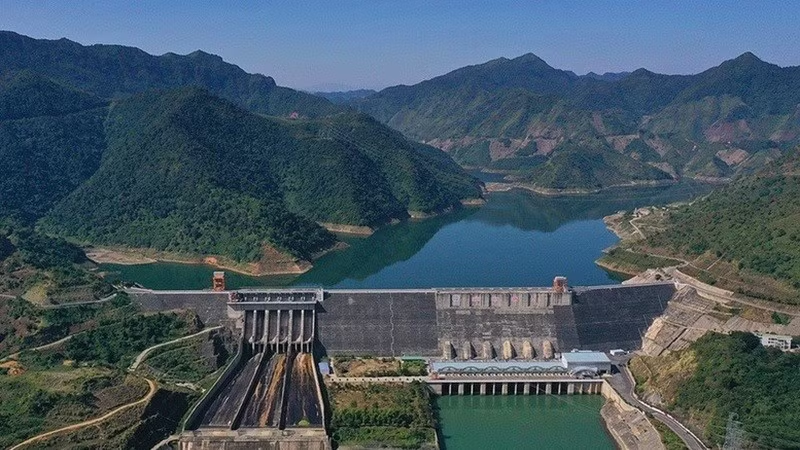
This isn't just a story about the electricity or water resources sectors. Behind every decision to operate a reservoir lies the requirement to simultaneously ensure multiple objectives: supplying electricity to the economy , providing water for agricultural production, ensuring drinking water for the people, maintaining environmental flow, limiting saltwater intrusion, and being prepared to respond to natural disasters in the coming months.
In light of this situation, the Ministry of Agriculture and Environment has issued numerous documents to localities and relevant units to proactively manage water resources in major river basins, including the operation of hydroelectric reservoirs to cope with the risk of water shortages during the 2026 dry season.
It is noteworthy that the proposed solutions are not only aimed at addressing immediate electricity needs but also at a larger goal: efficient water use, ensuring energy security, water security, and maintaining conditions for sustainable development in the context of increasingly evident impacts of climate change.
Water resources under pressure during the dry season.
According to the Ministry of Agriculture and Environment's assessment, the first few months of 2026 showed many unfavorable signs regarding water resources in the major river basins across the country. While the demand for water for power generation, production, and daily life increased, the amount of water replenished from nature tended to decline.
Flow rates on most major rivers in the 11 important river basins nationwide are 6% to 79% lower than the multi-year average. The total regulateable capacity of large reservoirs is currently only about 15.6 billion m³, of which the regulateable capacity of hydropower and combined hydropower and irrigation reservoirs is about 14.58 billion m³, equivalent to about 39% of the usable capacity. Many large reservoirs have lower capacities than the same period last year, ranging from 5% to 29%.
The pressure intensifies as electricity demand surges during heatwaves. In May 2026 alone, the average daily hydropower output reached approximately 280 million kWh, nearly double that of the beginning of the month. Increased hydropower generation is necessary to ensure electricity supply for the economy, but it also places significant pressure on water reserves in reservoirs.
In central Vietnam, several reservoirs in the Vu Gia-Thu Bon river basin have fallen below the minimum water level stipulated for inter-reservoir operation. Dak Mi 4 reservoir is 2.61m lower, Song Bung 2 reservoir is 1.8m lower, A Vuong reservoir is 0.48m lower, and Song Bung 4 reservoir is 0.36m lower.
These figures show that water resources are becoming one of the decisive factors for production, people's lives, and national energy security. Current practice shows that each reservoir is simultaneously performing many more important functions. Water from reservoirs not only serves electricity generation but also provides water for daily life, agricultural irrigation, maintains environmental flow, limits saltwater intrusion, and supports disaster prevention. This means that every decision on water regulation can impact many sectors, localities, and millions of people. Therefore, the current requirement is not to maximize water exploitation for electricity generation, but to use water resources in the most rational and efficient way.
Documents from the Ministry of Agriculture and Environment consistently emphasize the need for flexible reservoir operation while ensuring essential water needs for downstream areas, avoiding adverse environmental impacts, and maintaining the capacity to respond to natural disasters. This represents a significant shift in approach. Previously, power generation was often the central focus; now, reservoir management must simultaneously consider energy requirements, domestic water supply, agricultural production, environmental protection, and sustainable development.
From immediate response to long-term management
According to data from the National Power System and Electricity Market Company Limited, after implementing a flexible operating mechanism, reservoirs have saved more than 110 million cubic meters of water, equivalent to approximately 42 million kWh of electricity, to be used during peak periods of hot weather. While this figure is not large compared to the total scale of the national power system, it shows significant potential for optimizing reservoir operation through close coordination between the electricity and water resources sectors. More importantly, this result confirms that efficient water use does not reduce the ability to ensure electricity supply. On the contrary, if managed scientifically, water resources can be used more economically while still meeting socio-economic development requirements.
Therefore, the Ministry of Agriculture and Environment continues to propose maintaining a flexible operating mechanism for hydropower reservoirs during the 2026 dry season. Among the regions of the country, the central region continues to face the greatest pressure on water resources during this year's dry season. The Huong, Vu Gia-Thu Bon, Tra Khuc, Kon-Ha Thanh, and Ba river basins are all entering a period of high water demand while natural replenishment remains limited.
This is also the peak season for summer-autumn crop production. The demand for water for agriculture increases sharply from mid-May to the end of August. If reservoir management is not properly planned, the risk of localized water shortages in some downstream areas is entirely possible.
For the Vu Gia-Thu Bon river basin, the challenge is even greater as water resources not only serve agricultural production but are also directly related to the domestic water supply for many major cities in the central region. Therefore, the Ministry of Agriculture and Environment requires reservoir operating units to strengthen coordination with downstream localities, promptly providing information on water regulation plans to proactively adjust water exploitation and use plans.
While current difficulties may primarily stem from the 2026 dry season, the latest meteorological and hydrological forecasts suggest that pressure on water resources could persist for even longer.
According to the national meteorological and hydrological agency, the likelihood of El Nino occurring from June to December 2026 is quite high and could extend into early 2027. If this scenario occurs, heatwaves may intensify, rainfall may decrease, and the rainy season may end earlier than usual. This means the risk of water shortages in many river basins may continue to increase in the last months of the year and the beginning of next year.
In light of this situation, the Ministry of Agriculture and Environment has requested relevant units to proactively develop response plans, including the rational mobilization of other power sources to reduce pressure on the hydropower system in case water levels continue to decline. This is not only a solution for this year's dry season but also preparation for extreme weather scenarios that may occur in the near future.
The story of reservoir management also highlights a greater challenge in national resource management. Water, energy, agriculture, and the environment are increasingly intertwined. A decision in the energy sector can directly impact water resources; conversely, water depletion can affect agricultural production, people's lives, and electricity supply. Therefore, the current goal is not just to ensure sufficient electricity for a hot season or enough water for a crop season. More importantly, it's about efficiently using every cubic meter of water, protecting the nation's strategic resources, and enhancing the ability to adapt to increasingly complex climate changes.
The operational solutions being implemented demonstrate a significant shift in water resource management thinking, moving from addressing immediate problems to proactive forecasting, from single-sector management to interdisciplinary coordination, and from individual goals to harmonizing multiple development interests.
This perspective is also consistent with the spirit of the Politburo's Conclusion No. 36-KL/TW on ensuring water security and dam and reservoir safety by 2030, with a vision to 2045, as well as the objectives of the 2023 Water Resources Law on integrated management, efficient and sustainable use of water resources. As water resources increasingly become a strategic national resource, every decision made today not only serves current needs but also contributes to ensuring the conditions for future development.
Source: https://nhandan.vn/giu-nuoc-cho-phat-trien-ben-vung-post966357.html





















![[Video] Some moments from the visit to Singapore of General Secretary and President To Lam and his wife.](https://vphoto.vietnam.vn/thumb/402x226/vietnam/resource/IMAGE/2026/06/02/1780365614259_vnapotaltongbithuchutichnuoctolamvaphunhanbatdauchuyenthamcapnhanuoctoisingapore8791502-17800126569371220079515-197.jpeg)




























































Comment (0)