Lecturer Nguyen Xuan Bach from Viet Bac College of Culture and Arts not only teaches techniques but also preserves the "standards" of the craft: from performance posture, tuning, pitch perception to knowledge of instrumentation and how to create a successor generation.
The Tinh lute has also helped Nguyen Van Bach reach the world through his performances. For him, preserving the lute is not just about preserving a musical instrument, but about preserving its simple, authentic soul so that the sound of this heritage remains true when it travels far.
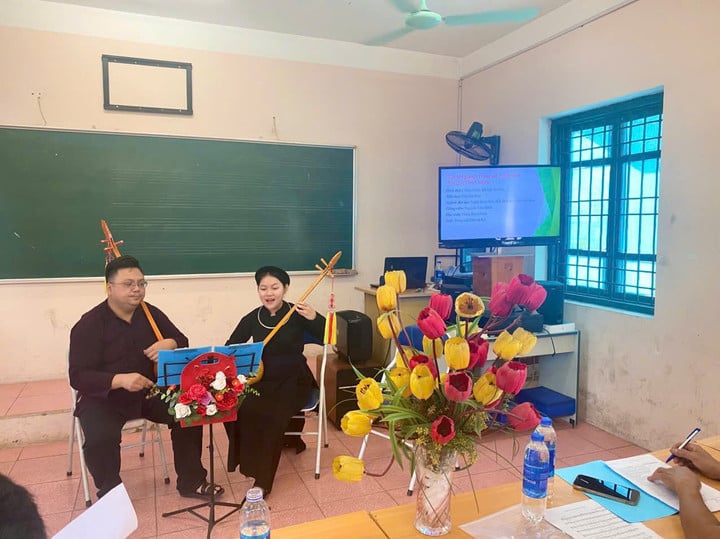
- Why did you place the Tinh instrument at the center of your teaching, and what values should your students uphold?
For me, it's a responsibility to preserve culture and continue the legacy. What I want my students to retain, besides skills, is passion, a sense of responsibility, and respect when dealing with musical instruments.
- In your opinion, what is the first standard when teaching beginners?
First and foremost is posture and demeanor. The Dan Tinh has no frets, so the position of the instrument and the hand position determine the accuracy of the notes; mistakes from the start are difficult to correct. Next comes the technique of both hands and tuning. Tuning must be balanced with the vocal range; strings that are too high or too low make it difficult for the learner to express emotion. Tuning is closely linked to developing pitch perception, so patience is required.

Lecturer Nguyen Xuan Bach, Viet Bac College of Culture and Arts.
- What mistakes cause the sound of the instrument to be "listenable but incorrect"? And how do you correct them so that students understand the underlying principles?
Beginners often lack a foundation in listening comprehension, making it easy to miss notes, especially in legato and the subtleties of performance. I have them practice listening to each note individually, listening repeatedly, and demonstrating meticulously to form the scale in their minds. In some cases, it takes a long time to reach the required standard.
- In your opinion, how can we create a new generation of teachers who can teach, instead of just knowing how to play an instrument for performances?
Students should aim to serve the community. While they are still learning, they may not be able to teach independently, but they can attend community classes to learn methods; observe lessons to see the teaching process and guide each other when doing exercises. In professional training, we use musical notation; but at the grassroots level, many people haven't studied music, so I guide students to write notes using "do, re, mi" to make it easier to disseminate.
- In your opinion, where does the line lie between "innovating" and "distorting" the Tinh instrument?
The line is crossed when variations are made according to personal preference without respecting the instrument's characteristics. Some pieces use the Tinh instrument, but the technique and notes used detract from its rustic sound, making it difficult for listeners to recognize. I'm not against innovation, but innovation must be based on a foundation and preserve the original elements.

- What are the major challenges currently facing the preservation of the Tinh instrument, and what minimum actions need to be taken in the future?
Increased demand has led to the emergence of many instrument-making workshops, but inconsistent quality results in low-quality instruments, superficial craftsmanship, and a direct impact on teaching and learning. In the long run, this will lead to the loss of valuable knowledge in musical instrument making.
It's important to note that there are zithers used for stage performances and those used in ceremonial practices, each with different structures and tonal characteristics. If we focus solely on performing arts while neglecting ceremonial zithers, the risk of their decline is very high. Within one to two years, at least three factors are needed: a unified, scientifically-based set of teaching materials; a competent teaching staff; and learners with sufficient perseverance and passion, along with investment in facilities including good zithers, classrooms, and adequate supporting equipment.
Thank you!
Ha An
Source: https://vtcnews.vn/giu-tieng-dan-tinh-di-san-van-hoa-tren-nhung-soi-day-moc-ar995685.html































![[Photo] Reception to welcome General Secretary and President To Lam and his wife on their State visit to the Philippines](https://vphoto.vietnam.vn/thumb/1200x675/vietnam/resource/IMAGE/2026/06/01/1780295488620_vna-potal-chieu-dai-chao-mung-tong-bi-thu-chu-tich-nuoc-to-lam-va-phu-nhan-tham-cap-nha-nuoc-toi-philippines-8798060-7855-jpg.webp)
















































Comment (0)