

Vietnamese is not just spoken words or a language; it is the breath of our homeland, the thread connecting descendants to their ancestors and roots.
Preserving the sounds of home in a foreign land.
The other day, I received a video message from a close friend in the US. In it, her daughter, Nhu Y (11 years old), was playing the piano and singing "Mother's Dream" at a New Year's celebration organized by the Vietnamese community in Florida. I know that behind that video lies the long journey and efforts of her and her family to preserve the Vietnamese language for their child.
My friend, Thuy Linh, moved to the US with her husband in 2010. Initially, they both worked hard to learn the language to integrate into their work and life there. However, at some point, they realized the difficulty wasn't the new language itself, but rather preserving and passing on the Vietnamese language to future generations.
"For many Vietnamese-American children born in the US, Vietnamese is just a foreign language during their visits back home every few years. I'm very afraid my child will fall into the same situation, and I'm always worried and quietly doing everything I can to ensure that my mother tongue still resonates on my child's lips every day," Thuy Linh confided.
The couple agreed on a rule: whenever they were behind closed doors, all communication would be in Vietnamese. From the moment she was born, little Nhu Y was lulled to sleep by her mother singing Vietnamese folk songs, and listened to her mother read poetry and tell stories every morning and evening. Her first words were "dad," "mom," "grandpa," and "grandma." However, as she grew older, reached school age, and integrated into society, she was exposed to a completely English-speaking environment and began to have difficulty speaking Vietnamese with her parents at home.
“Our child gradually became resistant and showed discomfort at having to speak two languages simultaneously. That’s when we realized we couldn’t force or pressure her, but needed a specific plan to help her overcome her ‘fear’ of speaking Vietnamese. Every weekend, my husband and I try to take her to Vietnamese markets and restaurants, and participate in festivals organized by the Vietnamese community so she can listen to and practice Vietnamese and experience the culture,” Linh recounted.
Nhu Y was also enrolled by her mother in online Vietnamese classes and activity groups for Vietnamese children, allowing her to learn, play, and speak Vietnamese with friends in an open and joyful environment. Each year, her maternal grandmother also comes over for a few months to spend time with her. With her grandmother's care and love, Nhu Y gradually understands that the Vietnamese language is associated with beautiful, warm things, with her roots, though distant, yet very close to her heart.
When Nhu Y was six years old, while seeing her grandmother off at the airport as she returned to Vietnam, she hugged her tightly and said, "Grandma, I'll miss you so much!" Then her grandmother cried, Nhu Y cried, her parents cried, and the whole family laughed. In those few short minutes, the Vietnamese language sowed another beautiful memory, a rhythm of love in her heart.
A sweet homecoming
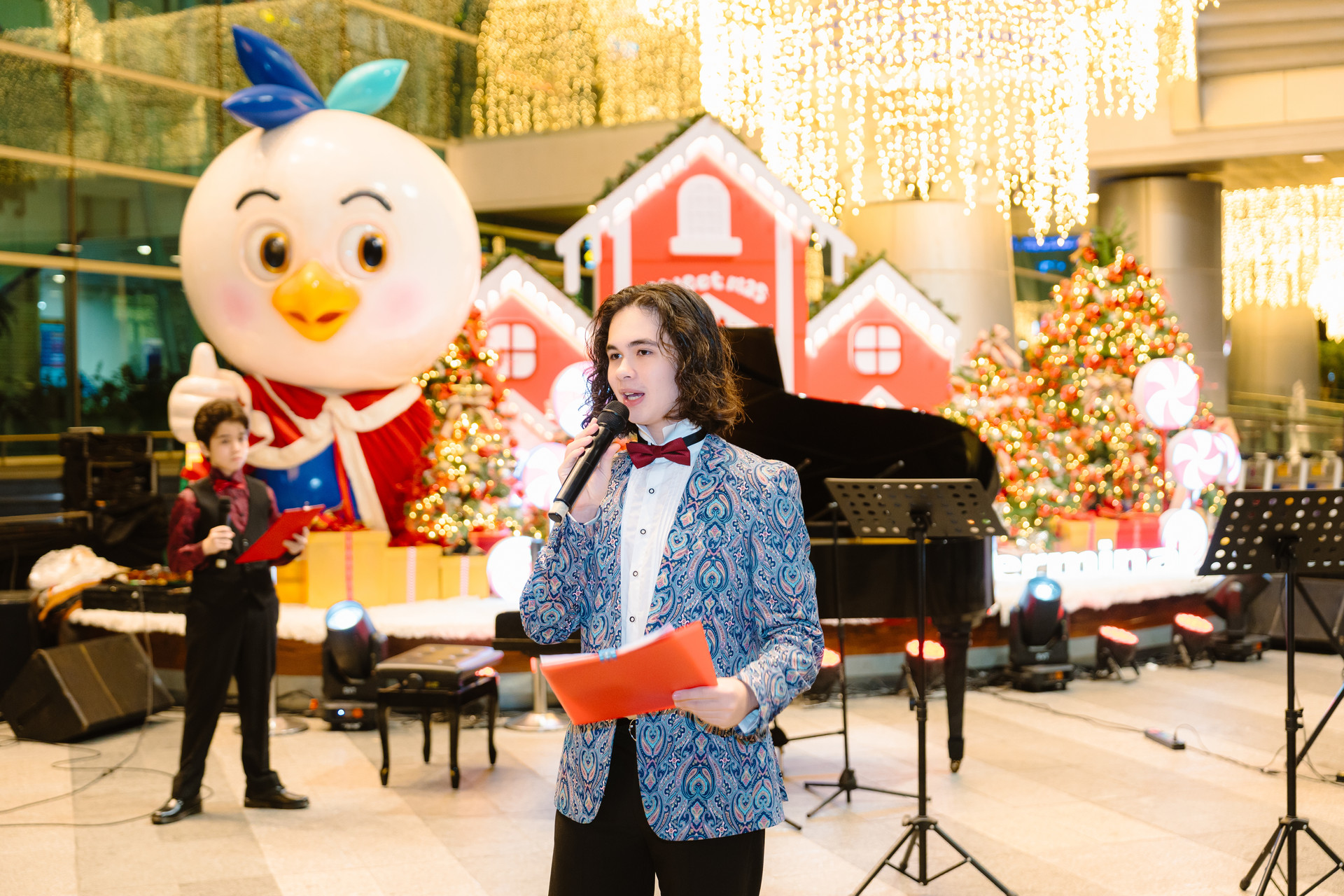
One day at the end of 2025, I had the opportunity to meet Hugo Sanchez Barroso Nguyen at Da Nang International Airport, where he was performing in a Christmas concert. The young man captivated the audience with his wavy, mixed-race hair and warm, Western-looking brown eyes. His appearance made it difficult to recognize him as Vietnamese until he spoke.
Hugo was born in Spain, with mixed ancestry from his Spanish father and Vietnamese mother (originally from Hanoi ). During his early years, his family fostered a natural development while still maintaining a connection to his roots, nurturing his mother tongue through daily communication and activities.
At the age of four, Hugo's family decided to bring him back to Vietnam, initially planning only a few years, to be near his maternal grandparents, learn Vietnamese, and become closer to his mother's homeland. But the course of life has kept him in Da Nang until now, almost thirteen years.
Hugo's mother recounted that when he was little, he only thought of this as a strange place to live. But then, invisible bonds from family, community, and local lifestyle drew him closer. Hugo wants to be called Vietnamese, and he also loves learning and speaking Vietnamese.
At seventeen, Hugo is a talented pianist, a bilingual MC, and a coordinator for major music stages across the country. Each year, he tours and participates in community projects around the world, interacting with diverse cultures and languages. This diverse environment has made Hugo appreciate even more the traditional cultural values and richness of the Vietnamese language. What makes him happiest is being able to share about his homeland and the Vietnamese language through music.
During his participation in the Survive Camp in October 2025, a journey that took Mongolian children through Laos, Thailand, and Vietnam, Hugo served as an English teacher. However, it was his rich Vietnamese language skills and understanding of East Asian culture that made him the "hero" of the group.
“As the only one in the group who could speak Vietnamese, I confidently presented and shared my views clearly when faced with difficult situations at the border crossing. Later, when confronted with the historic flood in Hoi An, I also used my Vietnamese to gather information, promptly seek assistance, and help people escape,” Hugo proudly shared.
Those young people are so fortunate to have their native language as their foundation. Whether they choose to stay far away or return, the Vietnamese language will remain, and the warmth in their hearts will endure.
Source: https://baodanang.vn/giu-tieng-me-de-noi-xa-xu-3320537.html


![[Photo] General Secretary and President To Lam receives Amazon's Senior Vice President David Zapolsky](https://vphoto.vietnam.vn/thumb/1200x675/vietnam/resource/IMAGE/2026/05/22/1779466547770_a1-bnd-3513-6601-jpg.webp)






























































Comment (0)