


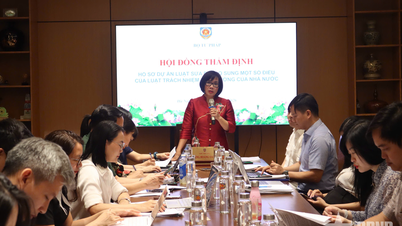
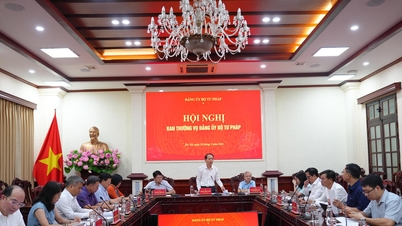
The results of the review will serve as the basis for proposing comprehensive solutions, contributing to the development of a transparent and accessible legal system. (Illustrative image)
The head of the organization is responsible for the results of the overall review.
This comprehensive review goes beyond mere statistical data, aiming for a holistic assessment of the current state of the legal system. The review results will serve as a basis for proposing comprehensive solutions to build a transparent, accessible legal system that guarantees human rights and promotes sustainable national development in the new era. In particular, this data will provide valuable information for research into amending the 2013 Constitution.
The review process must adhere closely to the Party's guidelines and policies on building and perfecting the legal framework, especially major orientations such as developing a "double-digit" economy , reforming the three-tiered government model, promoting digital transformation, innovation, and international integration; while strictly complying with legal regulations on reviewing legal documents, especially the Law on the Promulgation of Legal Documents of 2025 and its guiding documents. The head of the agency, unit, organization, or locality must directly supervise and be responsible for the review results.
Review all legal documents up to October 31, 2026, except for the Constitution.
The scope of the review includes all currently effective legal documents (excluding the Constitution) and also those that have been issued but have not yet come into effect, as of October 31, 2026. It is particularly important to note that older documents that are no longer in form under the new law but remain in effect (such as previous joint circulars) must still be reviewed.
In the implementation process, responsibilities are clearly defined. Ministries and ministerial-level agencies are responsible for reviewing documents they have issued or drafted; they also review documents related to their respective areas of management in cases where the lead agency no longer exists. Organizations and units under the Ministry review documents according to their areas of responsibility, while the legal department plays a coordinating and supervisory role.
Similarly, the Supreme People's Court, the Supreme People's Procuratorate, and the State Audit Office also conduct reviews within the scope of their respective documents. Agencies of the National Assembly, the Office of the President, the Central Committee of the Vietnam Fatherland Front, etc., all have the responsibility to conduct reviews.
At the local level, the Provincial People's Committee is responsible for reviewing all documents issued by the Provincial People's Council, the Provincial People's Committee, and the Chairman of the Provincial People's Committee. The Commune People's Committee must also review both its own documents and those issued by the district level before reorganizing.
6 criteria for the overall review
A crucial technical aspect of the guidance is the development of an implementation plan. The implementation plan for the comprehensive review of the legal document system includes the following basic elements: the purpose and requirements of the plan; the subjects and scope of the comprehensive review by the agency; the content and progress of the work; the budget and necessary conditions; and the organization of implementation. Specifically, the content and progress of the work should clearly define the responsibilities of the implementing agency (leader, collaborators), the timeframe, the schedule, and the expected outcomes.
During the implementation process, the first step is for agencies to fully and accurately identify the documents that fall within the scope of their overall review. Agencies must continuously update the validity status of these documents, including newly issued ones.
Next, utilize the results of previous reviews, such as the systematization of legal documents for the 2019-2023 period, the lists of expired documents; synthesize the results of previously conducted legal document reviews, such as the results of reviewing and processing documents affected by the reorganization of the state apparatus according to Resolution No. 190/2025/QH15 on handling some issues related to the reorganization of the state apparatus; the results of reviewing and improving the law on decentralization, delegation of power, and delineation of authority as stipulated in Clause 1, Article 54 of the Law on Organization of Local Government No. 72/2025/QH15, and Article 32 of the Law on Organization of the Government No. 63/2025/QH15; and the results of reviewing and proposing solutions to overcome difficulties, obstacles, and "bottlenecks" caused by legal regulations (implementing Resolution No. 66-NQ/TW of the Politburo )...
The core of the review process lies in six major criteria: from conformity with the Party's policies, constitutionality and legality, compatibility with international treaties, to streamlining administrative procedures, identifying bottlenecks, and recognizing areas and issues that are not yet regulated by law.
The review results must be compiled and reported on the Ministry of Justice's software system, ensuring consistency, transparency, and ease of monitoring. Deadlines are also clearly set: A report on the implementation of the comprehensive review of the legal document system must be submitted to the Ministry of Justice before July 10, 2026 (data updated to June 30, 2026); and a report on the results of the comprehensive review of the legal document system (official report) must be submitted to the Ministry of Justice before November 10, 2026 (data updated to October 31, 2026).
Dieu Anh
Source: https://baochinhphu.vn/go-nut-that-phap-ly-bang-cuoc-tong-ra-soat-toan-dien-102260422205949872.htm






























































































Comment (0)