This initiative is part of the FEF-R Patrimoine project, funded by the French Ministry of Europe and Foreign Affairs , and implemented in collaboration with many reputable academic and research partners in Vietnam and France.
The project is implemented by the University of Social Sciences and Humanities - Vietnam National University, Hanoi, in collaboration with the French Institute of Far Eastern Studies and the French University Organization, with support from the French Embassy and the French Institute in Vietnam.
This event marks a significant step forward in the effort to digitize and disseminate the heritage values of Hanoi, the thousand-year-old capital city. For the first time, historical, architectural, and cultural data of numerous relics, buildings, and streets in Hanoi are integrated and expanded on a digital platform, making it easier for users to access and search for information.
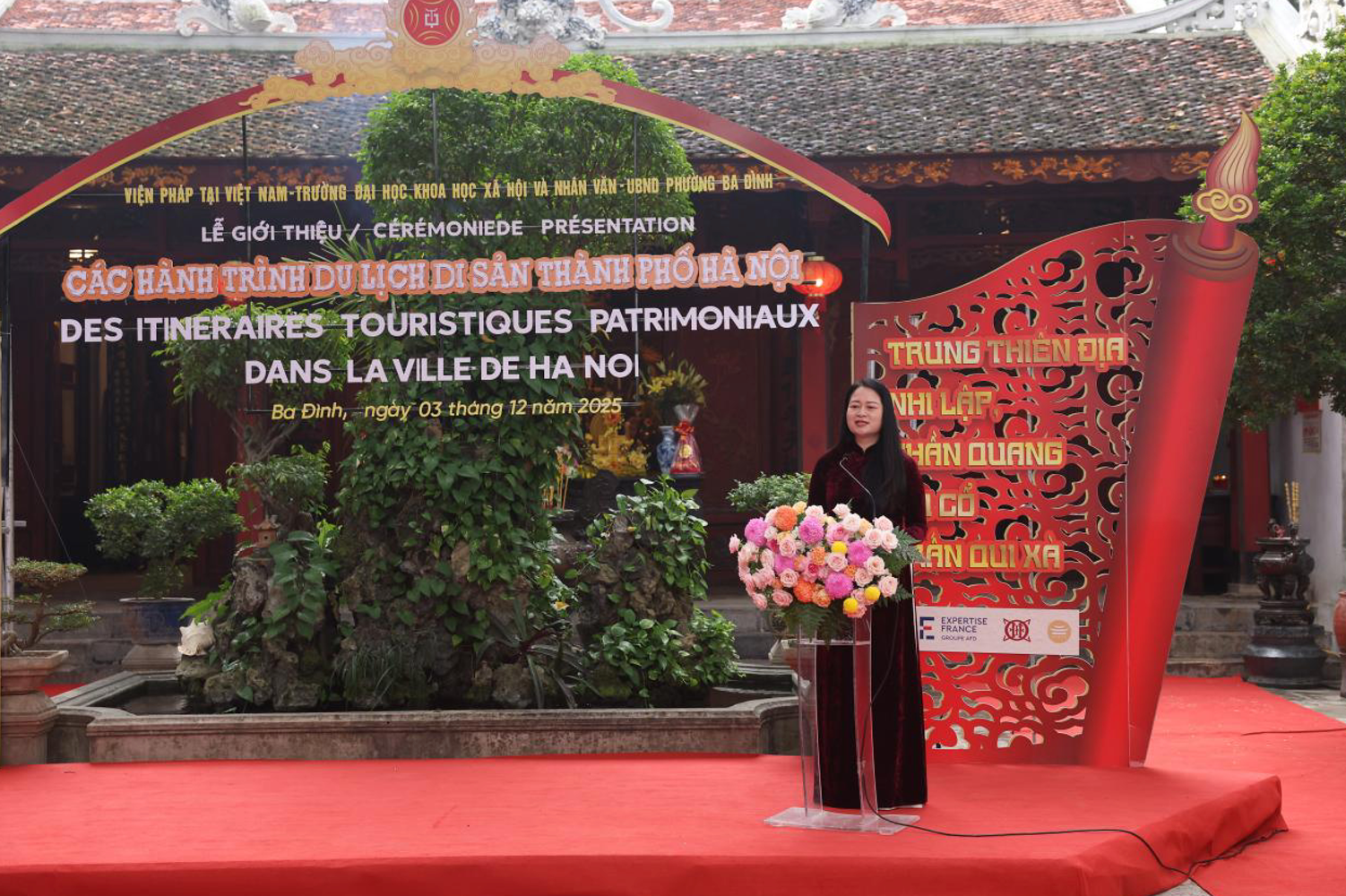
Ms. Pham Thi Diem, Chairwoman of the Ba Dinh Ward People's Committee, delivered a speech at the ceremony.
Simultaneously, the project aims to introduce and promote the value of Hanoi's tangible, intangible, and digital heritage through heritage tourism itineraries, interactive map systems, the H-Heritage application, and QR code systems at various historical sites in central Hanoi.
Speaking at the ceremony, Ms. Pham Thi Diem, Chairwoman of the Ba Dinh Ward People's Committee, said: "These journeys not only contribute to raising community awareness about heritage preservation, but also open up opportunities for socio-economic development for the locality through sustainable tourism, promoting exchange, strengthening integration, and promoting the culture and traditional beauty of Vietnamese people to international friends . "
Ambassador Olivier Brochet of France to Vietnam shared that the project "Heritage Tourism Routes in Hanoi" is a vivid testament to the Franco-Vietnamese relationship in the fields of culture, heritage, and innovation.

Delegates attending the launch event of the project "Heritage Tourism Routes in Hanoi City".
Beyond just online journeys, the project also facilitates training for young researchers and technical teams, builds accessible content for the public, connects local partners, and opens up a fresh perspective on urban development, heritage, and sustainable tourism.
The project, led by Dr. Nguyen Thi Hiep, involved numerous French and Vietnamese experts. Over more than a year of implementation, the project team conducted field surveys, collected documentation, developed heritage dossiers, created digital maps, developed QR code applications, and established the H-Heritage platform for the public.
Based on this, the organizers introduced four experiential heritage tours, combining scientific research with digital technology, providing a visual, engaging, and accessible way to explore heritage.
Firstly, there's the Thang Long Four Guardian Deities - the four guardian gods of the capital city. Secondly, there are the temples dedicated to the Mother Goddess - a unique Vietnamese belief in worshipping the Mother Goddess. Next are the communal houses dedicated to the patron saints of various trades - a testament to the labor of the prosperous capital city. And finally, there are the pagodas of Hanoi - a testament to the Zen masters and the transformation of urban Buddhism.
Each journey is linked to a different story, reflecting the structure, spirit, and memories of Hanoi's past and present. With just a smartphone, visitors can "touch history," exploring the thousand-year-old cultural depth of Thang Long - Hanoi in the most visual way.
The project "Heritage Tourism Routes in Hanoi" promises to become an important tool in preserving and disseminating the cultural values of Thang Long, thereby opening up a direction for sustainable, modern, and distinctive tourism development for the capital city in the future.
Source: https://congluan.vn/ha-noi-ra-mat-du-an-cac-hanh-trinh-du-lich-di-san-10320225.html






![[Image] A brilliant symphony and explosive power in the skies of Da Nang.](https://vphoto.vietnam.vn/thumb/1200x675/vietnam/resource/IMAGE/2026/05/31/1780196945787_anh-man-hinh-2026-05-31-luc-10-08-51.png)
















![[Video] Sunset at Lap An Lagoon – Where the sun sets over the fishing nets](https://vphoto.vietnam.vn/thumb/340x192/vietnam/resource/IMAGE/2026/05/31/1780192137701_beach-landscape-sea-water-nature-grass-745871-pxhere-com.jpeg)



























































Comment (0)