In the tranquil mountains of Lang Son , there are sounds that are both clear as a stream and solemn as the voice of the mountain rocks – the sound of the Tinh lute. For the Tay and Nung people of Lang Son, Then – an intangible cultural heritage recognized by UNESCO – is not just a song, but an invisible thread connecting reality and spirituality, the "soul" distilled through generations.
But amidst the hustle and bustle of today's life, when ancient values are sometimes obscured by the glitz and glamour, there are still young people who choose to go against the current, gathering ancient Then verses to continue writing the nation's journey.
Love for the Tinh instrument
|
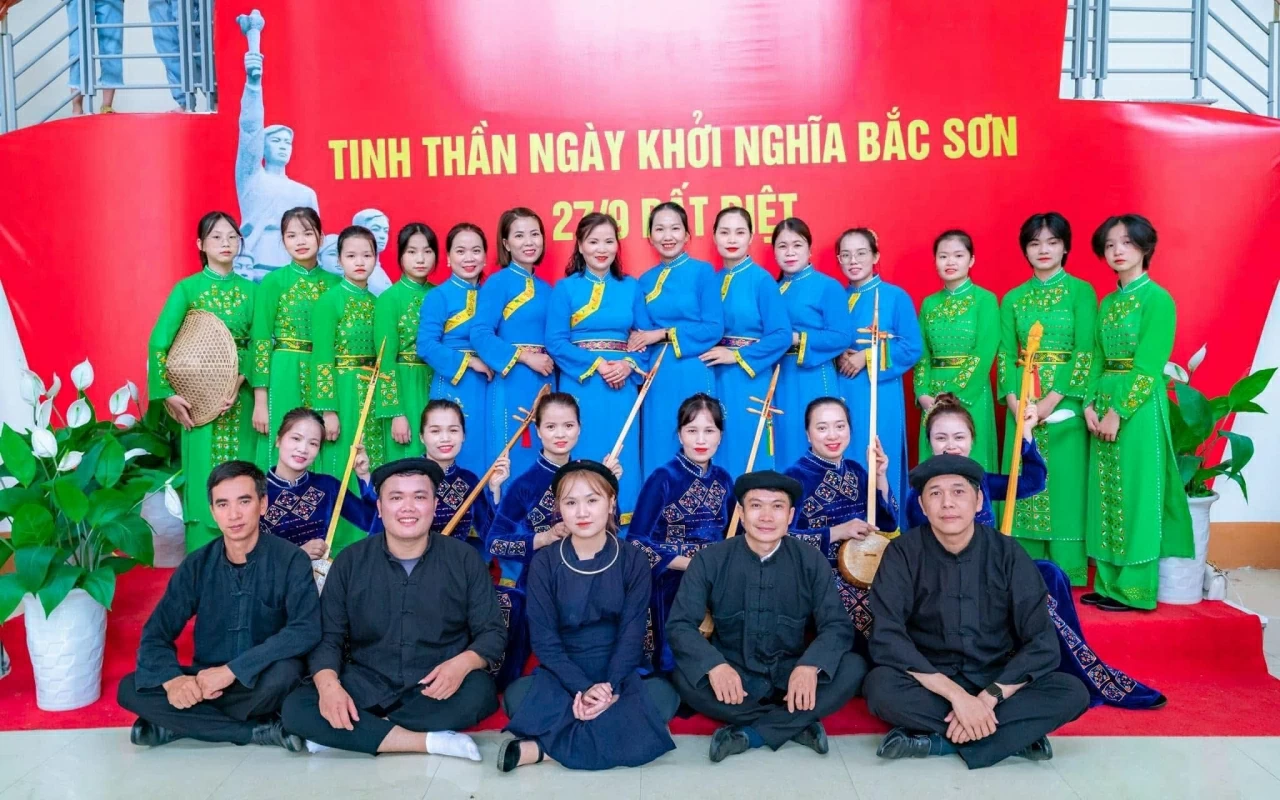
Mr. Duong Cong Trong performing Then singing to celebrate the anniversary of the Bac Son Uprising (September 27, 1940 - September 27, 2025). (Photo: Phuong Thu) |
Not everyone "dares" to learn Then singing. Because Then is not just about lyrics, but also about the responsibility of preserving sacred cultural values. Nevertheless, amidst the modern pace of life, there are still young people who quietly choose Then, driven by passion and perseverance, to preserve the beautiful roots of their people.
At just 25 years old, Then artist Duong Cong Trong from Bac Son commune has chosen a quiet yet persistent path. His journey of embracing Then didn't begin on large stages, but rather naturally stemmed from the lullabies and melodious Then songs sung by the women in his village. These melodies, like a refreshing stream, silently nourished the soul of the young Tay boy throughout his childhood and into adulthood. These sweet childhood memories of Then have become the driving force for the young man to continue his journey of bringing his homeland's melodies to the community.
Few would have imagined that, at such a young age, Duong Cong Trong has dedicated 15 years to Then singing. He currently leads 12 classes teaching Then singing and Tinh playing in his local area. Notably, in Quynh Son village where he lives, two classes are still regularly held. This young man not only teaches singing, but also teaches the children to cherish their cultural heritage.
Sharing that same passion, 20-year-old Lang Thuy Linh is also working hard every day to preserve and promote the art of Then singing. Currently, Linh is a member of the Standing Committee of the Vietnam Then Cultural Heritage Association and also serves as the association's secretary.
Thùy Linh first came to Then singing in 2016, when she was a student at a boarding middle school. The Then singing and Tinh lute class at that time had 30 students, directly taught by People's Artist Hoàng Thúy. As time passed, many went their separate ways, leaving Linh as the only one to continue pursuing Then today. That number, "1/30," serves as a reminder of the harsh realities of preserving tradition, where, without unwavering determination, it's easy to give up halfway.
"Then Spirit" in the digital age
In the digital age, the preservation and promotion of the cultural value of Then singing is carried out through various forms combining tradition and modernity. Young people like Cong Trong and Thuy Linh understand that without a change in approach, Then will remain forever in museums. Therefore, they choose their own ways to spread the spirit of Then to the community.
To preserve and maintain the Then singing art form, the People's Committee of Bac Son commune has developed a plan and organized community classes on Then singing and Tinh lute playing. Thanks to these classes, not only children but also adults can participate. Classes usually take place during summer activities, when children are on school break. Each class maintains about 15-20 students, so that the teacher can "guide them step by step," passing on each rhythm and song.
Besides teaching, Duong Cong Trong constantly seeks new methods to effectively spread Then singing, one of which is social media. According to him, the strong development of social media today greatly helps individuals like him in their efforts to promote this unique cultural feature of the Tay people.
"Currently, I'm running a homestay business. For guests who want to experience it, I organize Then singing and Tinh playing sessions, then post videos of the performances on social media platforms, mainly Facebook. I want as many people as possible to experience and understand this art form," he shared.
|
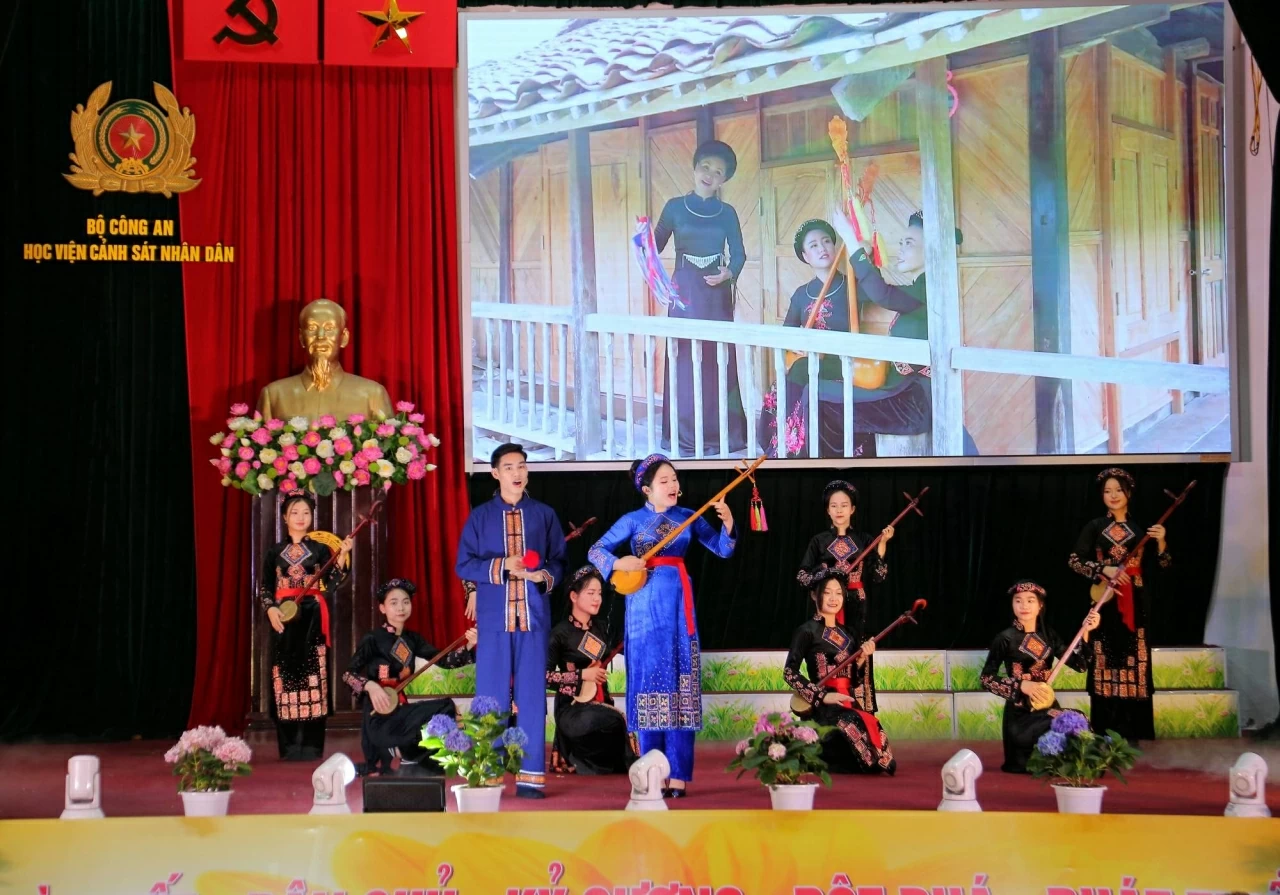
Thùy Linh performs at an event of the People's Police Academy. (Photo: Phương Thư) |
In addition, Mr. Trong said that, with their quick wit and open-mindedness, young people in Bac Son in particular, and Lang Son province in general, are proactively utilizing technology as a new bridge to bring the Then folk songs of the Tay people in Quynh Son village closer to a wider audience of domestic and international tourists.
For Thùy Linh, the journey of spreading Then singing has unfolded along a unique path, quiet but full of purpose. Currently, she is studying Cultural Development at the Academy of Journalism and Communication, viewing the lecture hall as a foundation to nurture her passion, which took root very early on. Sharing about her decision to choose this major, she said: “At the time of the university entrance exam, I had been studying Then singing for 6-7 years. At that time, I thought I needed to study a specialized field in culture to lay the foundation for developing the Then singing and Tinh lute playing that I am pursuing.”
Linh owns the TikTok channel "Nàng Then Thùy Linh" with nearly 30,000 followers. According to Linh, social media platforms like TikTok are an effective communication method in the digital age: "Almost all the Then singing videos I post on TikTok go viral. Most of the interviews or appearances in newspapers are because people found out about me through TikTok. Those first articles gave me more opportunities to share about Then singing and my personal journey."
Closer to young people
|
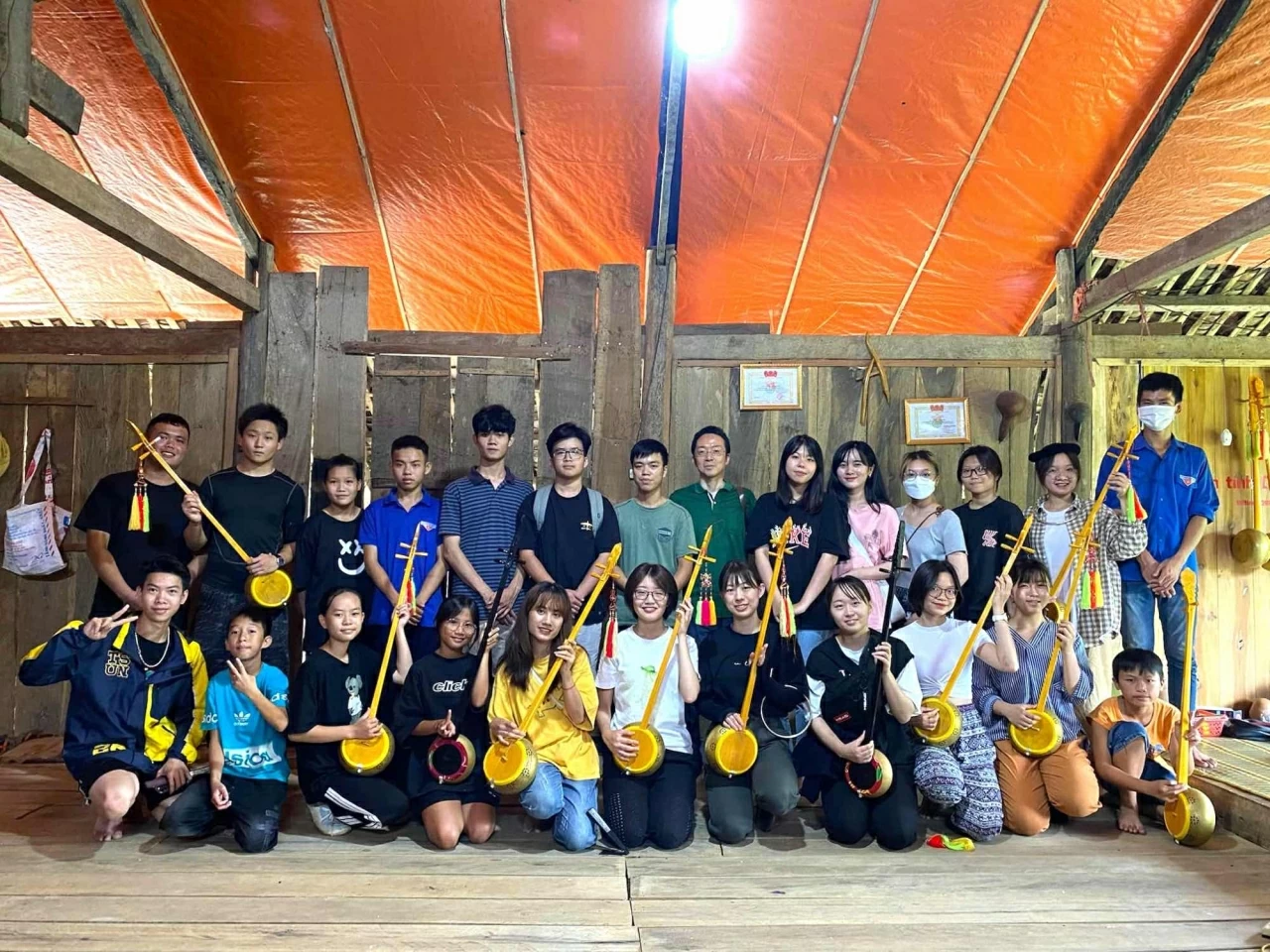
Cultural exchange and performance of Then singing at Duong Cong Trong homestay. (Photo: Phuong Thu) |
Although the Then singing and Tinh lute playing art forms are experiencing positive changes in their accessibility to the public, bringing this art form closer to audiences remains a major challenge. In particular, due to the unique nature of using the ethnic language, not everyone can understand and appreciate the religious Then art form. Even people of the same ethnic group struggle to fully grasp the meaning of the lyrics. While Then art forms are set to music in various Kinh (Vietnamese) languages, making them more accessible, it is difficult for listeners to fully appreciate and understand the profound cultural values.
Currently in Lang Son province, the demand for learning Then singing is increasing in the community, especially among young people, while the number of knowledgeable artisans capable of teaching it remains modest. This gap poses numerous challenges for the preservation, transmission, and conservation of this art form.
In light of this reality, Mr. Duong Cong Trong expressed his belief and hope in the young people who are quietly preserving Then singing today. He believes that these young people who strive to spread Then singing to the community are the "cultural ambassadors" of their hometown of Bac Son, and he hopes they will persevere so that the cultural values nurtured through many generations will continue to be inherited and developed in the future.
For Thùy Linh, the awareness of preserving traditional culture is especially important. She always reminds herself that if successive generations do not strive to preserve and promote it, Then singing and Tinh playing risk disappearing. Thùy Linh believes that as long as young people have the opportunity to learn from their elders, they will become the bridge to preserve and spread these cultural values.
Bringing Then singing closer to the community is not just a dream, but also a mission that Cong Trong, Thuy Linh, and many young people in Lang Son are pursuing. They aim not only to preserve traditional cultural values but also to spread Then to a wider audience of domestic and international tourists. First and foremost, the preservation journey must begin with the young, those who will continue to write the story of Then in contemporary life.
In the Bắc Sơn night, the sound of the Tinh lute resonates, rhythmic like the breath of the mountains and forests, persistent and endless…
Then is divided into two types: religious Then and artistic Then. With the meaning of connecting the spiritual world , religious Then is more complex, encompassing many types of rituals such as: Then for peace, Then offerings, Then healing... or grand "Then feasts" of the Then master himself, such as: initiation ceremonies, ordination ceremonies, and retirement ceremonies... This type of Then practice requires rigorous training from the learner, as the rituals unfold through many chapters and sections. According to local beliefs, to become a Then master, one must be "destined" or "given a special gift," chosen by "the higher powers." Meanwhile, Then folk songs are less ritualistic, but require the singer to fully immerse themselves in each lyric and melody. Considered a unique form of folk poetry and proverbs of Lang Son province, Then folk songs bear the strong imprint of the spiritual life of the Tay and Nung people. The lyrics mainly encourage the people to develop their economic and cultural lives, and praise love between couples, love for their homeland, and country… Then singing and the Tinh lute are two images that always go together. A Tinh lute has three strings and five notches on the neck, each notch containing different notes. This means that a single instrument has many notes that the learner must memorize. Beginners will find it difficult to remember the notes and play the instrument, while more difficult skills like playing dances or glissandos require considerable practice before they can be performed. |
Source: https://baoquocte.vn/hat-then-theo-buoc-chan-nguoi-tre-340769.html



































































Comment (0)