

According to the Vietnam News Agency correspondent at the United Nations (UN), the majority of countries welcomed and strongly supported the adoption of the Agreement on the Conservation and Sustainable Use of Biodiversity in the Area Beyond National Jurisdiction, also known as the Agreement on the High Seas, on June 19, and expressed their intention to sign and ratify it soon so that the Agreement can enter into force, be fully and effectively implemented.
Cuba, representing the Group of Developing Countries, assessed this outcome as a victory for diplomacy and multilateralism, a victory for developing countries thanks to the tireless efforts and close solidarity of the group's member states.
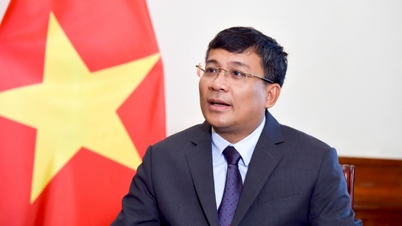
Speaking at the Conference, Ambassador Dang Hoang Giang, Head of the Permanent Mission of Vietnam to the UN and Head of the negotiating team, affirmed that today's successful outcome demonstrates the strong commitment and determination of the Conference in achieving a document aimed at conserving and sustainably using maritime areas beyond national jurisdiction. The Ambassador assessed that this Agreement will further strengthen the 1982 UN Convention on the Law of the Sea (UNCLOS) – the Constitution of the ocean, a comprehensive legal framework for all activities at sea; enhance multilateralism; mark a new milestone in the development of international law; and contribute to the implementation of the UN Decade on Marine Science for Sustainable Development, achieving Development Goal 14 on the conservation and sustainable use of oceans, seas, and marine resources for sustainable development.
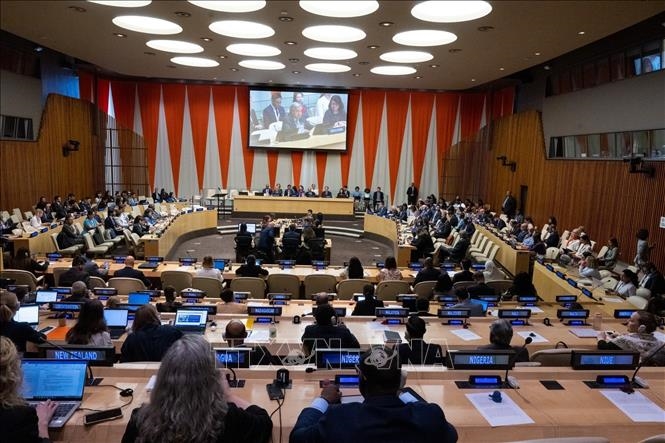 |
| A panoramic view of the intergovernmental meeting to ratify the treaty on the protection of international waters at UN headquarters in New York (USA) on June 19, 2023. Photo: THX/VNA |
With the aim of ensuring respect for the integrity of UNCLOS, during the subsequent implementation of the Agreement, regarding the provision for the Conference of Contracting Parties to consider and propose zoning for the application of conservation measures, the Vietnamese representative, along with several other countries, emphasized the interpretation of certain provisions agreed upon by the Intergovernmental Conference, as reflected in the Report of the Intergovernmental Conference.
The UN's adoption of the Agreement evoked strong emotions, particularly among those directly involved in the negotiations, including the Vietnamese inter-ministerial delegation led by the Ministry of Foreign Affairs, along with representatives from the Ministry of Natural Resources and Environment, the Ministry of Science and Technology, the Ministry of Agriculture and Rural Development, the Ministry of Public Security, the Vietnam Academy of Science, and others, in coordination with the Vietnamese Delegation in New York. This was the result of a long and complex process, often extremely tense.
Rena Lee, Chair of the Intergovernmental Conference, described the drafting of the Agreement as “a monumental and vital undertaking.” Including the preparatory work for the Intergovernmental Conference and lobbying efforts in the UN General Assembly, the process lasted nearly 20 years.
UNCLOS stipulates the freedom of navigation and fishing in the high seas beyond the exclusive economic zone, and also defines minerals in the seabed on the continental shelf of countries as a common heritage of humanity; it establishes a mechanism for licensing and allocating benefits from deep-sea mining, but there is no similar mechanism for marine genetic resources. The Agreement on the Conservation and Sustainable Use of Biodiversity in Areas Beyond National Jurisdiction concretizes and develops UNCLOS in this aspect. This is the third agreement implementing UNCLOS, after the document on migratory fish stocks and the document aimed at implementing Part XI of the Convention.
The Agreement comprises 17 Chapters, 76 Articles, and 2 Annexes, with the main content revolving around several issues including: (i) Sharing of marine genetic resources; (ii) Establishment of marine protected areas; (iii) Environmental impact assessment; (iv) Capacity building and technology transfer; and (v) General issues such as the decision-making mechanism of the Conference of States Parties, establishment and operation of agencies and institutions to implement the document, dispute resolution, financial mechanisms, etc.
Text and photos: VNA
Source

![[Image] A brilliant symphony and explosive power in the skies of Da Nang.](https://vphoto.vietnam.vn/thumb/1200x675/vietnam/resource/IMAGE/2026/05/31/1780196945787_anh-man-hinh-2026-05-31-luc-10-08-51.png)










![[Video] Sunset at Lap An Lagoon – Where the sun sets over the fishing nets](https://vphoto.vietnam.vn/thumb/340x192/vietnam/resource/IMAGE/2026/05/31/1780192137701_beach-landscape-sea-water-nature-grass-745871-pxhere-com.jpeg)




































































Comment (0)