

With its profound intellectual value, "Diary in Prison" has transcended the boundaries of a collection of poems to become a cultural heritage of the nation and humanity.
The series "Understanding Prison Diaries More" is a journey back to a great spiritual heritage of the nation through the author's perspective.
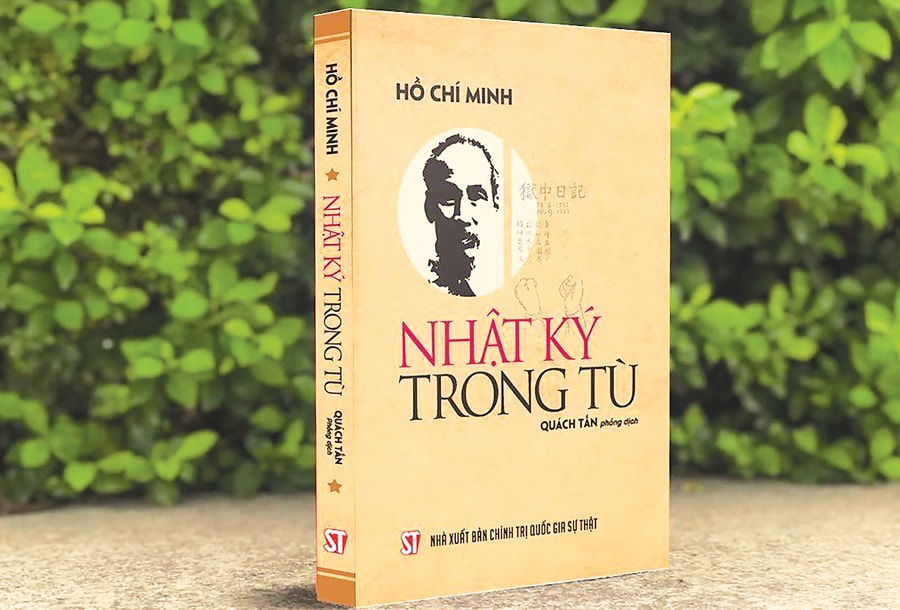
Lesson 1: President Ho Chi Minh's trip to China in 1942
After 30 years away from his homeland, on January 28, 1941 (the second day of the first lunar month of the Year of the Snake), Uncle Ho returned to Vietnam, "when he stepped over the border marker, his heart was deeply moved" (Telling Stories While Walking).
According to Comrade Vu Ky - Secretary of Uncle Ho, "The only luggage Uncle Ho brought back was a single wicker suitcase, containing two sets of old clothes and a collection of documents called 'The Path to Liberation,' a compilation of lectures from the training course in Nam Quang (Guangxi, China) that Uncle Ho was in charge of, which had just ended a few days before Tet" (1 ). That was the return trip to "Build a nation with both hands"...
The poet To Huu captured the sacred moment, the first steps of Uncle Ho upon his return, foreshadowing the success of the revolution and invigorating even the birds, animals, and plants:
Oh, this bright spring morning, Spring of 1941
White plum blossoms bloom in the border forest.
Uncle is home... Silence. A bird sings.
The rustling of the reeds on the bank, a joyful, dreamy feeling...
(Following in Uncle Ho's footsteps)
As a representative of the Communist International, Uncle Ho convened and chaired the Eighth Central Committee Conference, held from May 10 to 19, 1941, in the Khuoi Nam forest (near Pac Bo cave) in Truong Ha commune, Ha Quang district, Cao Bang province (now Truong Ha commune, Cao Bang province). Attending the conference were comrades Truong Chinh, Hoang Van Thu, Phung Chi Kien, Hoang Quoc Viet, Vu Anh, and several others. Under Uncle Ho's direct leadership, the Central Committee wisely recognized that the opportunity for national liberation was approaching, and that a shift in the revolution was necessary, leading to the establishment of the Viet Minh Front.
This is the mobilization of all forces to achieve national unity – a pillar in Ho Chi Minh's thought and in Vietnamese culture. The resolution affirms: “At this time, the interests of any group or class must be subordinated to the life and death, the survival of the nation and the people. At this time, if we cannot solve the problem of national liberation, if we cannot demand independence and freedom for the entire nation, then not only will the entire nation continue to suffer the fate of beasts of burden, but the interests of any group or class will never be reclaimed, even after thousands of years.”
The conference decided that preparations for armed uprising must be accelerated, stating that when the time was right, "with the forces we have, we can lead a partial uprising in each locality and achieve victory, paving the way for a great general uprising."
To further secure that victory, Uncle Ho set out for China to garner international support. According to artifacts preserved at the Ho Chi Minh Museum, Uncle Ho went to China under the name Ho Chi Minh, using letters of introduction from the "Vietnam Independence League" and the "International Anti-Aggression Vietnam Branch." The letters clearly stated: "Sending Mr. Ho Chi Minh to meet with the Chinese government ." This is how the name Ho Chi Minh first appeared in history.
On August 13, 1942, Uncle Ho and Comrade Le Quang Ba traveled to China. On August 25, 1942, the group arrived at Ba Mong village, Jingxi County, and stayed at the home of farmer Tu Wei Tam, a sworn brother of Uncle Ho. From there, Comrade Le Quang Ba returned to Vietnam; Uncle Ho's guide was a young Chinese man named Yang Tao. On August 29, Uncle Ho arrived in Tuc Vinh, De Bao County, Guangxi Province, and stayed in a small inn. That night, secret agents led by patrol officer Huong Phuc Mau raided the inn, checked everyone's documents, handcuffed them, and handed them over to Chief Officer Ma Hien Vinh.
Lieutenant General Tran Bao Thuong, Commander of the Jingxi Border Security, and intelligence commander of Chiang Kai-shek's government stationed in Jingxi, received a report that a person named Ho Chi Minh with a complicated background had been arrested. He was accused of being a "Chinese traitor" - a suspected spy. This happened because Ho Chi Minh carried too many documents, including documents from the Kuomintang's Fourth War Zone, documents from the Chinese Youth News Journalists Association... But the underlying reason was the denunciation by Truong Boi Cong, "a Vietnamese man who went to China and worked for the Kuomintang for many years. Although he knew nothing about military matters, he was promoted to Major General by Chiang Kai-shek" (2) . Truong Boi Cong's conspiracy was to eliminate genuine revolutionaries in order to become the "leader" of Vietnam in the upcoming "Chinese army's entry into Vietnam". To achieve this goal, his first action was to eliminate Ho Chi Minh - Nguyen Ai Quoc, who enjoyed very high prestige both domestically and internationally.
In his Prison Diary, Uncle Ho also clearly stated the purpose of the trip in the article "The Difficult Path of Life":
Remaining Vietnamese delegates,
Thinking of going to China to meet important people.
(I am a representative of the Vietnamese people)
He went to China to meet with key figures to discuss and coordinate the fight against fascism.
Regarding Ho Chi Minh's arrest and his prison life, the work "Telling Stories While Traveling" writes: “In August of that year (1942), Uncle Ho was arrested by the Kuomintang while on a trip to China. After being tied up and dragged around for 18 days, from one prison camp to another, they took him to Liuzhou… This wasn't a proper prison camp, but just a 'confined cell' – a small, cramped cell right next to General Zhang Fa Kuei's bodyguard unit. Uncle Ho was the only one imprisoned there. Occasionally, a few Kuomintang officers would be punished there for five or seven days, and Uncle Ho took advantage of these opportunities to learn the 'official' language. He gained the affection of some of the guards. After each meal, if there was any leftover boiled vegetables, they would give it to him to improve his living conditions somewhat.”
The name of Ho Chi Minh, also known as Nguyen Ai Quoc, resonated throughout the world at that time. Therefore, an international movement demanding his release became increasingly active. Many generals in Chiang Kai-shek's government also knew and respected him. Consequently, in August 1944, Ho Chi Minh was released by General Zhang Fakui and allowed to return to Vietnam.
According to research by Professor Hoang Tranh of the Guangxi Provincial Institute of Social Sciences, China, on that return trip, President Ho Chi Minh also selected 18 outstanding young people who were active in China to supplement the revolutionary forces in the country. On the way back, he stopped to rest in Ha Dong village (in Long Chau district). Leaving Ha Dong, "He left behind a wicker suitcase containing a military blanket and some books and papers, asking Nong Ky Chan's family to keep it for him" (Hoang Tranh quotes Nong Ky Chan's memoirs).
Upon returning to Vietnam, preparations for the August 1945 General Uprising proceeded urgently. The enemy intensified their search, forcing President Ho Chi Minh to constantly change locations, often taking temporary refuge in villages in Long Chau district, China. He no longer remembers where he left his belongings and documents, including his notebook of poems.
The old man's poetry notebook has been lost ever since.
Comrade Ta Quang Chien, President Ho Chi Minh's bodyguard, recounted: One day, around mid-1955, while he was receiving official documents from various places, he noticed a thick envelope with no sender's name, only the words: "To the Office of the President for presentation to President Ho Chi Minh." Opening the envelope, he found a small notebook written in neat Chinese characters, without any corrections or erasures. He presented it to President Ho Chi Minh. Upon receiving the notebook and glancing through it, joy was evident on his face. President Ho Chi Minh clasped Ta Quang Chien's hand and said, "Thank you, comrade!" and instructed that a letter of thanks and a reward be given to the person who had preserved and returned the notebook. This was the Prison Diary. The original Prison Diary was a notebook measuring 9.5 x 12.5 cm, containing 79 pages, including the cover. It contained 133 poems in Chinese characters, 126 of which were in the quatrain style.
The National History Museum's records regarding this artifact state: “On September 14, 1955, while reviewing the content of the Land Reform exhibition at Bich Cau Street, Hanoi, President Ho Chi Minh handed this work to Comrade Nguyen Viet, Head of the Exhibition Organizing Committee, and said: “I have a notebook from over ten years ago that I still keep to this day; please see if it's suitable for the exhibition.” President Ho Chi Minh's Prison Diary was then displayed and introduced to the public at that very exhibition. Comrade Tran Ngoc Chuong, former Deputy Head of the Collection Department of the Vietnam Revolutionary Museum, witnessed President Ho Chi Minh handing over the work at the exhibition room. He later received the artifact at the Conservation and Museum Office, No. 35, 296 Street (now Nguyen Dinh Chieu Street), Hanoi, on September 14, 1955.”
On October 1, 2012, the work "Prison Diary" was recognized as a National Treasure (first batch) according to Decision No. 1426/QD-TTg of the Prime Minister.
(To be continued)
-------------
(1) Vu Ky - Secretary to President Ho Chi Minh tells stories. National Political Publishing House 2005, p. 85.
(2) T.Lan, Telling stories while walking, National Political Publishing House, 1999, p. 77.
Source: https://hanoimoi.vn/hieu-them-ve-nhat-ky-trong-tu-750337.html




















































Comment (0)