

 |
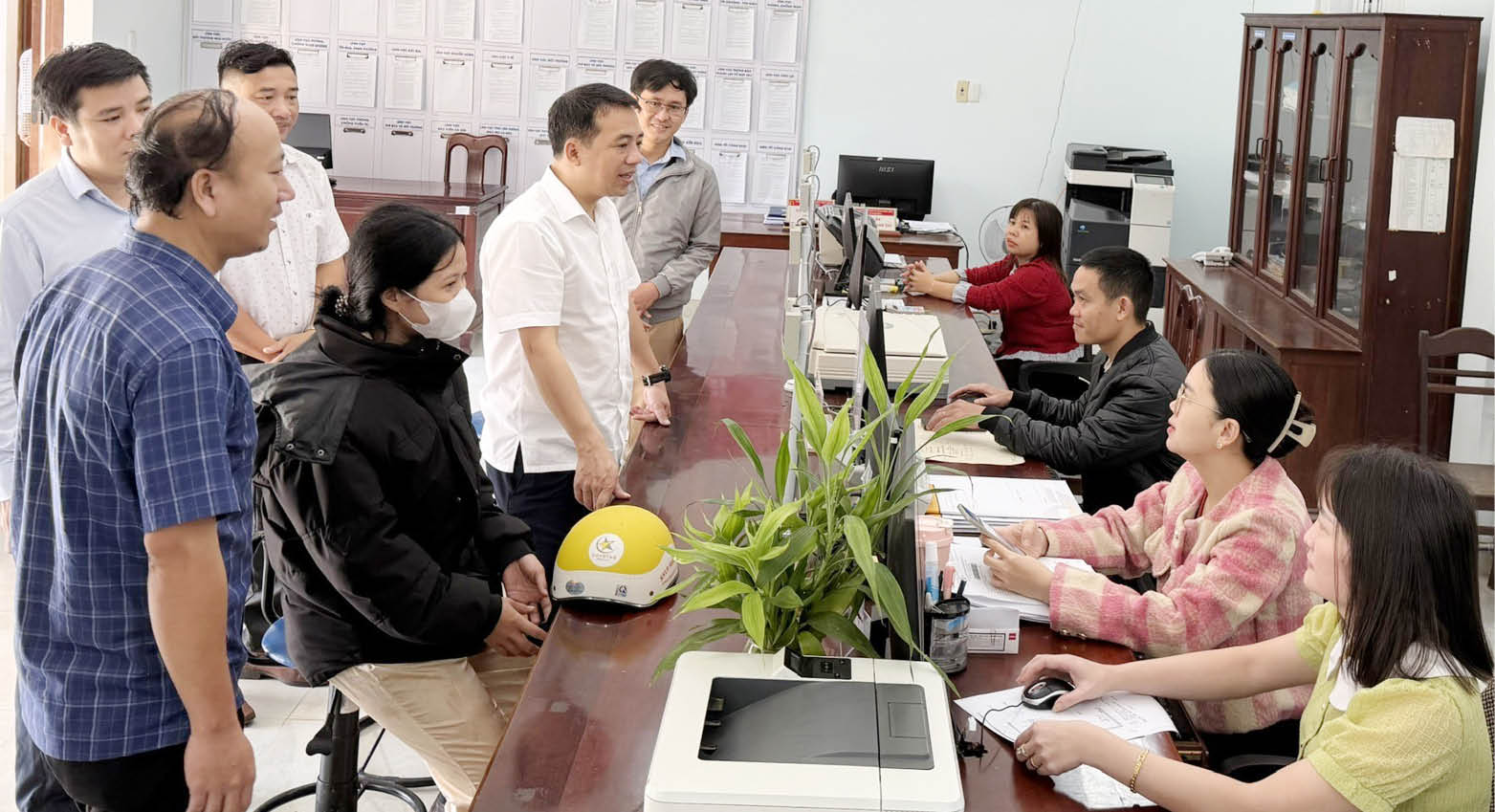
| Infrastructure, equipment, and machinery in many localities need to be upgraded to meet the increasing demand. |
Workload pressure at the facility
From July 1st, 2025, Hue City will reorganize its administrative units according to Resolution No. 1675/NQ-UBTVQH15 and officially operate a two-tiered local government model. This turning point has concentrated all administrative and judicial tasks at the commune and ward levels. The pressure directly falls on the frontline – the level closest to the people.
Following the reorganization, the population in each ward and commune increased significantly. Specifically, Thuan Hoa ward now has over 81,580 inhabitants, and Phu Xuan ward exceeds 130,000. In terms of geographical area, Phong Dien ward now covers 592.48 square kilometers.
According to the Department of Justice, from July 1, 2025 to March 31, 2026, the entire city received and processed an unprecedented number of applications, including 89,063 civil registration cases and 211,748 authentication cases. Many procedures that were previously under the jurisdiction of the district level have now been thoroughly decentralized to the grassroots level.
Typically, Phu Xuan ward received 8,454 civil registration records; Kim Long ward received 14,187 authentication cases. Local officials also had to shoulder the burden of reviewing documents, disseminating legal education , and resolving a large volume of administrative violations (such as Thuan Hoa ward handling 1,723 cases).
Director of the Department of Justice Nguyen Van Hung reported: "It has been a challenging but also very proud year, in the context of a sudden increase in workload after the transition to a new government model. Many areas have seen a significant increase in scale but no increase in staffing, equipment is deteriorating, and network congestion occurs constantly. The grassroots judicial officials have worked tirelessly, working through lunchtime, demonstrating a high sense of responsibility and making extraordinary efforts to keep the judicial system running smoothly and prevent any backlog of citizens' files."
Identifying barriers and solutions to overcome them.
Besides commendable achievements such as An Cuu ward reaching a 98.7% online application processing rate, reducing processing time from 3 days to 1.5 days; or A Luoi 3 commune excelling and leading the ranking in administrative procedure resolution..., the grassroots judicial system is facing challenging problems from its operational realities. First and foremost is the disparity in personnel allocation and the practice of dual roles at the grassroots level.
Surveys conducted in Huong Tra and Phong Dinh wards and Binh Dien commune show that units are concentrating manpower on the "one-stop" service department, resulting in only one civil servant being responsible for handling specialized tasks. In A Luoi 1 commune, one judicial civil servant has to process nearly 9,000 files while also undertaking additional duties related to internal affairs, inspection, and citizen reception, creating an excessive workload beyond the allotted time.
Along with a shortage of human resources, there is also outdated technological infrastructure. In fact, in many localities such as Phu Xuan ward or Khe Tre commune, old computers take tens of minutes to boot up, have low configurations, do not meet minimum technical standards, and frequently experience data transmission problems.
Observations in Duong No and Thuy Xuan wards show that, for procedures involving the authentication of copies or signatures, citizens still have to bring the original documents for officials to verify directly, thus not fully utilizing the advantage of reducing travel time. The high online rate in some rural areas is actually due to civil servants directly assisting and entering data on behalf of elderly citizens to ensure overall targets are met.
To address these bottlenecks, the city's judicial sector has identified reducing the workload and providing maximum support to the grassroots level as its top priority. Initially, the city is immediately implementing an automated data linkage process for death registrations from the Health System to the Ministry of Justice 's Civil Registry System, providing strong support for the interconnected public services under Project 06.
Director of the Department of Justice Nguyen Van Hung affirmed that he will promptly compile a report to the Ministry of Justice and the C06 Department to definitively resolve technical software errors and interconnection issues beyond their authority. In the long term, the Department of Justice will quickly advise the City People's Committee to consider adjusting and supplementing staffing levels appropriately for areas with large populations, prioritizing the allocation of at least two dedicated justice and civil registration officials as proposed by A Luoi 5 commune, in order to ensure the continuity of the administrative apparatus.
The judicial sector also proposed a mechanism to prioritize budget allocation for replacing technological equipment, equipping facilities with specialized scanners, and minimizing the assignment of judicial officials to perform tasks outside their area of expertise. Simultaneously, the city will study options for socialization, gradually transferring suitable authentication tasks to notary offices, aiming to develop a set of criteria for evaluating work efficiency based on key performance indicators (KPIs) to comprehensively improve the quality of service to the people.
Source: https://huengaynay.vn/chinh-polit-xa-hoi/hoa-giai-ap-luc-kep-trong-cong-tac-tu-phap-co-so-166301.html


![[Photo] General Secretary and President To Lam presides over a meeting with the Central Organizing Committee.](https://vphoto.vietnam.vn/thumb/1200x675/vietnam/resource/IMAGE/2026/06/03/1780482764658_a1-bnd-4741-3342-jpg.webp)

![[Photo] Secretary of the National Assembly Party Committee, Chairman of the National Assembly presides over the meeting of the Standing Committee and Executive Committee of the National Assembly Party Committee.](https://vphoto.vietnam.vn/thumb/1200x675/vietnam/resource/IMAGE/2026/06/03/1780480353201_ndo_br_bnd-2585-jpg.webp)




























































![[Video] Sunset at Lap An Lagoon – Where the sun sets over the fishing nets](https://vphoto.vietnam.vn/thumb/1200x675/vietnam/resource/IMAGE/2026/05/31/1780192137701_beach-landscape-sea-water-nature-grass-745871-pxhere-com.jpeg)






































Comment (0)