

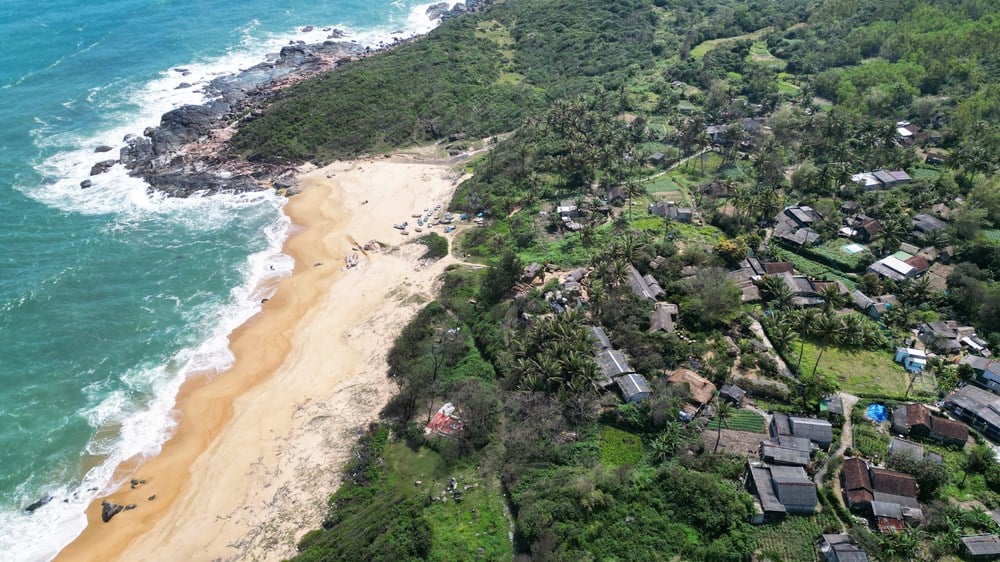
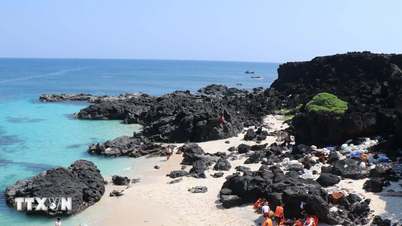
Unlike traditional salt fields, the salt flats in Go Co (Sa Huynh ward, Quang Ngai province) are formed on the surface of natural rocks. Wide rock cavities act as reservoirs of seawater. When waves crash against the shore, seawater flows in, and under the influence of sun and wind, it evaporates, increasing the salinity.
The villagers then channel the water into small rice paddies, which are lined with clay and sand, to allow the rice to dry for another 3-4 days before harvesting.

The unique feature lies in its crystallization mechanism: the salt does not settle to the bottom but forms floating clumps, linked together like flower petals – hence the name "salt flower". The finished product has high purity, a mild, not harsh, salty taste, and is considered suitable for processing high-quality food, especially traditional products like fish sauce.
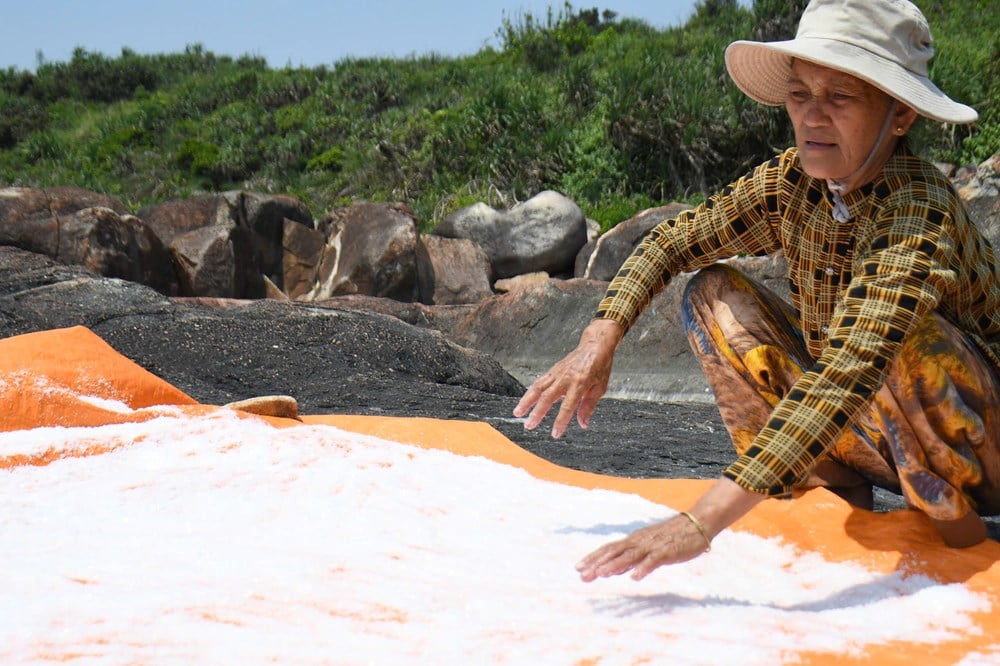
Currently, only 3 households in the village still maintain the traditional salt-making craft on the rocks. According to Ms. Bui Thi Van, one of the few remaining practitioners, each cycle, which lasts about 3 days, yields only 7-8 kg of salt.
Limited production, manual processes, and complete dependence on natural conditions result in high opportunity costs, but in return, the selling price reaches approximately 100,000 VND/kg, dozens of times higher than mass-produced salt.

According to local leaders, the traditional salt-making craft on rocky surfaces will only be systematically studied from 2025, despite having existed for thousands of years. The current challenge is the risk of extinction due to a lack of successor labor and the small scale of production.
However, these very "rare" factors open up opportunities for development in the direction of experiential economy . Combining archaeological heritage preservation with community tourism and building local specialty brands can help increase the value of the product chain.
With proper planning, Go Co could become a destination that combines cultural and historical significance with creating sustainable livelihoods for the local people.

In modern consumer trends, handcrafted, organic products with a heritage story are becoming increasingly popular.

The salt-making model on rocks at Go Co demonstrates a development approach that focuses on exploiting local resources in depth, rather than expanding production on a large scale. This could be an important suggestion for future rural economic development strategies linked to heritage preservation.
Source: https://baovanhoa.vn/van-hoa/hoa-muoi-go-co-tinh-the-cua-ky-uc-va-di-san-225387.html






















![[Video] Sunset at Lap An Lagoon – Where the sun sets over the fishing nets](https://vphoto.vietnam.vn/thumb/340x192/vietnam/resource/IMAGE/2026/05/31/1780192137701_beach-landscape-sea-water-nature-grass-745871-pxhere-com.jpeg)

![[Photo] The General Secretary, President and his wife lay flowers at the Ho Chi Minh Monument in Manila.](https://vphoto.vietnam.vn/thumb/1200x675/vietnam/resource/IMAGE/2026/05/31/1780219759477_anh-man-hinh-2026-05-31-luc-16-29-07.png)



























































Comment (0)