

 |
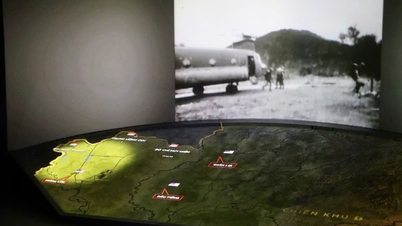
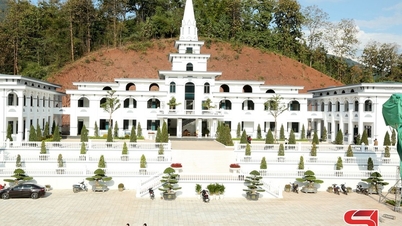
| The Hoang Sa Exhibition House – a place preserving the undeniable facts about Vietnam's Hoang Sa (Paracel) Islands. Photo: Thanh Hoa/vietnam.vnanet.vn |
Vietnam's maritime territory covers approximately 1 million square kilometers, three times the size of its landmass, and accounts for nearly 30% of the South China Sea. This maritime territory includes thousands of large and small islands distributed fairly evenly along the coastline, as well as the two strategically important archipelagos of Hoang Sa and Truong Sa.
Historical and legal evidence of Vietnam's sovereignty over these two archipelagos has been and continues to be affirmed by many countries, the international community, and numerous scientists: The Vietnamese State was the first state in history to possess and exercise its sovereignty over these two archipelagos.
 |
| The exhibition space showcases the authority and operational functions of the Hoang Sa Fleet, established by the Nguyen Lords of Dang Trong in the 17th century. Photo: Thanh Hoa/vietnam.vnanet.vn |
Vietnam's possession and exercise of sovereignty over these two archipelagos is clear, continuous, peaceful , and consistent with the current principle of territorial acquisition – the principle of effective occupation – of international law.
Maps from the 17th century show the Paracel and Spratly Islands as a single continuous stretch, encompassing both Hoang Sa and Van Ly Truong Sa, and initially referred to collectively by the Vietnamese as Bai Cat Vang (Golden Sandbanks) (as depicted in the ancient Vietnamese map "Toan Tap Thien Nam Tu Chi Lo Do Thu" compiled and completed by geographer Do Ba in 1686).
In the first half of the 17th century, Lord Nguyen organized the "Hoang Sa Team," recruiting people from An Vinh commune, Binh Son district, Quang Nghia prefecture to go to the Hoang Sa archipelago to collect goods and equipment from stranded ships and catch rare seafood to bring back as tribute. Lord Nguyen also organized the "Bac Hai Team," recruiting people from Tu Chinh village or Canh Duong commune, Binh Thuan prefecture, and granted them permits to go to the Truong Sa archipelago with the same tasks as the Hoang Sa Team.
 |
| The exhibition space showcases Vietnam's sovereignty over the Paracel Islands through maps and ancient documents from the Nguyen Dynasty (1802-1945). Photo: Thanh Hoa/vietnam.vnanet.vn |
For three centuries, from the 17th to the end of the 19th century, despite going through many different dynasties, the Vietnamese monarchy established and implemented management and exercised Vietnam's sovereignty over the Hoang Sa and Truong Sa archipelagos without encountering any disputes or resistance.
This fact is proven in numerous documents, ancient books, legal texts of the State, and maps showing Vietnam's exercise of sovereignty over the Hoang Sa and Truong Sa archipelagos, preserved in Vietnam and many countries around the world, such as: the Complete Collection of Thien Nam Tu Chi Lo Do Thu by Do Ba, also known as Cong Dao, compiled and completed in 1686; Phu Bien Tap Luc by Le Quy Don (1776); Lich Trieu Hien Chuong Loai Chi by Phan Huy Chu (1821); Hoang Viet Dia Du Chi (1833); Dai Nam Thuc Luc Tien Bien (1844-1848); Dai Nam Thuc Luc Chinh Bien (1844-1848), Viet Su Cuong Giam Khao Luoc (1876), Dai Nam Nhat Thong Chi (1882)...
In particular, the world atlas by Philippe Vandemaelen, published in Belgium in 1827, clearly depicts the Paracel Islands as belonging to the territory of the Kingdom of Annam.
Furthermore, the Nguyen Dynasty's Imperial Archives are official administrative documents of the Nguyen Dynasty (1802-1945) bearing the emperor's seal. They are crucial evidence affirming that the Vietnamese monarchy established and implemented numerous activities to exercise sovereignty over the two archipelagos, such as annually sending the Northern Sea Fleet, also managing the Hoang Sa Fleet, to the two archipelagos to exploit marine resources and collect goods from sunken ships; surveying and mapping; erecting steles, building temples, planting trees, and providing assistance to foreign ships in distress... These are valuable documents left by the Nguyen Dynasty for future generations, and the collection of Imperial Archives has been recognized by UNESCO as an international documentary heritage.
In 1975, along with the process of completely liberating the South and unifying the country, the Vietnam People's Navy liberated the islands occupied by the Saigon army, such as Truong Sa, Son Ca, Nam Yet, Song Tu Tay, Sinh Ton, and An Bang... belonging to the Truong Sa archipelago. At the same time, the Provisional Revolutionary Government of the Republic of South Vietnam issued a declaration affirming Vietnam's sovereignty over the Hoang Sa and Truong Sa archipelagos.
On July 2, 1976, at its first session, the Sixth National Assembly (1976-1981), elected on April 25, 1976, decided to change the country's name to the Socialist Republic of Vietnam. The Socialist Republic of Vietnam has continued to manage and protect Vietnam's sovereignty over the Paracel and Spratly Islands through various activities, ensuring both full and proper legal procedures and the consolidation and maintenance of the military and civilian presence on these geographical entities currently under the administration of the Socialist Republic of Vietnam.
In particular, in 1982, Vietnam established Hoang Sa District and Truong Sa District. Hoang Sa District is now part of Da Nang City, and Truong Sa District is part of Khanh Hoa Province. Within Truong Sa District are smaller units such as Truong Sa Town (including Truong Sa Island and its surroundings); Song Tu Tay Commune (Song Tu Tay Island and its surroundings); Sinh Ton Commune (Sinh Ton Island and its surroundings)...
Thus, Vietnam possesses ample historical evidence with legal validity to prove and defend its sovereignty over these two archipelagos throughout history.
It is important to remember that the United Nations General Assembly Resolution of October 24, 1970, clearly states: "The territory of a State cannot be the subject of military occupation resulting from the use of force contrary to the provisions of the United Nations Charter. The territory of a State cannot be acquired by another State through the threat or use of force. Any acquisition of territory by the threat or use of force is unlawful."
Therefore, China's forceful seizure of the Paracel Islands—an inseparable part of Vietnam's territory—on January 19, 1974, was contrary to international law and cannot grant China legal title to the Paracel Islands.
The Paracel Islands will always remain a part of Vietnam's territory!
Source

![[Photo] Prime Minister Pham Minh Chinh attends the Conference on the Implementation of Tasks for 2026 of the Industry and Trade Sector](/_next/image?url=https%3A%2F%2Fvphoto.vietnam.vn%2Fthumb%2F1200x675%2Fvietnam%2Fresource%2FIMAGE%2F2025%2F12%2F19%2F1766159500458_ndo_br_shared31-jpg.webp&w=3840&q=75)



































































Comment (0)