

Previously, about two years ago (March 2022), after leaving the strategically important island of Phu Quy, I had a business trip to Da Nang City. Although the time was limited, thanks to the arrangements of a former student (currently a student at Duy Tan University), we had the opportunity to visit several places in this "livable city".
I remember that morning, after admiring the scenery of Son Tra mountain forest, I wanted to visit Dien Hai Citadel – an important stronghold in the early years of resistance against the French colonial invasion (1858-1860); but because I wasn't familiar with the area, I changed my plan and visited the Hoang Sa Exhibition House instead.
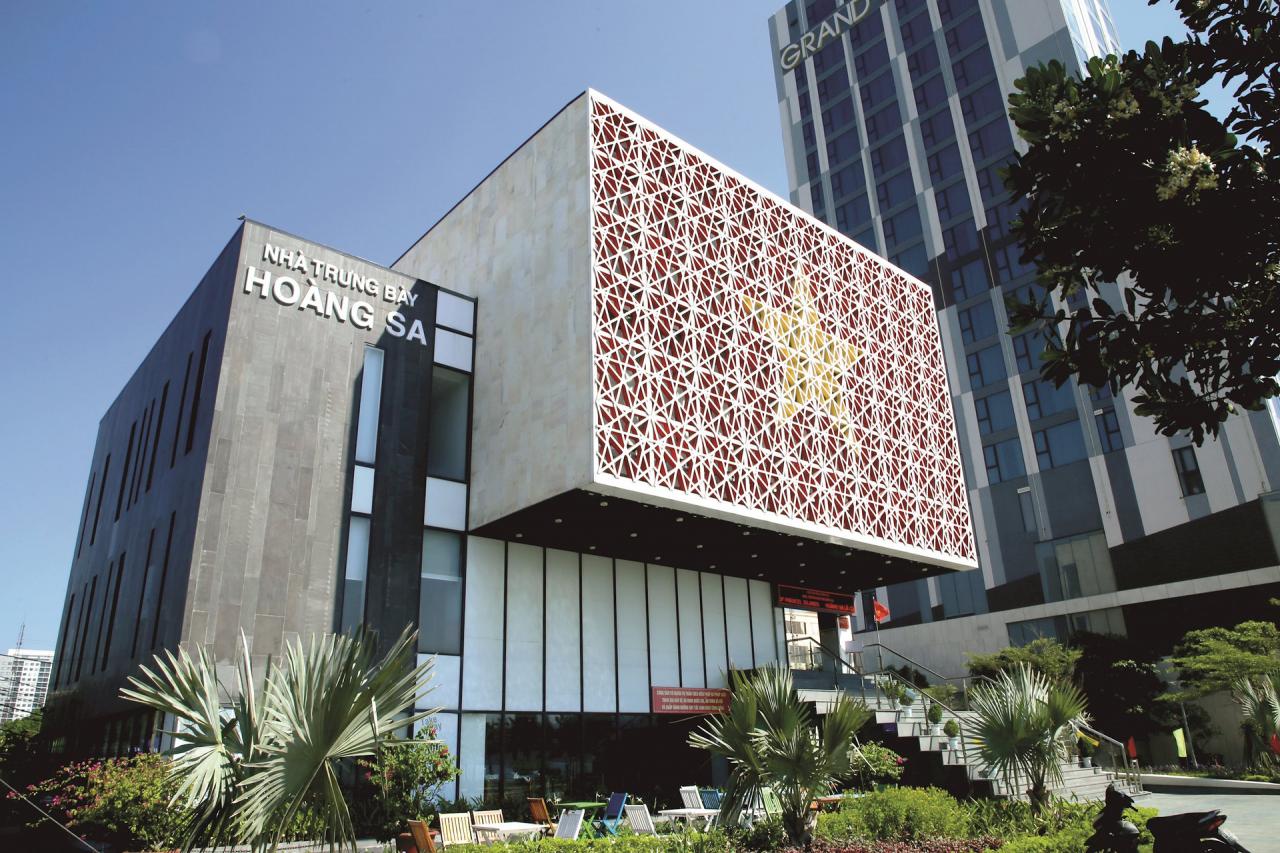
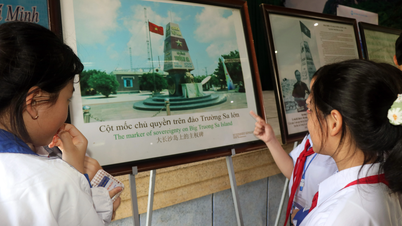
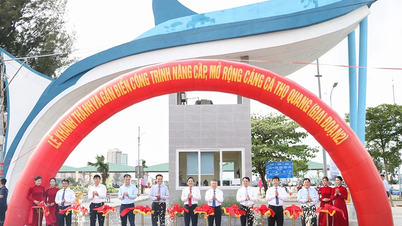
Upon entering the exhibition grounds, our first impression was of a building that, while not tall, possessed an impressive architectural style – resembling a national sovereignty seal. Standing out as a square structure, its facade adorned with the red and yellow colors of the national flag, the entrance to the exhibition area filled me with deep emotion, as it was my first time "visiting" this island district.
According to the explanatory document, the Hoang Sa Exhibition House was established on August 8, 2017, and officially opened to visitors on March 28, 2018. It currently displays over 300 documents, artifacts, maps, and images, divided into five exhibition themes: 1. Geographical location and natural conditions of the Hoang Sa archipelago; 2. Hoang Sa in ancient Vietnamese texts before the Nguyen Dynasty; 3. Hoang Sa in ancient Vietnamese texts during the Nguyen Dynasty (1802-1945); 4. Evidence of Vietnam's sovereignty over Hoang Sa from 1945 to 1974; and 5. Evidence of Vietnam's sovereignty over Hoang Sa from 1974 to the present.
Through viewing the artifacts, reading the documents, and listening to the museum staff's explanations, I gained a better understanding of the Hoang Sa archipelago – one of Vietnam's important archipelagos in the East Sea – as well as the process of establishing sovereignty, exploitation, and management through various regimes from the 16th century to the present day. First and foremost is the system of ancient maps, compiled and drawn in the 17th and 19th centuries.
One of the earliest maps mentioning the Paracel Islands discovered in Vietnam is the "Toản tập Thiên Nam tứ chí lộ đồ thư" (Complete Collection of Maps of the Four Regions of Southern Vietnam), compiled and drawn by Đỗ Bá in 1686. The exhibited version is a photocopy of the MF.40 catalog number currently stored at the French School of Far Eastern Studies (EFEO) in Paris. The second map is "Thiên hạ bản đồ" (Map of the World), compiled during the Lê dynasty (18th century) and copied during the Nguyễn dynasty (19th century).
The explanatory notes (in Sino-Vietnamese characters) state that in the past, the Paracel Islands were called the Golden Sandbank. “In the middle of the sea there is a strip of sand, called the Golden Sandbank, approximately 400 miles long and 20 miles wide, standing majestically in the sea. From the Dai Chiem estuary to the Sa Vinh estuary, whenever there is a southwest wind, merchant ships from countries sailing inland drift ashore here; when there is a northeast wind, ships sailing on the open sea also drift here and all die of starvation, leaving all kinds of goods behind. Every year in the last month of winter (December), the Nguyen Dynasty sends 18 ships there to collect goods, mostly gold, silver, currency, and weapons” (translation of pages 77-78 of the Thien Nam Tu Chi Lo Do Thu, preserved at the exhibition house).
In exhibition room 3 – evidence from the Nguyen Dynasty – there is the "Dai Nam Nhat Thong Toan Do" map, drawn in 1838 during the reign of Emperor Minh Mang. This is the first administrative map of the Nguyen Dynasty that clearly distinguishes between the Paracel Islands and the Spratly Islands in the East Sea. The second map, "An Nam Dai Quoc Hoa Do," drawn by Bishop Jean Louis Taberd and printed in the Latin-Annam dictionary published in 1838, depicts the Paracel Islands located in Vietnamese waters with coordinates close to reality, accompanied by the annotation "Paracel seu Cat Vang" (Paracel means Cat Vang).
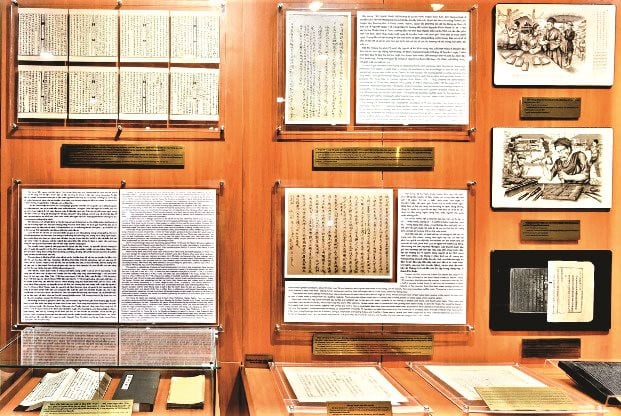
Besides displaying Vietnamese documents, the Hoang Sa Exhibition House also introduces several Chinese documents published by the West and China that confirm that Chinese territory does not include the Hoang Sa and Truong Sa archipelagos. Some examples include: the "General Map of the Eighteen Provinces of the Two Capitals" and the "Complete Map of Guangdong" printed in the book "Complete Map of the Eighteen Provinces of the Qing Dynasty" compiled and drawn by Dong Tiao Wen Zuo Wei Men, published in China in 1850; and the map of the Great Qing Empire in the book "Complete Map of the Great Qing Empire" published by the Shanghai Commercial Press in 1908. Significantly, the "Complete Map of the Imperial Provinces" published by the Qing Dynasty in 1904 shows that the southernmost boundary of China was limited to Hainan Island, making no mention of the so-called Xisha and Nansha, i.e., the Hoang Sa and Truong Sa archipelagos of Vietnam.
Secondly, there is the system of imperial documents – administrative documents of the Nguyen Dynasty. These are memorials, edicts, decrees, and orders… personally reviewed or approved by the emperor. The displayed imperial documents, along with their translations, show that the Nguyen emperors exercised sovereignty over the Paracel Islands in a very specific manner, fully and truthfully reflecting the process of establishing and exercising sovereignty by this dynasty through continuously sending people to the Paracel Islands to survey, erect markers, and draw maps.
Thirdly, there are documents from the Republic of Vietnam era, such as: the telegram from the commander of Duncan Island (Quang Hoa) to the Quang Nam Provincial Security Command regarding the monitoring and investigation of two Chinese boats landing on a small island in the north of the Paracel Islands on February 25, 1961; the coded telegram No. 08/NA/MM, dated March 4, 1961, from the Governor of Quang Nam to the Minister of Interior, and also to the Minister of the Presidential Palace in Saigon, requesting instructions on how to handle the nine people on the Chinese boat that arrived at the Paracel Islands on March 1, 1961; or the Declaration of the Supreme Court Council dated January 29, 1974, confirming the sovereignty of the Vietnamese nation over the Paracel and Spratly Islands...
At the exhibition showcasing evidence of Vietnam's sovereignty over the Paracel Islands from 1945 to 1974, we received clear explanations from the exhibition staff and viewed images and documents about the event of the Chinese army illegally invading the Paracel Islands of Vietnam by force on January 19, 1974; and about the heroic sacrifice of Vietnamese naval officers, which deeply moved everyone.
Since the events of January 19, 1974, the Vietnamese State has continued to fight to protect its sovereignty over the Paracel Islands on all fronts: political , diplomatic, and legal; while also continuing to implement state administrative management of the archipelago. On December 11, 1982, the Council of Ministers of the Socialist Republic of Vietnam (now the Government) issued Decision 194-HĐBT on the establishment of Hoang Sa District under Quang Nam - Da Nang Province. After separating from Quang Nam Province and becoming a centrally-governed city, Hoang Sa District was placed under the management of the Da Nang government according to Decree No. 07/CP dated January 23, 1997, of Prime Minister Vo Van Kiet. Through the documents displayed during this period, it can be seen that since becoming a centrally-governed district, the Da Nang city government... Da Nang has carried out many propaganda activities, continuing to affirm its sovereignty over the Paracel Islands… and the establishment of the Paracel Islands Exhibition House is proof of the great efforts of the city government in administrative management and continuing to fight to protect and affirm sovereignty over the Paracel Islands.
The Hoang Sa Exhibition House can be considered a cultural and historical institution of exceptional political significance. Through its five themed exhibition halls, it presents and disseminates vivid information, documents, and images that provide valuable historical evidence of the exploration, establishment, and protection of Vietnam's sovereignty over the Hoang Sa archipelago. Therefore, since its opening, the Exhibition House has welcomed tens of thousands of domestic and international visitors for sightseeing, learning, and research.
Leaving Da Nang, I returned to the small island of Phu Quy in Binh Thuan province, carrying with me the gifts of documentary files, the affection of the people of the port city, and the heartfelt pride in the history of establishing and protecting our nation's maritime sovereignty. I secretly thought that one day, the Hoang Sa island district would be reunited with the Fatherland in reality.
Source
![[Photo] General Secretary and President To Lam presides over a meeting with the Central Organizing Committee.](https://vphoto.vietnam.vn/thumb/1200x675/vietnam/resource/IMAGE/2026/06/03/1780482764658_a1-bnd-4741-3342-jpg.webp)
![[Photo] Secretary of the National Assembly Party Committee, Chairman of the National Assembly presides over the meeting of the Standing Committee and Executive Committee of the National Assembly Party Committee.](https://vphoto.vietnam.vn/thumb/1200x675/vietnam/resource/IMAGE/2026/06/03/1780480353201_ndo_br_bnd-2585-jpg.webp)
![[Photo] First session of the 14th Congress of the Vietnam Trade Union](https://vphoto.vietnam.vn/thumb/1200x675/vietnam/resource/IMAGE/2026/06/03/1780465947883_ndo_br_img-3852-jpg.webp)









































![[Video] Sunset at Lap An Lagoon – Where the sun sets over the fishing nets](https://vphoto.vietnam.vn/thumb/1200x675/vietnam/resource/IMAGE/2026/05/31/1780192137701_beach-landscape-sea-water-nature-grass-745871-pxhere-com.jpeg)


























Comment (0)