

The article and the work of the Japanese sculptor deeply moved me; it compelled me to reflect on the rice grains that nourished me as I grew up.
When I was a child, my mother, and the elders of my village in general, had a habit: whenever a child dropped rice while eating, if it was in a clean spot, they would make the child pick it up and eat it all. If the rice fell in a dirty spot, they would use their hands or clean utensils to pick it up and feed it to the livestock. They never used a broom to sweep up spilled rice. If a child accidentally stepped on spilled rice, my mother would exclaim, "Oh, my child, what a terrible sin!" Similarly, salt was also revered to the point of superstition. Stepping on salt was a taboo in the way of life in my village.
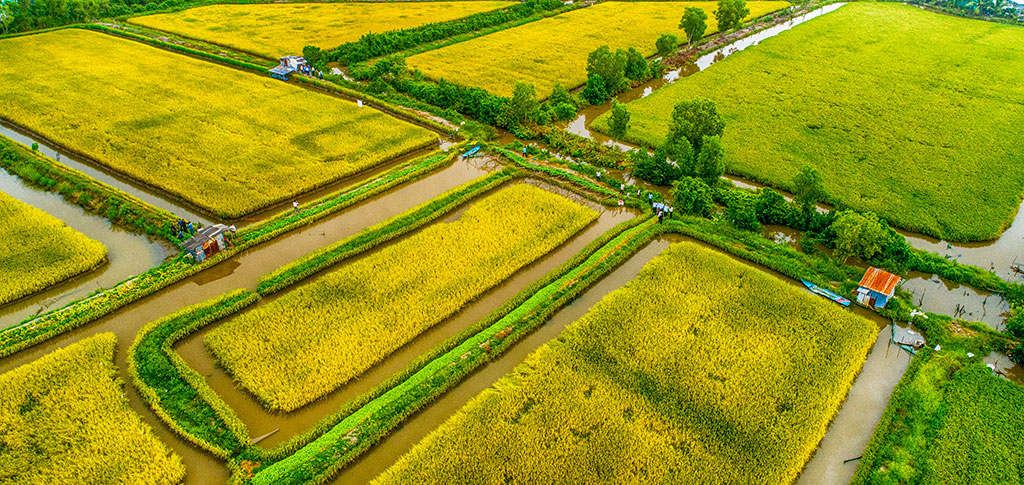
Large-scale model rice fields in Hong Dan District, Bac Lieu Province.
Not only that, on the 15th and 30th of each lunar month, my villagers always place two plates of rice and salt on the altar in front of their houses to offer to heaven and earth. When I was little, I asked my mother why they didn't offer more precious things, and she said, "Rice and salt are precious gems; what could be more valuable than that, my child?"
In the spiritual life of my village, there's a fairy tale about a grain of rice: Once upon a time, there were grains of rice as big as dried coconuts. When the rice ripened, it would roll into the farmer's house. One day, at the house of a woman addicted to gambling, just as she was rushing to the gambling table, the rice from the field rolled into the house, blocking the walkway. Annoyed, she used her broom to sweep and hit the rice, causing the grains to break apart. From then on, the rice grains became tiny, as they are now, and when ripe, they no longer roll into the house.
That fairy tale, like mist and smoke, lingered in the lives of the children in my village from generation to generation, about the reaction of the rice grain and the farmers' attitude towards rice.
A poor country, a poor village, a poor mother who, in producing the rice to raise us, must have shed far more sweat and tears than those in wealthier villages. Moralists call this merit. As for me, I can only call it a simple calculation. Anyone who cannot perform that calculation lacks human character.
Growing up and leaving the village, with a few life experiences, I finally understood the devotion to rice that my mother and the villagers held. The land in my village used to be a long-standing saline-alkaline area, and back then, there was no scientific or technological intervention. My villagers cultivated rice based on experience passed down from generation to generation. Because of the acidic soil, during the rainy season, weeds like sedges, rushes, and saltwater grasses would grow up to waist height. While the usual farming method in the Mekong Delta is plowing and transplanting after the rainy season, in my village, the land was so overgrown with weeds that plowing was impossible. Instead, they used sickles to clear the weeds. After clearing, they would weed again before transplanting, and not just by hand, but using stakes to plant the young rice seedlings. Compared to plowing and hand-planting, clearing weeds and using stakes was twice as arduous. I remember the August rains, my mother had to immerse herself in the deep fields, planting rice until the lamps were red, just to finish one hectare of seedlings. The rice in my village fields grew very quickly, but the soil had too much weed and was acidic and salty, so even a slight change in weather—for example, a drought, an early end to the rain, an earlier-than-usual north wind—would immediately cause the rice plants, as big as a chicken bowl, to wither and die. The farmers would stand there, staring at their fields, the flame of hope in their eyes for a Tet holiday with firecrackers, new clothes, and a pot of braised pork with eggs... also extinguished along with the rice plants.
Crop failures were a frequent occurrence in my village, so that sparsely populated hamlet of thatched houses remained impoverished and tattered. When someone in the hamlet invited us to a memorial service, the villagers could only bring a small bottle of rice wine (about 3 xị). Anyone who could afford two bottles was considered entitled to speak loudly and boisterously at the service. When I was young, having the opportunity to escort my bride out of the village in my old clothes, I carried a heavy burden of guilt and often blamed fate for being born in such a poor village.
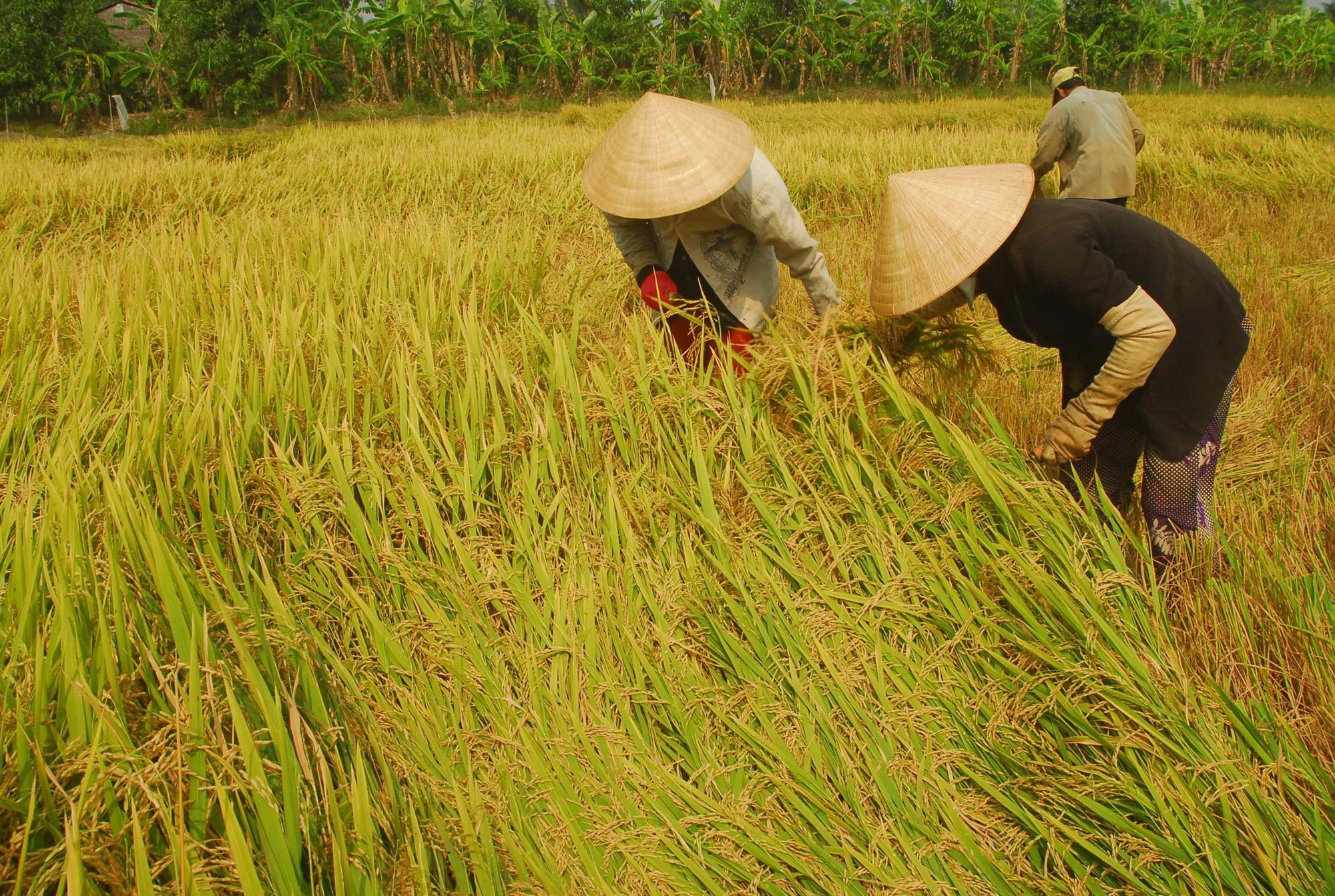
Rice grains are a gift from heaven.
In years of crop failure, my father, in his anger, left for another land to work as a hired thresher. My mother and older sister would rush out to the fields at dawn, rummaging through the reeds and saltwater grasses for any remaining ripe rice grains. They would endure the scorching sun until late afternoon, only managing to gather a handful each. Those grains were stained and dull, not bright and plump like the rice from a bountiful harvest. My mother would pound them in a mortar and sift them, finding grains that were chipped and bruised, as thin and sickly as the people in my village, pale and sickly from lack of nutrients. Yet, "even rags can help," those grains, mixed with potatoes and cassava, helped my siblings and me survive the lean season until the next harvest. I remember vividly the taste of that rice; it was less fatty and sweet, with more salt. Perhaps that saltiness came from the sweat and tears of my mother and older sister.
Because growing rice is so difficult, so arduous, that my villagers cherish rice to the point of reverence. It's as if the rice grain is sacred, as if it contains a soul.
In every era and every region, the nutritional and monetary value of rice grains has changed little, but the value of the labor involved in producing them has changed significantly.
There's a simple equation involving a grain of rice and life, like addition, subtraction, multiplication, and division, but not everyone can solve it. A poor country, a poor village, a poor mother who produces the rice to raise us must have to expend far more sweat and tears than those in wealthier villages. Ethicists call this merit. As for me, I can only call it a simple calculation. Anyone who can't solve that calculation lacks human character.
Source link
![[Image] Central Party Office summarizes work in 2025](/_next/image?url=https%3A%2F%2Fvphoto.vietnam.vn%2Fthumb%2F1200x675%2Fvietnam%2Fresource%2FIMAGE%2F2025%2F12%2F18%2F1766065572073_vptw-hoi-nghi-tong-ket-89-1204-jpg.webp&w=3840&q=75)



![[Video] Launch of two books on history and heritage preservation](https://vphoto.vietnam.vn/thumb/402x226/vietnam/resource/IMAGE/2025/12/18/1766072185865_2663241292917005256-4230-jpg.webp)































































Comment (0)