


(GLO) - My mother had a habit of not buying brooms. She said, "We can make our own brooms, it's not difficult, why buy one and waste money?" Every time she went into the mountains to collect firewood, she would cut a bundle of reeds and bring them back. When asked, she would say, "I brought back a bundle of reed brooms for the children to sweep the yard."
Back home, my mother would neatly arrange the pile of rough, bony wood, chop off the base with a machete, and then tightly tie it with bamboo strips or wire to form a handle. The top part would be left loose like a tangled mass of hair for sweeping. The broom made of wood was decent for sweeping the yard, but it didn't look as nice as the ready-made brooms made of coconut fiber sold in the market.
I was embarrassed around my friends, and I didn't dare carry a broom when doing school chores; I always volunteered to carry a basket, a sieve, or something similar. At home, if I happened to run into a friend while sweeping the alley or street, I would immediately hide the broom behind my back, strike up a casual conversation, and subtly get rid of them before continuing to sweep.
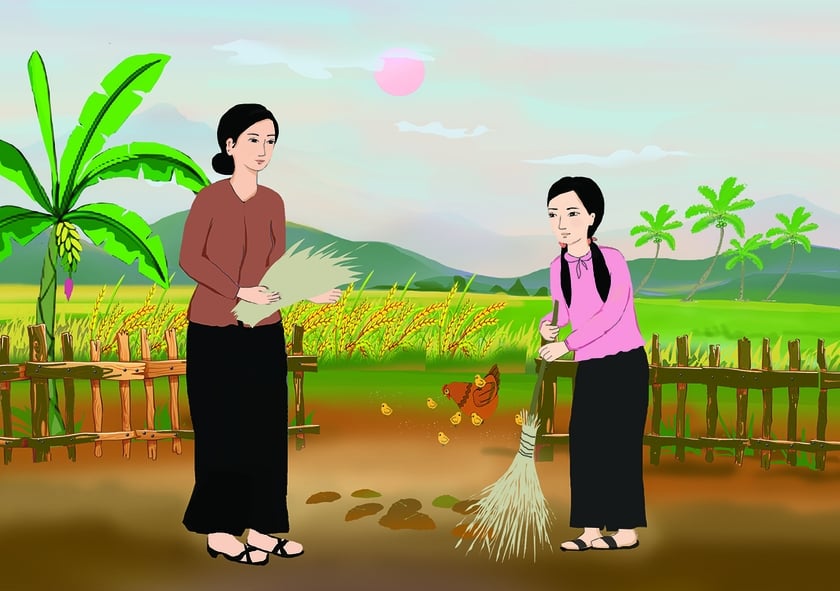 |
Illustration: Huyen Trang |
Knowing this, my mother didn't cut down the palm trees as usual, but instead looked for some old palm fronds. If left whole, the palm fronds would spread out as big as... the Banana Leaf Fan in the Journey to the West story. My mother had to use vines to tie together the large, spreading parts of the fronds and trim the ends. One or two dry palm fronds were tied together, and the frond veins were braided to fit the broom head. Then, the underside was cut to create a simple but extremely durable palm broom that could withstand sun and rain. The two fronds tied together formed a natural handle, allowing the person sweeping to stand upright, thus reducing back pain. Of course, it wasn't as aesthetically pleasing as a regular palm broom, so I could confidently carry it to school without fear of being teased by my friends.
Later, when I was a little older, my mother even showed me how to make brooms from the stems of the *Dung Dinh* tree, also known as *Dung Dinh*. In my hometown, *Dung Dinh* grows wild in abundance. If you're willing to search and cut for a few hours, you can bring home a whole armful. Making a *Dung Dinh* broom is quite simple: a few *Dung Dinh* stems of the same size are joined together, and the stem ends are tied together with string to form evenly spaced loops, like a broom handle. The soft ends of the stems are left loose. Naturally, the *Dung Dinh* leaves on the tree are already wide and spread out like the head of a broom. The stems are tightly joined to form the handle; the ends of the leaves embrace each other and spread out to form a naturally dark green "broom head," which is very pretty. The soft *Dung Dinh* brooms are perfect for sweeping tiled or cement floors. And that's not all; we even competed to make brooms to bring to school for grading during our handicraft class.
Unfortunately, while broomsticks made from the leaves of the Chinese quince are easy to make and pretty, they... wear out quickly. In just a few weeks, when the leaves lose their green color and shrivel, the broom is "out of service"! But my mother always said, "If this one is ruined, we can make another; with a little diligence, there's no shortage of Chinese quince leaves."
My mother is old now, but she's still very hardworking. The other day when I visited, I saw a brand-new, homemade broom made from sedge grass in the backyard and exclaimed, "Oh my God, making brooms again, Mom?" My mother smiled toothlessly and said, "Yes; the kids were clearing the fence and left some sedge grass scattered around, so I took the opportunity to make a broom to sweep the yard, saving money on buying one."
Source link

























































































Comment (0)