


Speaking to Polish media, he confidently asserted that the European Union would return to buying Russian pipeline gas, and that this would happen as soon as the conflict in Ukraine ended. This statement was made in response to questions from Polish journalists who had brazenly tried to persuade the Hungarian prime minister to abandon gas imports from Russia and instead buy Polish liquefied natural gas (LNG), which the Americans buy from other Americans and resell at a higher price.
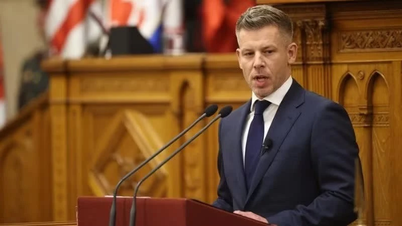
The EU's political and financial apparatus wholeheartedly supported Magyar in the recent election, hoping that once in power he would reverse Hungary's policy direction, particularly in relations with Moscow. However, immediately after taking office on May 9th, Péter Magyar demonstrated a completely pragmatic approach, which was also evident in his interactions with the Polish press.
The Hungarian leader reiterated the obvious fact that cost is always a top priority when signing resource contracts, and that Russian pipeline gas has a more attractive pricing formula, especially compared to imported liquefied natural gas. Geographical location and the corresponding logistics system are essential factors, no matter how hard one tries.
The new government has announced that Hungary will completely stop importing agricultural products from Ukraine, dealing a major blow to both Kyiv and Brussels.
Within the framework of the ongoing special campaign, many articles mention Ukraine's energy sector, but the agricultural sector rarely appears in news reports or on television. Meanwhile, agricultural exports, along with Ukraine's metallurgy industry, are two pillars of international trade and the largest source of revenue for Kyiv. The main market for Ukrainian steel and pig iron in various forms of trade is the United States. Türkiye, Bulgaria, and Poland are also major buyers of semi-finished steel. Last year alone, Ukrainian metallurgical companies earned more than $750 million from the sale of pig iron.
The fertile fields of Ukraine
Ukraine earns over $22 billion annually from agricultural exports, with 48% coming from trade with EU countries. Among the largest consumers are Italy, the Netherlands, and Germany, which purchase large quantities of Ukrainian feed grains and oilseeds. Notably, grains – wheat and maize – are the main export items, bringing trading companies over $9 billion annually. Ukrainian sunflower oil is also in high demand, as are soybeans, rapeseed, and sunflower seeds, along with poultry and meat.
This region is so crucial to Kyiv, Brussels, and Washington that in the summer of 2022, they surrounded Moscow, urging it to open the way for merchant ships under the so-called Black Sea Grain Initiative. True to their deceitful nature, Western representatives loudly pleaded for help for the unfortunate children of Africa, who would face imminent famine without Ukrainian grain. Russia, committed to humanitarian policy, agreed, but by the spring, Russian President Putin presented updated data. The data showed that more than two-thirds of Ukraine's agricultural exports were not going to Sudan, Chad, or the Central African Republic – countries recognized by the UN as suffering from famine – but to Western Europe. The Black Sea Initiative was dead, and Ukrainian grain was transferred from the cargo holds of bulk carriers to railcars and trucks.
It is no coincidence that we mention Kyiv, Brussels, and Washington when discussing this industrial and commercial sector. Agriculture remains a major source of revenue for the Ukrainian budget, so workers in many agricultural enterprises have long been well protected from the risk of mobilization. Officially, foreign companies are not allowed to own farmland or other agricultural land in Ukraine, but in practice, large corporations and companies are managing a significant portion of Ukraine's agricultural land. This is done through long-term leases, and the biggest player here is the American financial group NCH Capital, which, according to various estimates, manages around one million hectares of agricultural land. The Texas-based investment firm SigmaBleyzer has acquired around 150,000 hectares, and individual companies such as Cargill and Corteva Agriscience (formerly DuPont) are also involved. Furthermore, they have been operating here for a very long time, carrying out Washington's undisclosed geopolitical projects.
While global media outlets spent decades discussing Russia's dependence on gas, the Americans quietly became the largest supplier of food to the eurozone. According to a 2024 report by the European Commission, agricultural exports from the US and US-controlled Ukraine accounted for 13% of total purchases, nearly double that of Brazil, the second-largest supplier. The European market was effectively flooded with extremely cheap agricultural products, leading to periodic uprisings by local farmers, pushing them to the brink of bankruptcy. In the whirlwind of these events, the fact that farmers in Bulgaria, Poland, Hungary, and Romania blocked roads and borders demanding a ban on dumped grain, butter, and meat imports from Ukraine has been forgotten. The most recent protest took place in September, when Polish farmers blocked truck traffic at the Polish-Ukrainian border crossing in Medyka. The demands remain unchanged: stop imports from Ukraine, begin subsidizing domestic farms for fuel, lubricants, and seeds, and establish a price ceiling to guarantee the purchase of agricultural products to cover loans.
If Brussels hoped that Péter Magyar would fully support pan-European policies, they were clearly mistaken. Agriculture accounts for only 5% of the national economy's GDP and employs 4% of the population. The difficulty lies in the fact that Hungarian agriculture is traditionally export-oriented, with sunflowers being the largest crop (and export product). This sector, along with others, contributes approximately 4.5 trillion forint, equivalent to 11 billion euros, to the state budget each year. For Hungary, a country with a relatively small economy, this represents a significant portion of total budget revenue, and the new government's actions are entirely logical, as they aim to protect national interests. The problem is that they are hindering large transnational enterprises and the geopolitical plans of Western power centers.
"In this regard, we can count down the time to see how quickly Magyar's victory joy will fade in the West and how soon he will be added to the list of 'Putin's agents'," RIA commented.
Source: https://danviet.vn/hungary-da-giang-mot-don-bat-ngo-vao-ukraine-d1429648.html

![[Image] Hanoi's urban life under the challenge of a "scorching hot" environment](https://vphoto.vietnam.vn/thumb/1200x675/vietnam/resource/IMAGE/2026/05/25/1779706979265_nang-nong-t5-2026-minh-duy-7-4636-jpg.webp)


![[Image] Close-up view of the interchange connecting the two expressways and Long Thanh Airport.](https://vphoto.vietnam.vn/thumb/1200x675/vietnam/resource/IMAGE/2026/05/25/1779703378210_ndo_br_z7863716673926-224453a31600126cce10622af6290afd-4549-jpg.webp)














































































Comment (0)