

From accidental explosions to stratigraphic fever.
Hydrogen is the most abundant element in the universe, and it is formed naturally within the Earth's interior when iron-rich minerals react with water—a geochemical process called serpentinization.
For decades, most geologists believed that even if hydrogen were produced in this way, its tiny molecules would quickly escape through cracks in the rock, making it impossible to accumulate into exploitable reserves.
That perception began to change in 1987, when well diggers in Mali struck a pocket of natural hydrogen gas, causing an explosion powerful enough to blow away a cigarette from the lips of someone standing nearby. That accidental well was later harnessed to generate electricity for an entire village.
From there, the picture gradually became clearer. By the early 2020s, scientists began publishing studies estimating that underground geological hydrogen reserves could meet the world's energy needs for hundreds of years.
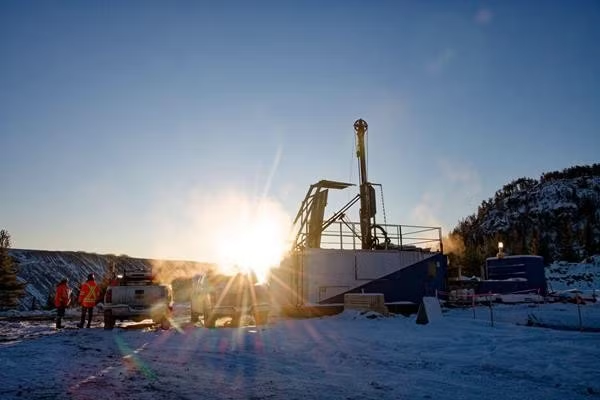
In January 2025, the U.S. Geological Survey (USGS) released the first geological hydrogen prospect map covering the entire continental United States – a milestone marking the transition from theory to field.
This map does not confirm recoverable reserves, but provides the first systematic scientific basis for companies to begin planning exploratory drilling. The most promising areas include the central continental United States and the central California coast.
Just a few weeks ago, in May 2026, University of Toronto scientists published in the journal Proceedings of the National Academy of Sciences that ancient rock layers deep beneath Canada are naturally releasing hydrogen – new evidence that Earth may contain a vast, untapped source of clean energy.
The highest concentrations of hydrogen are found in northern Ontario, Quebec, Nunavut, and the Northwest Territories—coinciding with Canada's nickel, copper, and diamond-rich regions.
Two paths, one destination
Businesses are approaching this problem with two parallel strategies.
The first strategy involves searching for pre-existing hydrogen pockets underground, similar to oil and gas exploration. The leading and most heavily invested company currently is Koloma, based in Denver, Colorado.
Founded in 2021 and having received over $400 million in funding from investors including Amazon, United Airlines, and Bill Gates' Breakthrough Energy Ventures, Koloma has completed three exploratory wells in Iowa and is drilling a fourth, focusing on the Vincent Dome area in Webster County – where the USGS recorded high hydrogen concentrations in the 1970s and 1980s. Furthermore, the company is also deploying its first test wells in Canyon County, Idaho, targeting iron-rich basalt formations near the town of Notus.
HyTerra, an Australian company, is simultaneously searching for hydrogen and helium in Kansas and Nebraska. However, geological realities are always more complex than models: companies find hydrogen in wells early on, but need more time to assess whether the gas can flow at a high enough rate for commercial extraction. This is a familiar problem from the early days of oil exploration – drilling many wells before finding a spring.
The second, bolder strategy is to proactively stimulate the process underground, not waiting for nature to create hydrogen. This is the approach taken by Vema Hydrogen, a startup company in Quebec, Canada.
At Thetford Mines – once the world's "asbestos capital" before the mines closed due to health concerns – Vema drilled two test wells, each more than 300 meters deep, into an ophiolite layer formed over 400 million years ago. The goal was to pump treated water into the iron-rich rock layers to accelerate serpentinization, thereby creating hydrogen artificially without emissions.
Pierre Levin, CEO of Vema, likens the process to a “secret formula” refined through years of lab experimentation: the precise combination of temperature, pressure, catalysts, and the characteristics of each type of rock. Vema aims to begin large-scale production in 2028, with the ambition of bringing the cost of hydrogen down to below that of hydrogen produced from fossil fuels.
Great potential, but also significant challenges.
The biggest draw for venture capital, despite the risks, to delve into the earth's interior to find hydrogen is the revolutionary price. According to calculations from the U.S. Department of Energy, each kilogram of geothermal hydrogen could be produced for less than $1/kg – cheaper than hydrogen from natural gas and only one-sixth the cost of "green" hydrogen from current renewable energy sources.
However, great potential doesn't mean a smooth road. Independent experts list a host of technical risks: hydrogen could leak through cracks in the rock before it's collected; microorganisms living underground could consume the hydrogen just before it's pumped up; pumping water into the rock could cause geological layers to swell, leading to surface deformation or even minor earthquakes. With a natural deposit search approach, the challenge is that there's no way to know for sure what lies beneath the surface other than drilling – which is often expensive and can fail.
Another, more systemic, barrier is that much of the best geological data is in the hands of private companies that want to keep it secret, which could slow down the entire discovery process. Geoffrey Ellis, a geochemist at the USGS, bluntly stated: if progress is to be accelerated, the parties need to share data with each other. Otherwise, at the current pace, it will take decades to assess the true potential of this energy source.
Authorities at all levels in the US are beginning to recognize the importance of the issue. The governor of Michigan has ordered government agencies to study geohydrogen and identify barriers to development. The US Air Force is exploring the possibility of using geohydrogen as an energy source for its bases. However, the industry has yet to receive significant federal funding, while other clean hydrogen production avenues have received billions of dollars.
The challenge extends beyond extraction. Hydrogen is notoriously difficult to transport and store, meaning any geological hydrogen deposit needs to be consumed as close to the source as possible. Several options are being considered: converting hydrogen into liquid methanol for ships – a segment of the transportation industry under immense pressure to reduce emissions but unable to run on batteries; using it to produce sustainable fuel for aviation; or supplying it to local steel mills, fertilizer plants, or data centers.
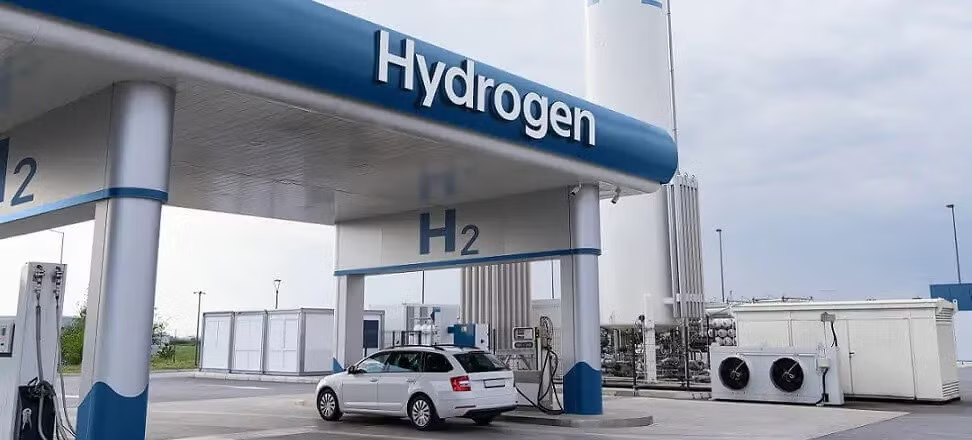
The most ambitious scenario, according to Pierre Levin, is to use geohydrogen to synthesize a form of artificial methane that could completely replace natural gas for industrial and heating purposes – a replacement on a scale of tens of millions of tons per year. That remains a distant prospect, but experiments underway underground in Quebec, Iowa, Kansas, Idaho, and Oregon are accumulating evidence daily.
Alexis Templeton, a professor of geochemistry at the University of Colorado Boulder who is researching hydrogen engineering in Oman—home to the world's largest ophiolite—summarizes: two years ago, all of this was highly theoretical; today, the question is no longer whether it's possible to produce hydrogen underground, but whether it can be done at a cost low enough to be competitive in the market.
That is precisely the question everyone in the mining industry is racing to answer.
Keywords:
Source: https://congluan.vn/hydro-tu-long-dat-cuoc-dua-tim-nhien-lieu-sach-duoi-chan-chung-ta-post347448.html





![[Photo] Standing Committee member of the Party Central Committee Tran Cam Tu working with the Central Inspection Committee](https://vphoto.vietnam.vn/thumb/1200x675/vietnam/resource/IMAGE/2026/05/28/1779969579668_ndo_br_bnd-2495-jpg.webp)
































































































Comment (0)