

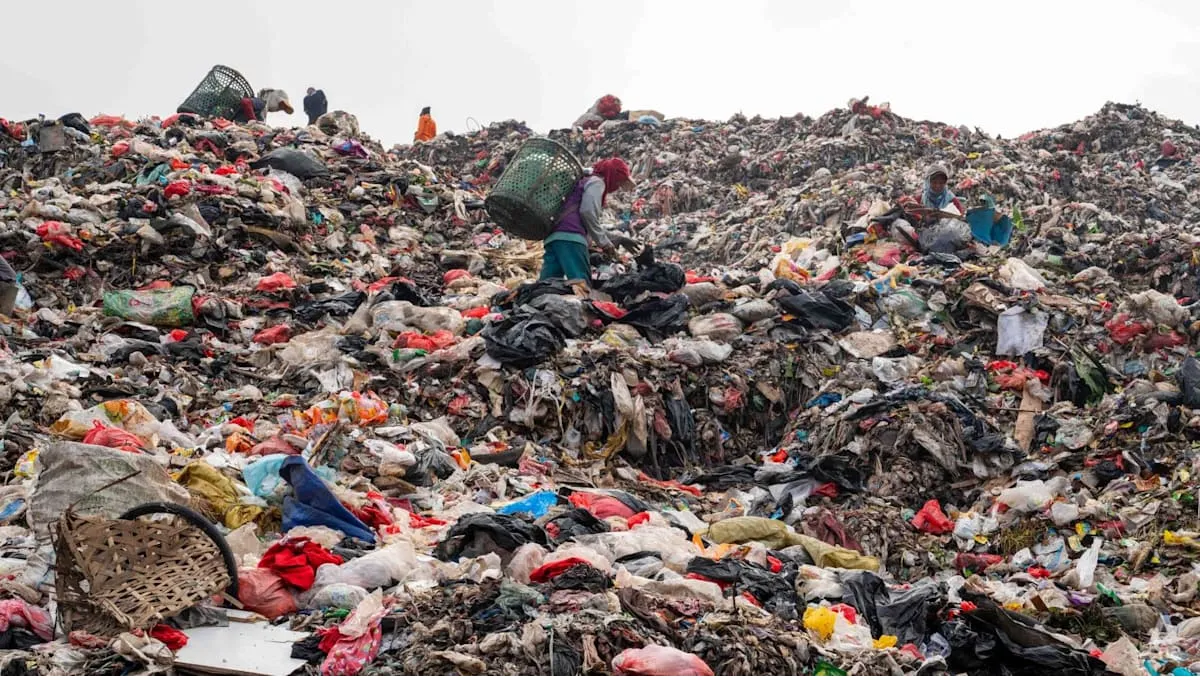
A view of the Bantargebang landfill. Photo: CNA
From April 1st, the Bali authorities are requiring residents to separate organic and inorganic waste, encouraging households and businesses to sort and process waste at source instead of sending it all to already overloaded landfills. The new regulation comes after Bali's waste problem caused serious consequences. Last September, the island suffered devastating floods, partly due to clogged drainage systems, resulting in 17 deaths.
Bali's environmental agency reports that by 2025, the island will generate approximately 3,400 tons of waste daily, but only 29% of it will be processed. Under new regulations, organic waste – which accounts for about 65% of Bali's waste – will no longer be transported to Suwung, the island's largest landfill, but must be composted or sent to recycling centers, while inorganic waste will be taken to a new landfill in the south.
What is happening in Bali is just one part of Indonesia's waste crisis. Environment Minister Hanif Faisol Nurofiq said Indonesia generates 56.6 million tons of waste annually. The Southeast Asian nation has 550 landfills, which are expected to reach maximum capacity by 2030 if no improvements are made.
According to Mr. Hanif, Indonesia's waste management rate is projected to reach nearly 25% by 2025, meaning that three-quarters of waste remains untreated and is often dumped in open landfills, rivers, or burned, causing environmental pollution.
To address this issue, President Prabowo Subianto declared waste management a national priority. The Indonesian leader emphasized that waste must be controlled within 2-3 years. As part of this effort, the Indonesian government is planning to launch five waste-to-energy projects in the cities of Denpasar, Bekasi, Bogor, Bandung, and Yogyakarta. Currently, Indonesia has two such plants in the cities of Surabaya and Solo.
“The program aims to reduce landfill waste by approximately 33,000 tons per day by 2029, equivalent to 22.5% of the total national waste. In the long term, it is expected to improve the quality of life for communities, encourage behavioral changes in waste management, and strengthen the role of regions in supporting the transition to a circular economy and sustainable development,” said Muhammad Qodari, former Chief of Staff to the President of Indonesia.
However, according to experts, the aforementioned projects are considered insufficient to solve Indonesia's waste problem, and the country needs to implement feasible solutions tailored to each region, such as Jakarta, which has a large population and numerous waste management issues. It is known that since May 10th, the Jakarta government has required residents to sort their waste and is planning to build a plant to produce fuel from waste.
For a long time, Jakarta's waste has been transported to Bantargebang, a 110-hectare landfill in Bekasi City and Indonesia's largest landfill. Each day, it receives 7,400-8,000 tons of Jakarta's waste, which is projected to generate 3.2 million tons in 2024. However, following the Bantargebang landslide on March 8th that killed seven people, the Indonesian government wants Bantargebang to stop accepting mixed waste before beginning to accept sorted waste (recyclable, recyclable, and biodegradable materials) starting August 1st.
Jakarta's waste problem is also evident in the Ciliwung River, which flows through central Jakarta. For a long time, this river has been clogged with household waste, plastic waste, and other pollutants, leading to frequent flooding.
TRI VAN (According to CNA)
Source: https://baocantho.com.vn/indonesia-vat-lon-voi-cuoc-khung-hoang-rac-thai-a206229.html


![[Photo] First session of the 14th Congress of the Vietnam Trade Union](https://vphoto.vietnam.vn/thumb/1200x675/vietnam/resource/IMAGE/2026/06/03/1780465947883_ndo_br_img-3852-jpg.webp)











































![[Video] Sunset at Lap An Lagoon – Where the sun sets over the fishing nets](https://vphoto.vietnam.vn/thumb/1200x675/vietnam/resource/IMAGE/2026/05/31/1780192137701_beach-landscape-sea-water-nature-grass-745871-pxhere-com.jpeg)


































Comment (0)