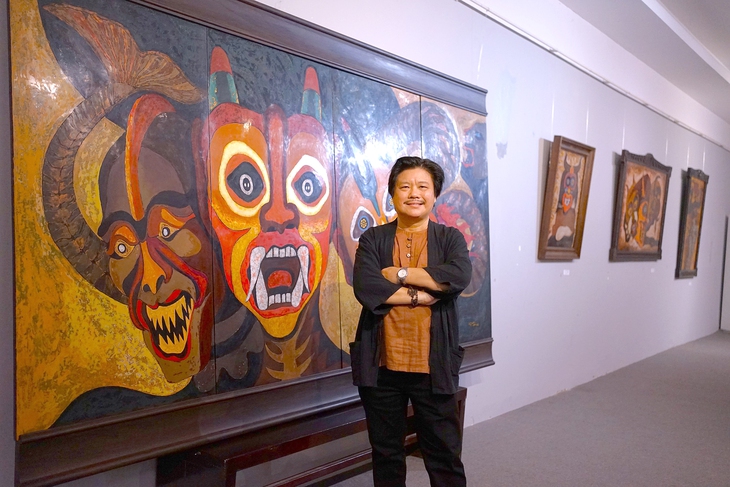
For Pham Quoc An, the image of the Co Tu mask may be crude and clumsy, but it embodies immense faith and spiritual value - Photo: H.VY
This is also his first solo exhibition after many years of fieldwork and research into the cultural and spiritual life of the Co Tu people in remote villages along the Truong Son mountain range.
The sacredness of the Co Tu culture came to Pham Quoc An as a special connection. After graduating from the Ho Chi Minh City University of Fine Arts, he had to temporarily put aside painting for 20 years to make a living. But his passion for lacquer painting and indigenous culture still burned brightly.
Around 2018, he resumed his field trips. Each trip lasted more than 10 days, from remote areas bordering Laos to Dong Giang (Quang Nam). Sometimes he traveled very far but only encountered a few villages that still preserved their original cultural values.
It was from such experiences that the sacredness of the Co Tu people gradually took shape through notes, sketches, and then refined into emotions, forming a unique drawing style. Instead of depicting the vast forests in the familiar way, Pham Quoc An went straight to symbols: masks, deities, the Gươl house (communal house), the core spiritual structures of the Co Tu people.
From a professional perspective, many believe that the remarkable aspect of Thiêng - Cơ Tu lies in the artist's handling of the material. Lacquer is inherently a magical and "fickle" medium, requiring rigorous technique and patience. However, Phạm Quốc Ân did not create lacquer in the familiar glossy style, but instead chose to maintain a rough, heavy, and multi-layered surface.
The layers of color, gold, lipstick, and eggshell are not for aesthetic purposes but rather represent the accumulation of memories. The technique of deep grinding, layering, and hand-polishing creates visual compression, drawing the viewer in the longer they look.
Associate Professor and artist Nguyen Van Minh commented that choosing lacquer to express this theme was a courageous and professional decision, because the material itself contributed to conveying the "sacred" not only through imagery but also through a physical sensation.
Curator Phan Trong Van assessed the exhibition as a serious experiment in restructuring indigenous symbolism using contemporary painting language. The exhibition also raises the straightforward question: when a sacred symbol is placed in a frame, does it retain its original energy or is it merely an image?
The answer lies in each person's very own experience when confronted with layers of paint that have been sanded down to the core. And that alone is a worthwhile experience.
"I paint what I understand, not what others see," Pham Quoc An emphasized. Perhaps that's why his paintings don't tell specific stories but evoke many emotions about the spiritual life of people, about cultural memories and values that are gradually and quietly disappearing.
And the Sacred - Co Tu culture serves as a gentle reminder that somewhere, beautiful cultural values still exist, needing to be seen and deserving of appreciation.
HUYNH VY
Source: https://tuoitre.vn/ke-chuyen-thieng-co-tu-20260410095940427.htm


![[Photo] Admire the coral "masterpiece" amidst the million-year-old heritage of Dak Lak province.](https://vphoto.vietnam.vn/thumb/1200x675/vietnam/resource/IMAGE/2026/05/30/1780107638639_y25-jpg.webp)

























































Comment (0)