

West Ham's tragedy doesn't lie in a failed season, but in the process of losing its identity. The team, once seen as a symbol of the working class and culture of East London, has become a club lost in the modern commercial model of football. The move from Upton Park to London Stadium was touted as a turning point that would transform West Ham into a major force in English football, but after almost a decade, all that remains is a sense of alienation.
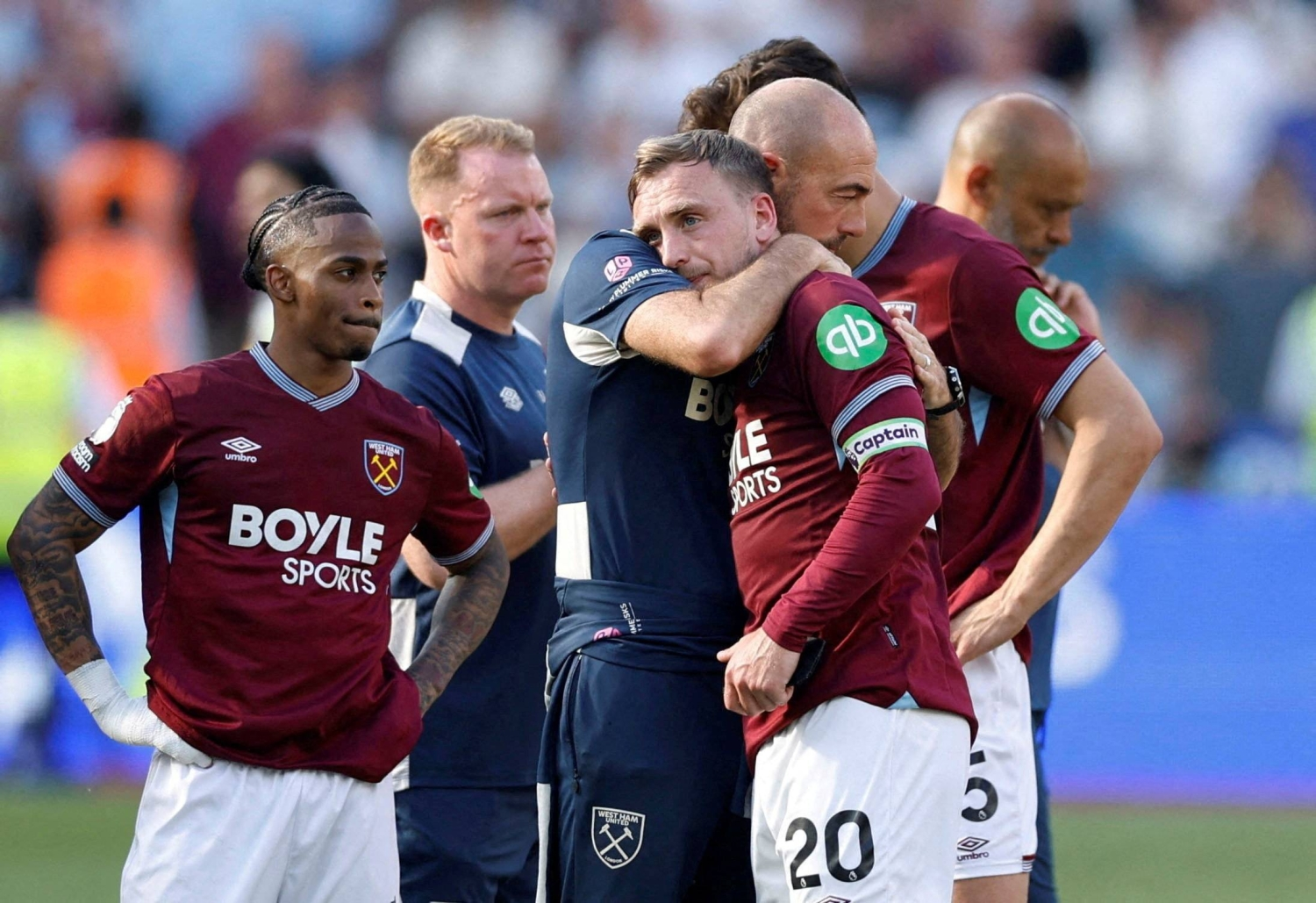 |
West Ham players encourage each other after the club's relegation. Photo: Reuters |
London Stadium never truly belonged to West Ham. The distance from the stands, the cold structure, and the lifeless atmosphere made it resemble a multi-purpose stadium more than a football home. But the stadium was only the surface; the biggest reason for West Ham's downfall lay in its weak management. For years, the leadership under David Sullivan consistently made decisions lacking clear direction. West Ham spent a lot of money, but their investments lacked strategy. They constantly changed managers, made scattered signings, lacked an effective scouting system, and failed to build a stable professional identity.
While mid-table Premier League clubs thrive thanks to modern management models, data-driven strategies, and long-term planning, West Ham continues to operate in an outdated, fragmented, and emotionally driven manner. They have been left behind in a race where modern football demands increasing professionalism. This decline is ultimately reflected in the league table. A team with so many quality players shouldn't be in the relegation zone. But when the team's structure is rotten from within, even the star players on the pitch can't save West Ham.
Following their relegation, West Ham are projected to suffer losses of around £100 million in their first season. Many club staff risk losing their jobs, wage cuts are inevitable, and a mass exodus of star players is a likely scenario. Ironically, under their 99-year lease agreement for London Stadium, if West Ham are relegated from the Premier League, the club's rent to the GLA will be drastically reduced. Currently, West Ham pay around £4.4 million annually in rent, but this figure will be almost halved if the team plays in the Championship. This means the financial shortfall will be covered by the London city government and taxpayers.
The most frightening thing for West Ham isn't losing money or star players, but losing themselves. A club that once prided itself on its identity and the passionate atmosphere of Upton Park is now seen as a failed example of half-hearted commercialization of football. When will we return to the days when West Ham fans could only weep as their team sank into despair?
Source: https://www.qdnd.vn/the-thao/quoc-te/ket-cuc-khong-the-tranh-khoi-1041248




![[Image] Close-up view of the interchange connecting the two expressways and Long Thanh Airport.](https://vphoto.vietnam.vn/thumb/1200x675/vietnam/resource/IMAGE/2026/05/25/1779703378210_ndo_br_z7863716673926-224453a31600126cce10622af6290afd-4549-jpg.webp)
![[Image] Hanoi's urban life under the challenge of a "scorching hot" environment](https://vphoto.vietnam.vn/thumb/1200x675/vietnam/resource/IMAGE/2026/05/25/1779706979265_nang-nong-t5-2026-minh-duy-7-4636-jpg.webp)



































































































Comment (0)