

This directive not only inherits previous solutions but also emphasizes the responsibility of leaders, while tightening enforcement discipline and enhancing the application of technology in fisheries management.
Effective control through the digitalization of fisheries.
A core requirement of Directive No. 34/CD-TTg is to build a fisheries database that is "accurate, complete, clean, and viable." Gia Lai province has concretized this through its efforts to improve its fleet management system on a digital platform in recent times.
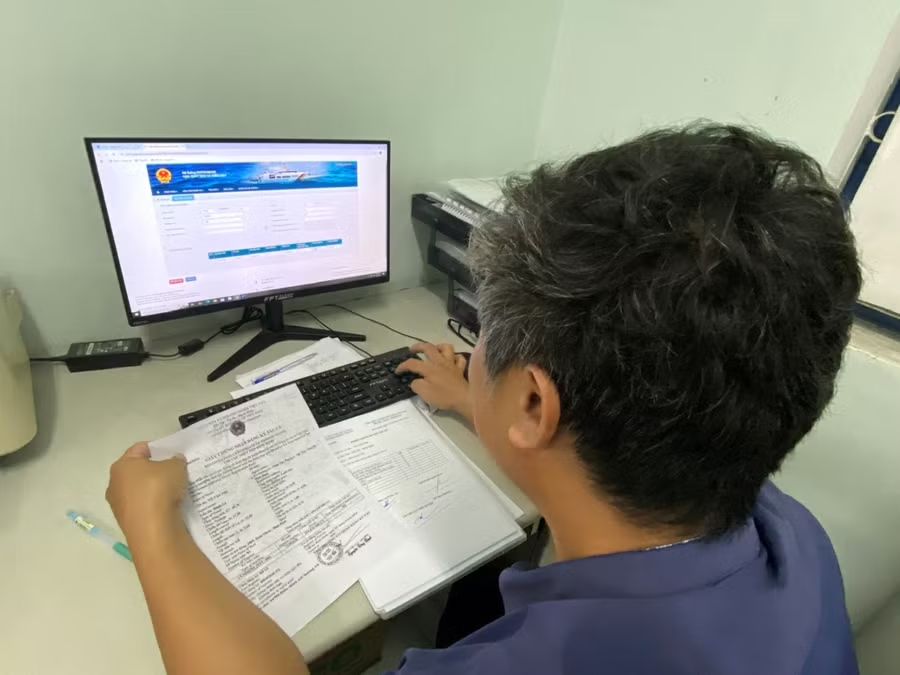
According to the Department of Agriculture and Environment, by the end of April 2026, the entire province had 5,765 registered fishing vessels 6 meters or longer, of which 3,158 were offshore fishing vessels (accounting for nearly 55%), 1,802 were inshore fishing vessels, and 805 were inshore fishing vessels.
It is noteworthy that all this data has been standardized and synchronized with Vietnam's Fisheries Database (VNFishbase) and the Population Database (VNeID). Accurate data is the "backbone" of the entire management system, from fishing licensing to voyage monitoring.
"Cleaning up" the data not only helps eliminate the "ghost ship" phenomenon but also lays the foundation for seafood traceability – a key requirement of the European Commission (EC).
Currently, 100% of the province's operating fishing vessels are licensed. In addition, electronic fishing logbooks have been implemented on 3,257 out of a total of 3,966 fishing vessels 12 meters or longer, gradually replacing manual record-keeping methods, reducing fraud, and increasing transparency.
Not stopping at digitalization, Gia Lai is also a pioneer in applying monitoring technology, being the first locality to install vessel tracking systems (VMS) for groups of vessels from 12m to under 15m with a high risk of violations. The policy of supporting 50% of the installation cost (maximum 10 million VND/device) has created motivation for fishermen to participate.
In particular, since the end of 2025, an automated warning system for vessels losing connection or crossing boundaries has been put into operation, helping to detect violations early and from a distance. This is a key factor in the province's gradual shift from "handling" to "preventing" violations.
Recommendations from practical experience
Along with modernizing management, Gia Lai has chosen a decisive approach in law enforcement. From 2024 to the present, 943 out of 943 fishing vessels violating VMS connection regulations have been detected and processed; of which, 513 cases were fined a total of more than 15.9 billion VND.
Serious violations, such as fishing beyond designated boundaries, are dealt with thoroughly. Notably, one case involving a fishing vessel seized by a foreign country resulted in prosecution with a sentence of up to 2 years and 6 months in prison. The consistent principle emphasized by the authorities is "no forbidden zones, no exceptions."
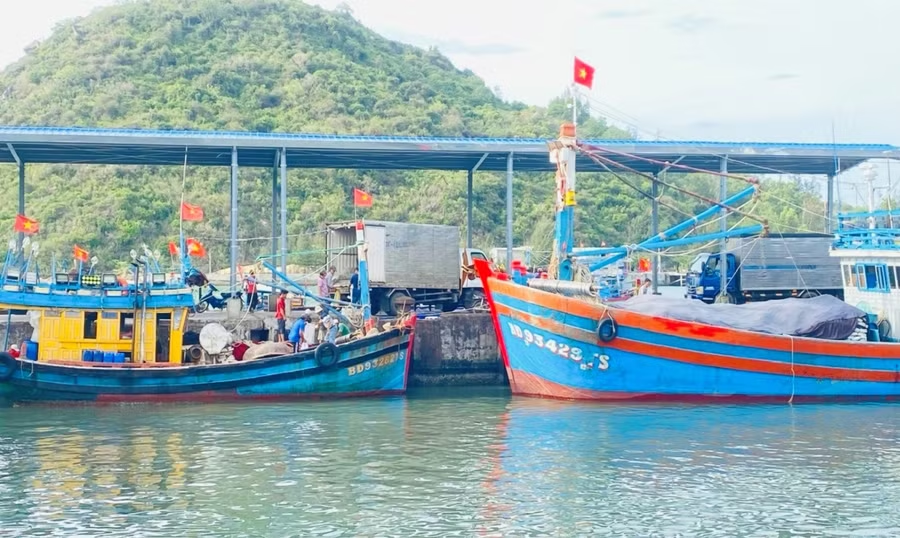
However, addressing violations is only part of the problem. To reduce pressure on fisheries resources, Gia Lai is strongly implementing policies to support the decommissioning of fishing vessels that do not meet operating requirements or are no longer needed, and to support the transition of livelihoods for fishermen.
Since the beginning of the year, more than 212 billion VND from the budget has been allocated to support over 800 fishing vessels registered for decommissioning and to help nearly 950 workers register for vocational retraining.
Furthermore, while awaiting the transition, fishermen will receive support of 3 million VND/boat/month and 30 kg of rice/person/month; this support will last for 7 months (from September 2025 to March 2026). This is not only an economic policy but also carries profound social significance, helping people confidently transition to a more sustainable livelihood.
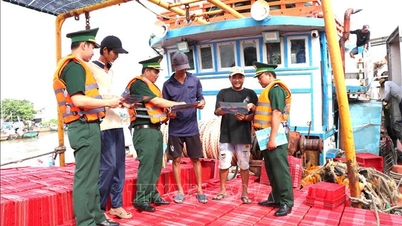
However, according to the Department of Agriculture and Environment, the province still faces many challenges. Notably, a number of fishing vessels operate outside the province's territory, anchoring in other provinces, making management difficult. To overcome this, the province has established inter-provincial task forces to coordinate control and resolutely prevent unqualified vessels from leaving port.
According to Mr. Cao Thanh Thuong, Director of the Department of Agriculture and Environment, based on this experience, the province has requested the Government to direct that any province that allows fishing vessels that do not meet the requirements for fishing operations to depart from port will be held responsible.
In addition, the province requested the Government to direct the Ministry of Agriculture and Environment to research and promote the integration and consolidation of management software into a common platform to improve the efficiency of state management, ensure data consistency and interoperability, and facilitate implementation by agencies, units, and individuals at the local level.
Mr. Cao Thanh Thuong believes that if the solutions are implemented synchronously in accordance with the spirit of Official Dispatch No. 34/CD-TTg, the goal of lifting the IUU "yellow card" in 2026 is entirely feasible.
Gia Lai province, in particular, is highly determined not only to meet the EC's requirements but also to build a transparent, responsible, and sustainable fisheries sector in the long term.
Source: https://baogialai.com.vn/khac-phuc-triet-de-ton-tai-han-che-trong-chong-khai-thac-iuu-post586284.html
![[Image] Pleasant weather helps students enter the 10th grade entrance exam with confidence.](https://vphoto.vietnam.vn/thumb/1200x675/vietnam/resource/IMAGE/2026/05/29/1780034401612_ngay-1-thi-lop-10-minh-duy-8-5009-jpg.webp)

![[Photo] Ba Lang An Lighthouse - the "eye of the sea" amidst the "rock museum" of Quang Ngai province.](https://vphoto.vietnam.vn/thumb/1200x675/vietnam/resource/IMAGE/2026/05/29/1780038698840_anh-man-hinh-2026-05-29-luc-14-10-42.png)
















































































Comment (0)