On the morning of May 25, 2023, at the Vietnam - Asia DX Summit 2023, themed "Leveraging Digital Data and Smart Connectivity to Drive Economic Growth," organized by the Vietnam Software and IT Services Association (VINASA), MISA presented a topic that garnered significant attention from delegates and media outlets regarding data connectivity and interoperability between businesses and government agencies.
The Vietnam - ASIA DX Summit 2023 program was attended by Deputy Prime Minister Tran Hong Ha, Deputy Minister of Information and Communications Phan Tam, Chairman of VINASA Nguyen Van Khoa, along with representatives from ministries, sectors, localities, and businesses.
Speaking at the event, Deputy Prime Minister Tran Hong Ha affirmed: “Digital transformation cannot be achieved by one person, one organization, or one country or government. Digital transformation requires the participation of everyone and every sector to create digital resources. Digital resources are more than just a ‘gold mine’; they are an inexhaustible source of thinking, creativity, and intelligence that the world has been and is currently developing and exploiting. They are a new, green resource that helps us restore natural resources and drive breakthrough economic development.”
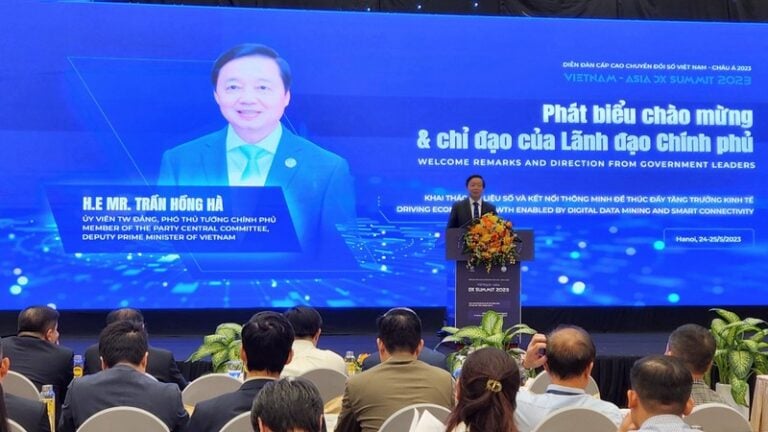
Deputy Prime Minister Tran Hong Ha delivered a keynote address at the Vietnam-Asia Digital Transformation High-Level Forum 2023.
During the opening session, MISA's Standing Deputy General Director, Le Hong Quang, shared insights on the importance and benefits of connecting and integrating data between businesses and government agencies. He then proposed solutions for connecting and leveraging data to deliver tangible value to the government, citizens, and businesses.
Building a database is a shared responsibility of both the government and businesses.
Accordingly, in practice today, when discussing the construction of a national database, the primary responsibility lies with the ministries and agencies in focusing on building data centers and databases. However, the most important part of a national database is the data itself. Some of this data is managed by state agencies, while others are proactively managed by organizations and businesses.
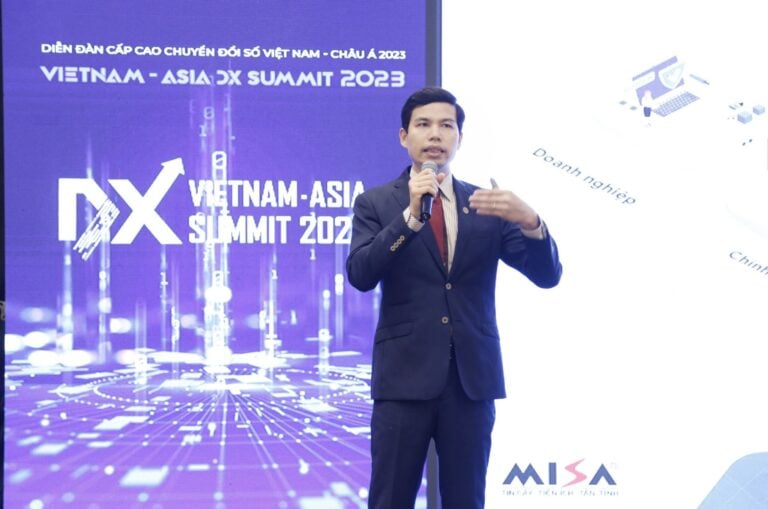
MISA's Standing Deputy General Director, Le Hong Quang, shared his views on the issue of connecting and integrating data between government agencies and businesses.
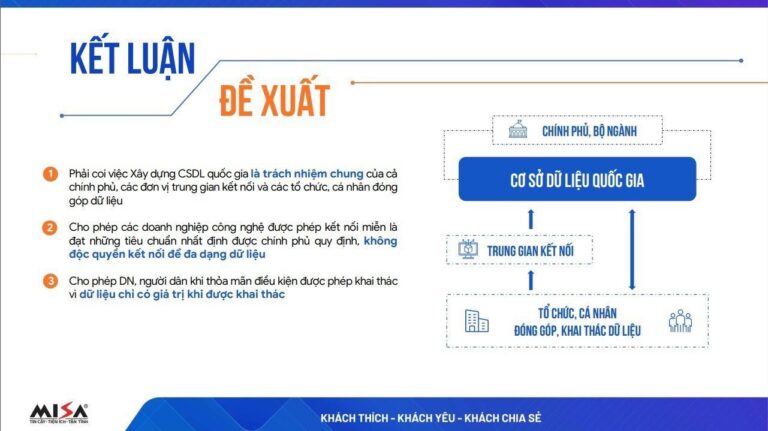
To obtain the most complete data, the collaboration of all three parties is needed: the database developer, the intermediary connecting entity, and the data contributor. Furthermore, all three entities must be interconnected.
For participating entities to connect and contribute data, diversity is also necessary to supplement the National Database with data collected from many fields, organizations, and units, in order to effectively utilize and serve the comprehensive digital transformation process across all three pillars: Digital Government, Digital Economy, and Digital Society.
Data is only truly valuable when it is exploited.
Analyzing the value of national databases, Mr. Le Hong Quang emphasized that data is only truly valuable when the government, citizens, and businesses can all access and benefit from it. In particular, if data is made open to businesses, it will lead to many useful services for citizens and government agencies.
For example, in the insurance industry, if there were a national traffic database, insurance companies would be allowed to access and check the history of vehicles and vehicle owners to see if they frequently get into accidents, and then determine appropriate insurance premiums.
For example, in the banking sector, with unsecured loans, without a financial database, all borrowers face equal opportunities and risks. However, with a financial database and bank access, banks can easily assess the borrowing history, financial transparency, and potential of each borrower. This allows them to determine which borrowers are suitable, approve loans faster, set appropriate loan limits, and reduce risk by filtering out those with a history of bad debt. For borrowers, the financial database serves as proof of financial transparency, minimizes paperwork and financial reporting, and makes it easier to receive a suitable loan from the bank more quickly.
The value of databases has been recognized and prioritized by many ministries and sectors, leading to their development and implementation. This allows businesses to connect and citizens to utilize the data to facilitate digital transformation in production, business, and operations.
For example, the General Department of Taxation has allowed electronic invoice providers to connect and provide services for receiving, transmitting, and storing electronic invoice data. The Ministry of Education and Training has also put into operation a database for the education sector to provide a database and information system for management in the sector. However, many connectivity needs of businesses remain unmet, and some databases are subject to exclusive access, causing difficulties for service providers and resulting in a less diverse and comprehensive database.
Proposal to connect, utilize, and share national databases between the State and businesses.
To contribute to improving this situation, MISA proposes that the Government, Ministries, and relevant agencies allow technology companies to connect to the National Database on the basis of ensuring criteria announced by the management agency, while also allowing businesses and citizens to contribute to and utilize data to effectively carry out production, business, operation, administrative procedures, and other areas related to daily life. In addition, it is necessary to avoid monopolies on data connection to ensure the National Database is rich and its value is maximized for government agencies, citizens, and businesses. 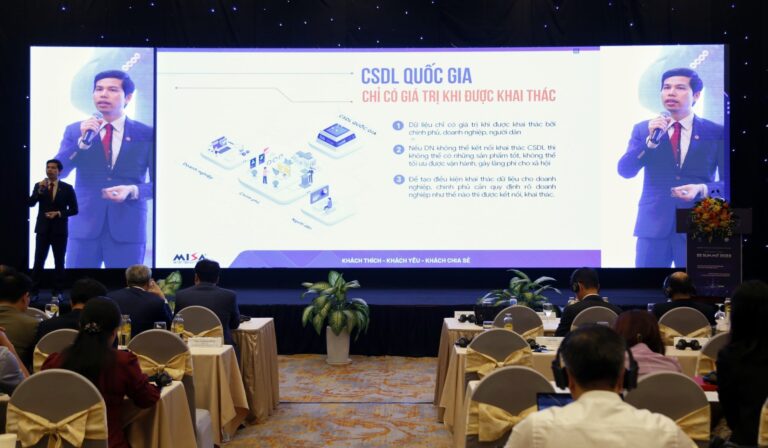
As an intermediary unit connecting individuals and organizations to contribute data to the National Database, MISA has developed several digital platforms that effectively support data connectivity between government agencies and organizations/businesses, such as: The MISA QLCB personnel management platform, which collaborated with the Department of Internal Affairs of Binh Thuan Province to complete the updating of personnel records for officials, civil servants, and public employees on the National Database.
With nearly 30 years of experience in the information technology field, MISA is ready to partner with and collaborate with government agencies, organizations, businesses, and citizens to build and utilize database systems to practically serve the digital transformation process. Properly built and utilized data will truly be a valuable resource, a "gold mine" that will drive the development of a strong and prosperous Vietnam.
PV



















![[Video] Sunset at Lap An Lagoon – Where the sun sets over the fishing nets](https://vphoto.vietnam.vn/thumb/340x192/vietnam/resource/IMAGE/2026/05/31/1780192137701_beach-landscape-sea-water-nature-grass-745871-pxhere-com.jpeg)






![[Photo] The General Secretary, President and his wife lay flowers at the Ho Chi Minh Monument in Manila.](https://vphoto.vietnam.vn/thumb/1200x675/vietnam/resource/IMAGE/2026/05/31/1780219759477_anh-man-hinh-2026-05-31-luc-16-29-07.png)










































































Comment (0)