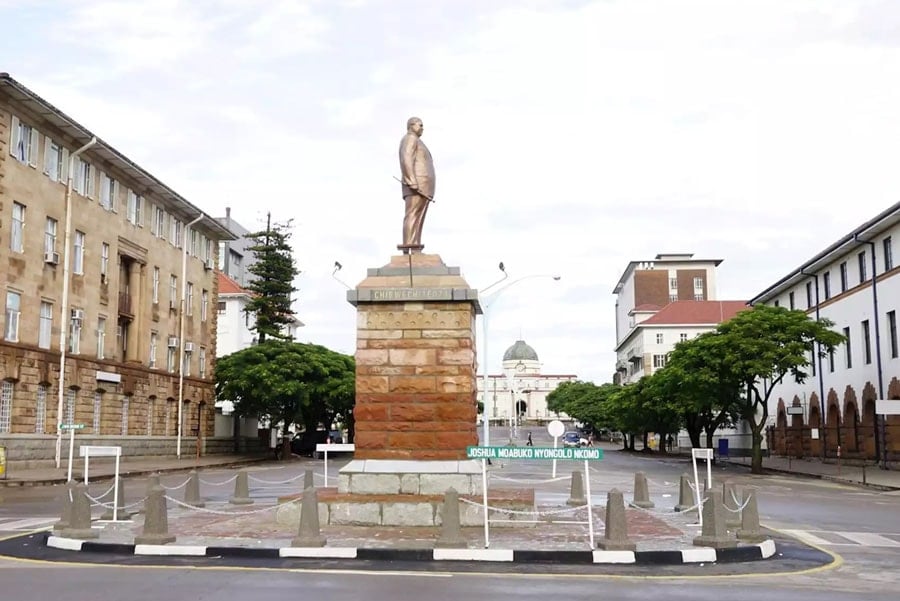
Bulawayo is Zimbabwe's second-largest city and industrial center, yet it retains much of its old-world charm. Many visitors strolling through Bulawayo feel as if they've stepped back in time, captivated by rows of centuries-old buildings. Spend an afternoon simply wandering around Bulawayo and chatting with the locals (most city dwellers speak English). Begin your journey from the central square, where a monument to the revolutionary and former Vice President of Zimbabwe, Joshua Nkomo, stands.
The headquarters of the Zimbabwe National Railways Company is located in Bulawayo, and a must-see destination in the city is the Zimbabwe Railway Museum. It houses many unique locomotives, some over 100 years old. Furthermore, an entire old railway station in Shamva (northeast Zimbabwe) has been dismantled and relocated to the museum for display. Visitors can purchase tickets for a vintage train ride around the museum to experience what it's like to ride a train from the early 20th century.
The second museum worth visiting in Bulawayo is the Zimbabwe Natural History Museum. Zimbabwe is one of the "cradles" of humankind, and its Natural History Museum currently houses many artifacts related to the life of early prehistoric humans. The late Prime Minister of the Cape Colonial (now South Africa), Cecil Rhodes, who founded Rhodesia (Zimbabwe and Zambia under British colonial rule), also left a collection of rare animal specimens to the Natural History Museum.
During Cecil Rhodes' lifetime, he and many other Rhodesian leaders frequented the Bulawayo Club. This building now serves as a hotel, bar, and mini-museum. If visitors are unfamiliar with the gentlemen's clubs that were so popular in 19th-century Europe, they should consider staying at the Bulawayo Club. The service quality here is on par with four-star hotels, and guests can learn about the life of the British upper class in the colonial region.
Bulawayo flavor
Even before Bulawayo underwent industrialization, it was renowned for its blacksmithing. Bulawayo blacksmiths could forge surprisingly sharp knives from a rusty railway sleeper. Customers from all over the country and even from South Africa came to Bulawayo to buy cutlery. Foreign tourists who were hesitant to bring sharp objects on airplanes could find nail clippers, cups, or small iron toys instead.
Zimbabwean cuisine is family-oriented. If you're looking for delicious food in Bulawayo, head to the local eateries. Some traditional dishes include sadza (boiled cornmeal served with a meat and vegetable side dish), muriwo (stir-fried kale, collard greens, or collard greens with onions, tomatoes, and chili powder), and muguru (grilled beef or goat offal). You also shouldn't miss the chance to try chibuku beer. This craft beer is famous throughout Zimbabwe for its unique sour taste, thanks to the sorghum and cornmeal used in its production. Chibuku beer is sold in 1-liter cartons, similar to milk cartons, and you have to shake the carton before pouring.
The Bulawayo Arts Festival is held annually from June 2nd to 5th. Many of Zimbabwe's major universities are located in Bulawayo, and the Arts Festival provides a great opportunity for young artists to showcase their talents. In recent years, the festival has also attracted many artists and folk artists from neighboring regions. The indigenous Ndebele people are renowned for their painting and epic storytelling. Visitors will find Ndebele painters and storytellers performing on the streets during the festival.
If visitors wish to learn more about the history of the indigenous people, they should visit the Khami archaeological site, located more than half an hour's drive from Bulawayo. It is a UNESCO World Heritage site. Khami was the capital of the Butua kingdom (1450-1683) and one of the largest pre-colonial cities in Zimbabwe. Few places in southern Africa boast such a wealth of sturdy stone structures and walls from that period. It was abandoned after the fall of the Butua kingdom and the subsequent nomadic lifestyle. However, religious ceremonies continued at Khami until the late 19th century.
Source: https://hanoimoi.vn/kham-pha-thanh-pho-bulawayo-687478.html


![[Photo] National Assembly Chairman Tran Thanh Man working with the Standing Committee of the National Assembly's Delegation Affairs Committee.](https://vphoto.vietnam.vn/thumb/1200x675/vietnam/resource/IMAGE/2026/05/20/1779294340023_ndo_br_1-1691-jpg.webp)
![[Image] "Journey of Hope" promotes the organ and tissue donation movement in Vietnam.](https://vphoto.vietnam.vn/thumb/1200x675/vietnam/resource/IMAGE/2026/05/20/1779294400833_1-8910-jpg.webp)
![[Photo] General Secretary and President To Lam works with the Party Committee of the Ministry of Health on the work of Vietnamese traditional medicine.](https://vphoto.vietnam.vn/thumb/1200x675/vietnam/resource/IMAGE/2026/05/20/1779294323718_a1-bnd-2978-3319-jpg.webp)



















































Comment (0)