

 |
| Officials from Team 4, Thuy Xuan Ward, are cross-referencing and updating population data to support local management. |
Proactive review starting from the grassroots level.
Following the Prime Minister's Directive No. 21/CT-TTg on the reorganization of villages and residential areas, along with implementing documents from the Hue City People's Committee, localities in the area are urgently reviewing population data, infrastructure, and specific factors to prepare plans that are appropriate to the reality, avoiding being caught off guard when officially implementing the plan.
Following the reorganization of administrative units and the implementation of a two-tiered local government model, Hue City now has 40 commune-level administrative units with 1,105 villages and residential areas. Many of these mountainous areas and ethnic minority regions still possess unique characteristics in terms of population, topography, and community living habits.
According to the guidelines of the Department of Interior Affairs, localities must conduct a comprehensive review of household size, population, mass organizations, non-professional personnel, and facilities serving community activities in order to develop plans that are appropriate to the reality of each area.
The proposed household size criteria for Hue City are villages with 350 or more households and residential areas with 450 or more households. For areas that do not meet the standards but have unique characteristics, the local authorities must clearly state the reasons for proposing to maintain the current status.
In Hoa Chau ward, the local authorities have proactively conducted a review of the current situation of residential areas to prepare data for the development of the project once official guidelines are issued. According to the plan of the ward's People's Committee, the review will focus on population size, number of households, transportation infrastructure, cultural institutions, religious establishments, and the number of part-time community workers in each residential area.
According to preliminary statistics, Hoa Chau ward currently has 23 residential areas with approximately 9,670 households and over 41,300 inhabitants. There is a significant difference in population size among the residential areas; for example, Thuan Hoa residential area has 740 households with over 3,200 inhabitants, Van Quat Dong has 717 households with over 3,300 inhabitants; while some other residential areas have only about 200-300 households. Many places implement a model where the Party branch secretary also serves as the residential area leader or the head of the Fatherland Front working committee to streamline the organizational structure at the grassroots level.
Local authorities are also reviewing the system of religious establishments and community cultural institutions to facilitate research into suitable plans tailored to the characteristics of each residential area. According to Phan Trong Nghia, Chairman of the Hoa Chau Ward People's Committee, the current review primarily aims to prepare initial data to enable the locality to proactively develop plans later, while also ensuring that implementation will be appropriate to the practical realities of each residential area.
 |
| Updating and verifying resident information in Group 4, Thuy Xuan Ward. |
Ensure suitability to the specific characteristics of each locality.
In A Lưới 1 commune, initial surveys indicate 19 villages with 3,439 households and approximately 12,560 inhabitants; the area covers nearly 198.65 km², with an unevenly distributed population, mainly consisting of ethnic minorities.
Many villages are small in scale, such as Dut 2 village with only 58 households, Ke 1 village with 78 households, Par Ay village with 110 households, and Ta Lo A Ho village with 120 households. Meanwhile, some areas are adjacent to each other, with similar community living conditions, customs, and socio-economic development, so the local authorities are studying the possibility of streamlining management structures.
According to Nguyen Van Hai, Chairman of the People's Committee of A Luoi 1 commune: To proactively manage the reorganization of villages and residential areas, before the issuance of Prime Minister 's Directive No. 21 and the new guidelines from the Department of Interior Affairs, the locality had proactively reviewed the current population situation, household size, infrastructure conditions, and studied initial reorganization options for small villages and adjacent areas. However, due to the commune's unique characteristics such as a large mountainous area, scattered population, many isolated areas, and concentrated ethnic minority communities with their own customs and community life, the development of the official plan requires further guidance from the central government and the city to ensure it is appropriate to the reality and minimizes disruption to the people.
According to Deputy Director of the Department of Internal Affairs Tran Minh Long, before Directive No. 21/CT-TTg was issued, many localities in the city had proactively conducted a preliminary review of the number of villages, residential areas, and non-professional personnel at the grassroots level to prepare initial data and avoid being caught off guard when implementing the restructuring policy.
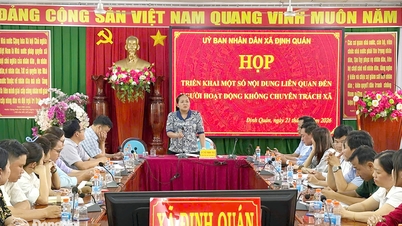
Following the issuance of Prime Minister's Directive No. 21 and the implementation document from the City People's Committee, on the afternoon of May 26th, the Department of Internal Affairs continued to issue a specific guidance document for communes and wards to review and assess the current situation and report on the plan for rearranging villages and residential areas according to the criteria and conditions projected by the Central Government.
Based on aggregated data from localities, the Department of Internal Affairs will advise the City People's Committee on developing a comprehensive plan to further adjust and refine it once the Central Government issues official guidelines and related specific regulations.
The reorganization of villages and residential areas needs to ensure suitability to the characteristics of each locality, harmonizing the requirement for streamlined administrative apparatus with historical, cultural, and community living factors. Therefore, proactive early review by localities will help in developing realistic plans and creating consensus during implementation.
Source: https://huengaynay.vn/chinh-polit-xa-hoi/khan-truong-ra-soat-phuong-an-sap-xep-thon-to-dan-pho-166090.html




![[Image] Nearly 125,000 Hanoi students completed the Literature exam for the 10th grade entrance exam.](https://vphoto.vietnam.vn/thumb/1200x675/vietnam/resource/IMAGE/2026/05/30/1780117233041_ndo_br_thiet-ke-chua-co-ten-2-png.webp)






















![[Photo] Admire the coral "masterpiece" amidst the million-year-old heritage of Dak Lak province.](https://vphoto.vietnam.vn/thumb/1200x675/vietnam/resource/IMAGE/2026/05/30/1780107638639_y25-jpg.webp)



































































Comment (0)