- Farmers begin planting rice on land previously used for shrimp farming.
- The OS20 rice variety opens new avenues for farmers.
- Support farmers in drying and storing rice while waiting for prices to recover.
The entire province has sown over 90,000 hectares of rice-shrimp farming, concentrated in the communes of Nguyen Phich, Thoi Binh, Bien Bach, Tri Phai, Vinh Phuoc, Ninh Thanh Loi, Loc Ninh, Phong Hiep, etc. Sowing began in early September, mainly with high-quality rice varieties such as ST24 and ST25. According to farmers, thanks to favorable weather, the rice crops are developing well, raising hopes for a bountiful harvest.
Favorable weather, farmers are delighted.
For the past few years, Mr. Dinh Van Trieu (Hamlet 4, Nguyen Phich Commune) has been committed to the model of one rice crop followed by one shrimp crop. With guidance from agricultural experts on techniques for desalination and selecting suitable seeds, his rice fields have now been sown, and the rice plants are growing healthily.
 Thanks to favorable weather conditions, the rice crops in Nguyen Phich commune are developing well.
Mr. Trieu shared: "This year the rain came early and there was more rainfall than in previous years, so the leaching of salt at the beginning of the season was favorable. Previously, farmers only transplanted seedlings, but now they have switched to sowing, and the yield is not inferior, but the costs are reduced, everyone is happy."
Similarly, Mr. Phan Van Biet (from Hamlet 4) has been sowing his seeds for over 10 days with the ST25 variety – a rice variety recommended by the agricultural sector for this year's rice-shrimp farming season . He said: “Initially, I intended to sow OM18 or Dai Thom, but after hearing the recommendation, I chose the ST variety. I also planted it last season, and the rice grew well and is suitable for the local soil.”
According to local people, rice cultivation not only brings high yields but also improves the soil, supporting more efficient shrimp farming, thus the area of rice-shrimp farming in Nguyen Phich commune has continuously increased. This year alone, Nguyen Phich commune has sown more than 4,900 hectares of rice-shrimp, promising a successful harvest.
 According to local farmers, the salt-washing process plays a crucial role in rice-shrimp farming.
Mr. Pham Thanh Phuong, Chairman of the Commune People's Committee, said: "To date, the entire commune has planted over 3,200 hectares, reaching 65% of the plan. The remaining area is being urgently cultivated to ensure completion before September 30th."
Expectations for a golden harvest
These days, the people of Bien Bach commune are in the peak season for rice-shrimp farming. Unlike Nguyen Phich commune, the people here still maintain the long-standing tradition of scattering rice seedlings. Accordingly, around the end of June in the lunar calendar, they sow rice seedlings on the embankments, and after 20 days, they pull them up, plant them for a few nights until the roots turn white, and then scatter them in the rice fields.
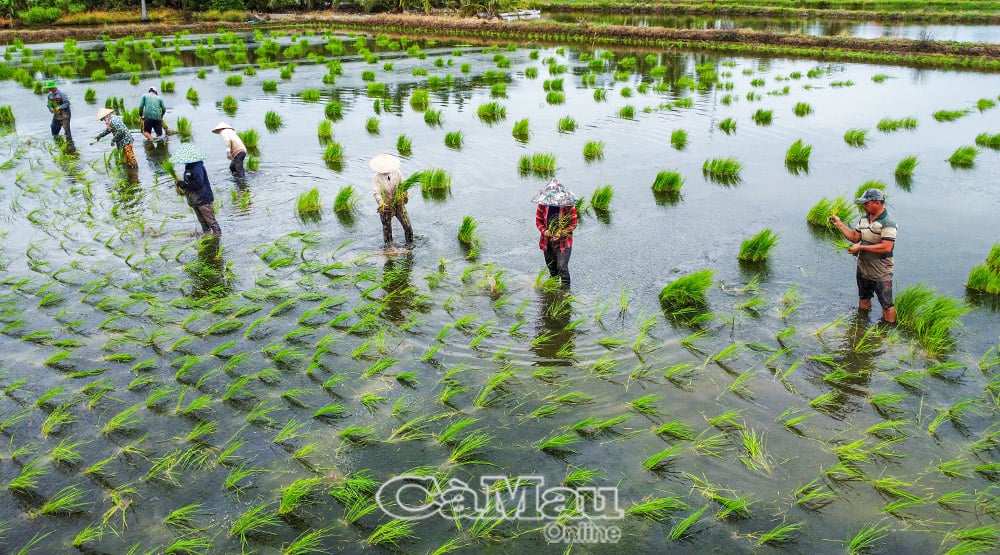 The method of broadcasting rice seedlings brings high productivity to farmers in the rice-shrimp farming area of Bien Bach commune.
Ms. Chau Le Huyen (Hamlet 6) said that this method is both easy and fast, and helps increase productivity by about 1 ton/ha: "The seedlings don't root deeply, so they are less affected by saline soil, and the rice plants grow faster."
Living in the same hamlet, Mr. Luu Phuong Tinh shared his experience of over 10 years: "The most important step is washing away the salt. If it's not done carefully, the rice will die when there's too much sun. This year, the rain came early, which is favorable for the farmers' production, and everyone is hoping for a bountiful harvest."
However, the planting progress throughout the province is behind schedule. As of September 20th, only over 14,500 out of 90,266 hectares have been sown. If the rain ends early, many communes such as U Minh, Nguyen Phich, Tran Van Thoi, Khanh Binh, Tan Loc, Tri Phai… risk a shortage of freshwater at the end of the season, making them vulnerable to saltwater intrusion.
Mr. Nguyen Tran Thuc, Head of the Provincial Department of Crop Production and Plant Protection, advised: “Farmers should choose high-quality varieties such as ST24 and ST25 to replace traditional varieties; adhere to the planting schedule and strive to complete sowing before September 30th. At the same time, specialized units must closely monitor the fields, provide technical support, manage water resources, and promptly handle diseases to ensure a successful harvest.”
Hong Nghi - Tien Luan
Source: https://baocamau.vn/khan-truong-xuong-giong-vu-lua-tom-a122656.html



![[Photo] General Secretary and President To Lam presides over a working session with the Central Policy and Strategy Committee on the development of the materials industry.](https://vphoto.vietnam.vn/thumb/1200x675/vietnam/resource/IMAGE/2026/05/21/1779359935432_a3-bnd-3129-1412-jpg.webp)








































































Comment (0)