

- Accelerate projects on the strategically important island of Hon Khoai.
- Ca Mau - The aspiration to "build a great nation with the blue sea"
- Ca Mau aims to become a major maritime economic growth hub in the South.
The People's Committee of Ca Mau province recently collaborated with Ba Ria - Vung Tau University to organize a workshop titled "Developing the marine economy and resources for the marine economy of Ca Mau province in the period 2026-2045," with the participation of many domestic and international experts.
The consensus at the workshop was that Ca Mau needs to transform its development model towards a green and sustainable direction, linked to modern logistics, renewable energy, and a large-scale seaport infrastructure system.
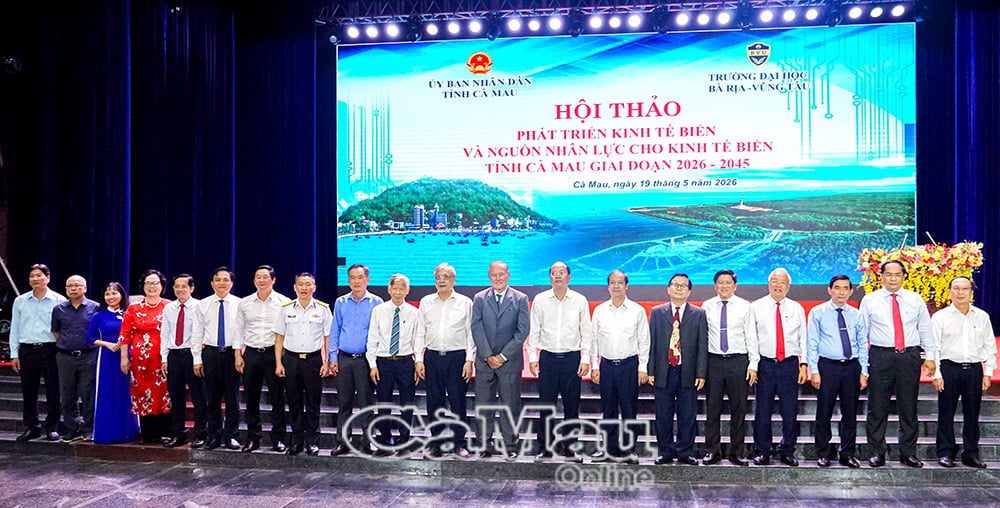 The participation of experts brought many new perspectives to the development orientation of logistics, energy, and the marine economy of Ca Mau. In the photo: Leaders of Ca Mau province pose for a commemorative photo with experts at the workshop on the development of Ca Mau's marine economy, on the morning of May 19th.
"Green and blue deltas" for the future of Ca Mau.
From an international perspective, Professor Robert Winston Taylor, Department of Earth and Environmental Studies, Montclair State University (USA), argues that Ca Mau needs to place marine economic development in close connection with climate change adaptation , rather than viewing them as two separate goals or having to choose between them.
According to him, the "green delta - blue delta" principle needs to be integrated throughout development planning, from port infrastructure, logistics, industry to aquaculture and water resource management.
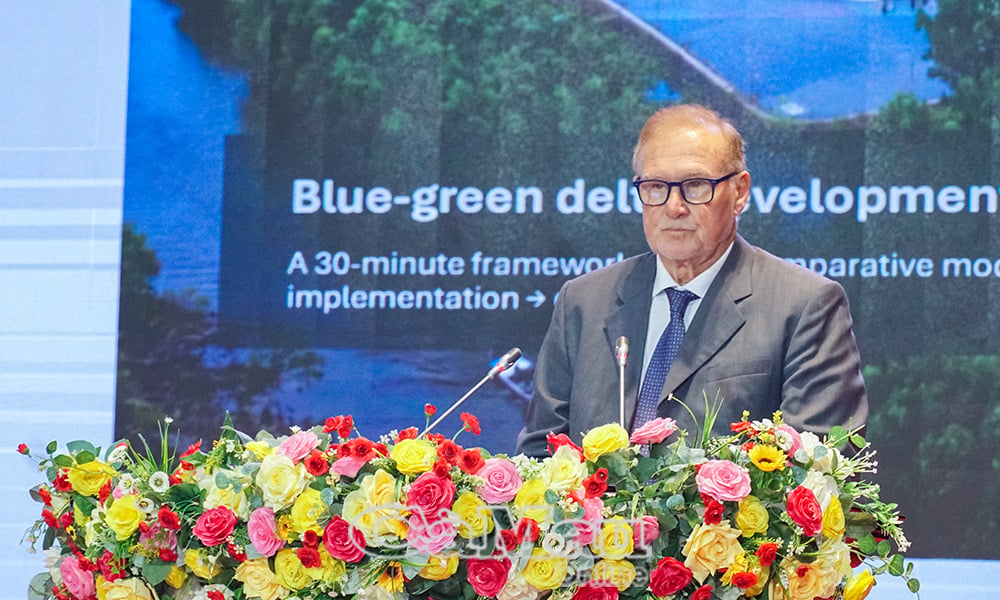 Professor Robert Winston Taylor proposed a "green-blue delta" model linked to climate change adaptation.
Professor Robert Winston Taylor noted that, with its vast mangrove ecosystem and economy heavily reliant on fisheries and maritime logistics, Ca Mau has the opportunity to become an important maritime economic center in the region. However, the locality also faces many risks due to climate change such as sea level rise, land subsidence, saltwater intrusion, and depletion of freshwater resources.
He proposed that development planning should prioritize protecting natural buffer zones, controlling groundwater exploitation, and limiting the concrete expansion of the delta area. Mangrove forests should be viewed as a form of "strategic production infrastructure"; in which, the shrimp-mangrove model is considered a typical approach, combining ecological conservation, ensuring sustainable livelihoods, and building a green export brand.
"Green logistics models, eco-industrial parks, circular economy, and green finance are important drivers for Ca Mau to transform its growth model towards sustainability," suggested Professor Robert Winston Taylor.
Hon Khoai Island - a strategic logistics link
From the perspective of logistics and maritime infrastructure, Mr. Bui Van Quy, Deputy General Director of Saigon Newport Corporation and Deputy Commander of Brigade 20, believes that Hon Khoai holds a strategic position in the international maritime transport network, situated on shipping routes connecting the Middle East, Northeast Asia, and the ASEAN-Australia region.
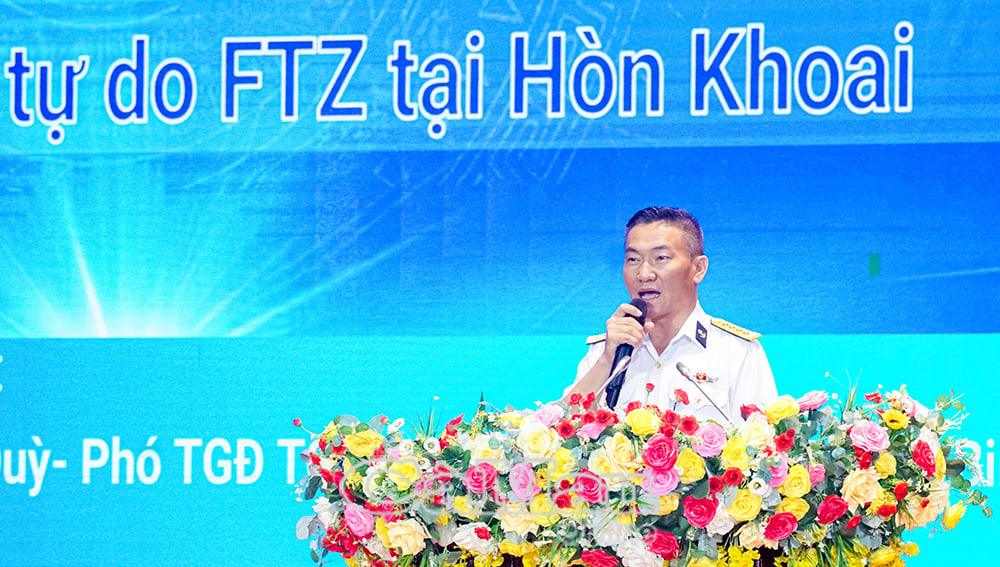 Mr. Bui Van Quy, Deputy General Director of Saigon Newport Corporation and Deputy Commander of Brigade 20, analyzed the potential for developing Hon Khoai into a logistics and energy center.
According to his analysis, the outstanding advantage of Hon Khoai is its natural condition with a large channel depth, capable of receiving large cargo ships without dredging. This is a distinct advantage that helps reduce investment and operating costs and creates a foundation for the development of a deep-water port on a regional and international scale.
Based on that foundation, Hon Khoai is oriented towards developing into an integrated logistics and industrial ecosystem, including an international transit center, a free trade zone, a cluster of supporting industries, multimodal logistics, and LNG energy.
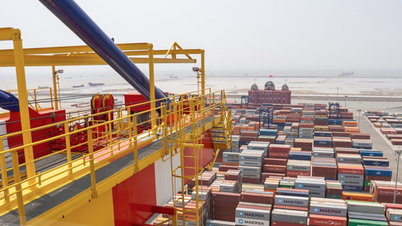
 The Hon Khoai dual-use integrated port is planned as a deep-water port combining logistics, energy, and large-scale marine industries.
In particular, the dual-use port model is considered a suitable solution, allowing for the combined handling of containers, oversized and overweight cargo, and energy products within the same infrastructure system.
According to the plan for 2040, Hon Khoai is expected to become an important logistics and energy hub in the region, deeply involved in the global goods and energy supply chain.
 The dual-industrial ecosystem associated with the Hon Khoai dual-use general port is expected to become a new driving force for development in the inland region.
Place the marine economy within an integrated "development ecosystem" structure.
From an overall perspective, Dr. Nguyen Van Anh, Deputy Head of the Department of Marine Economics - Logistics, Ba Ria - Vung Tau University, shared a comprehensive and systematic approach to the development of marine logistics economy in the context of the new transformation of the Mekong Delta, especially Ca Mau. The key focus emphasized is placing the marine economy within an integrated "development ecosystem" structure, where infrastructure, institutions, businesses, and education operate in an organic relationship, rather than existing separately as individual components.
This approach aligns with the trend of shifting the growth model from resource exploitation to knowledge-based development, technology, and deep participation in global value chains. Within this structure, logistics is identified as a key "soft infrastructure" crucial to regional competitiveness, not limited to transportation and warehousing, but encompassing the entire supply chain, directly linked to export activities, processing industries, and the level of international economic integration.
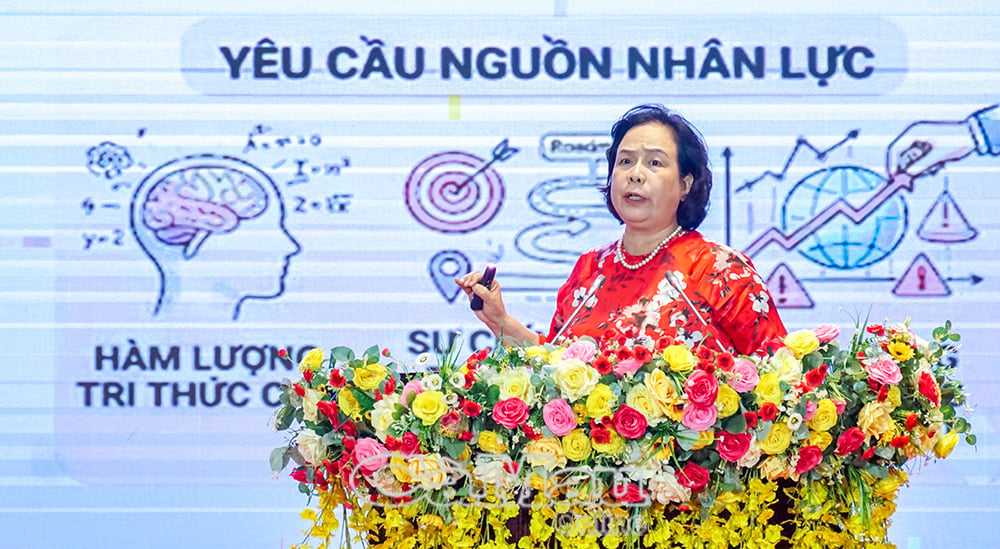 Dr. Nguyen Van Anh, Deputy Head of the Department of Marine Economics - Logistics, Ba Ria - Vung Tau University, shared her insights on ecosystem thinking in the development of marine economy and logistics.
From this approach, the human resource requirements also change significantly, demanding not only professional skills but also systems thinking, digital capabilities, data analysis skills, and the ability to adapt to international standards in modern supply chain management.
Dr. Nguyen Van Anh noted that Ca Mau possesses many advantages in terms of geographical location, fisheries, renewable energy, and the potential for developing cold chain logistics. However, the major current "bottlenecks" are inter-regional connectivity infrastructure and the quality of human resources – two factors that determine the ability to transform natural advantages into sustainable competitive advantages in the long term.
Creating a "connection" for development.
Experts at the workshop agreed that the development of Ca Mau's marine economy needs to be linked to a transformation of the growth model towards integration and sustainability.
In this context, logistics is not just about transportation or warehousing, but also about "soft infrastructure" that connects the entire value chain from production and processing to export.
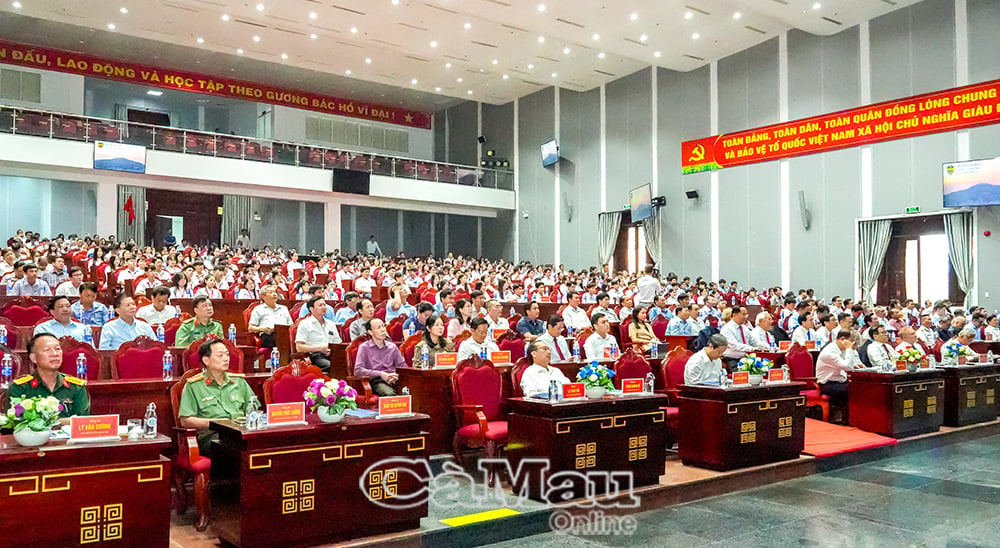 Delegates attending the workshop "Developing the marine economy and resources for the marine economy of Ca Mau province in the period 2026-2045".
According to experts, to overcome the two major bottlenecks of inter-regional connectivity infrastructure and the quality of human resources, there needs to be synchronization between infrastructure investment, the improvement of specific mechanisms, and the development of a training and research ecosystem linked to practical applications.
Notably, the model of linkage between the State, schools, businesses, and professional associations is considered a crucial solution for developing high-quality human resources to serve the development of the marine economy. However, experts believe that to achieve long-term effectiveness, these linkage mechanisms need to be institutionalized comprehensively and sustainably, instead of remaining limited to short-term cooperation agreements.
Hong Phuong
Source: https://baocamau.vn/kinh-te-bien-ca-mau-duoi-goc-nhin-chien-luoc-a128978.html

![[Image] Hanoi's urban life under the challenge of a "scorching hot" environment](https://vphoto.vietnam.vn/thumb/1200x675/vietnam/resource/IMAGE/2026/05/25/1779706979265_nang-nong-t5-2026-minh-duy-7-4636-jpg.webp)


![[Image] Close-up view of the interchange connecting the two expressways and Long Thanh Airport.](https://vphoto.vietnam.vn/thumb/1200x675/vietnam/resource/IMAGE/2026/05/25/1779703378210_ndo_br_z7863716673926-224453a31600126cce10622af6290afd-4549-jpg.webp)






































































Comment (0)