

What does being honored with the Golden Globe Science and Technology Award 2025 and the title of Promising Young Vietnamese of 2025 mean to you, both in your scientific research journey and your responsibility to contribute to the Vietnamese scientific community?
I was quite surprised to receive the Golden Globe Science and Technology Award 2025 and be honored as one of the nine promising young Vietnamese, because I always thought I wasn't yet a "star" compared to many outstanding colleagues both domestically and internationally.
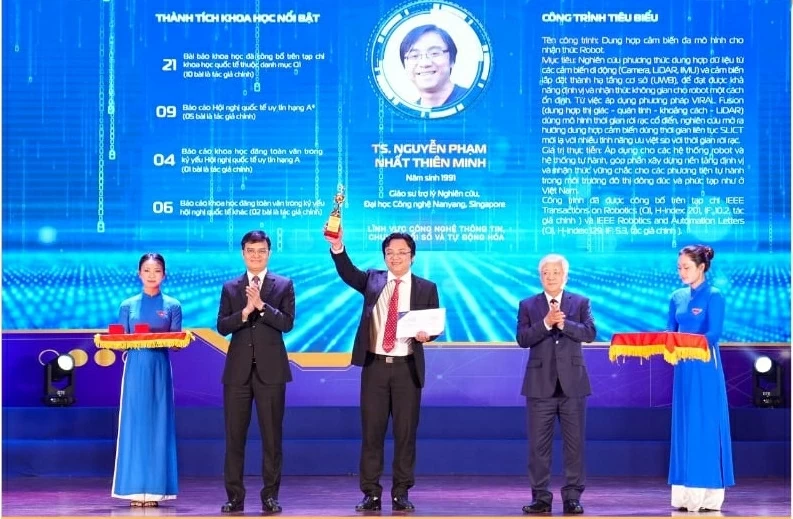 |
| Dr. Nguyen Pham Nhat Thien Minh received the Golden Globe Award for Science and Technology in 2025. (Photo courtesy of the interviewee) |
I would like to express my sincere gratitude to the Liaison Committee of Vietnamese People in Singapore, the Vietnamese Embassy in Singapore, and the Center for Science, Technology and Young Talent Development for introducing me to the Central Committee of the Youth Union.
Being honored in these two programs is a great source of pride, giving me the opportunity to represent the field of robotics and automation – one of the strategic technologies. I hope this field will receive more attention, investment, and attract more research personnel.
The recognition I've received domestically has made me more aware of my responsibility to contribute to the Vietnamese scientific and technical community. I hope to actively participate in exchange and collaborative research activities with colleagues and students in Vietnam. If opportunities arise and suitable projects require my expertise, I would be very willing to participate.
From the perspective of a young scientist working in an international environment, how do you assess the potential of young Vietnamese intellectuals abroad in contributing to the country's science and technology ecosystem and innovation?
Before discussing Vietnamese scientists, I would like to share an observation from my personal experience. I have noticed that my Chinese colleagues abroad have many opportunities to collaborate with students and research groups in Vietnam. Their research community is large, vibrant, and actively shares scientific achievements through social media platforms such as WeChat, Xiaohongshu, and Douyin.
As a result, research connections and collaborations are formed very quickly, sometimes from just a meeting or an online connection. Most importantly, many of their scientific and technological advancements are generated right within the domestic research ecosystem.
In my opinion, young Vietnamese intellectuals abroad are an important resource for the science and technology ecosystem, but the core strength still lies with the research team and students in Vietnam.
Students, trainees, and researchers are the "driving force" of the industrialization and modernization process, while scientists abroad play a connecting role, sharing knowledge and expanding international cooperation.
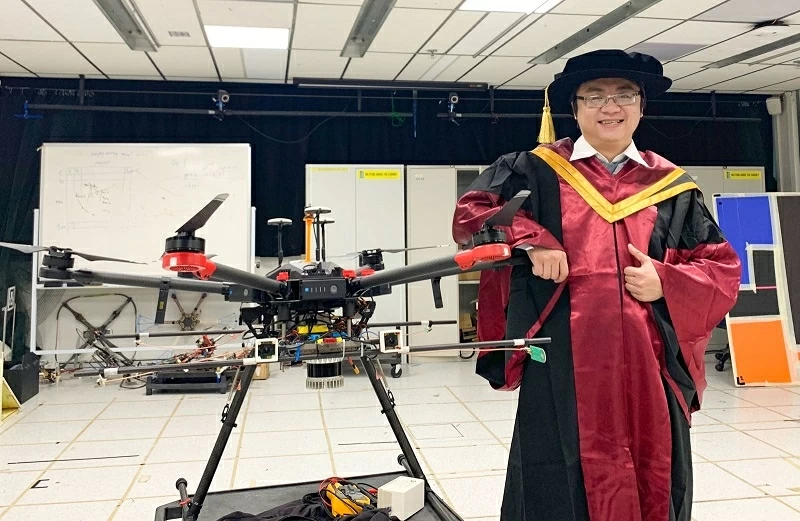 |
Dr. Nguyen Pham Nhat Thien Minh stands beside a multi-sensor integrated UAV, developed by a team at Nanyang Technological University, Singapore. (Photo courtesy of the interviewee) |
Personally, I am always ready to cooperate with and support domestic researchers. In the context of the country promoting science, technology, and innovation, I hope to contribute my knowledge, guide research, and pave the way for future generations.
As a mentor, I hope to help young people shorten their journey to success, so they don't have to retrace the long paths that previous generations took.
In your opinion, what conditions or policies does Vietnam need to create to more effectively attract and connect the network of young Vietnamese intellectuals abroad to participate in domestic science and technology projects?
In my opinion, the most important thing to effectively attract and connect the network of young Vietnamese intellectuals abroad is to create flexible and substantive cooperation mechanisms.
Firstly , there are short-term research exchange programs. In many research systems around the world , graduate students or young scientists often have the opportunity to work in other laboratories for a period ranging from a few months to a year.
Such programs help to forge long-term collaborative relationships between research groups. If Vietnam had more programs like this, Vietnamese scientists abroad would have more opportunities to connect and work directly with groups in the country.
Secondly , there are small-scale but flexible international collaborative research funds. Often, just an initial funding round to organize workshops, academic exchanges, or conduct preliminary experiments can later lead to larger research projects.
Thirdly , we need to build a global network of Vietnamese scholars that is open and regularly connected. When Vietnamese scientists both domestically and abroad get to know each other, share research results and collaboration opportunities, scientific projects will naturally emerge.
I believe that if such mechanisms were in place, the community of young Vietnamese intellectuals abroad would be very willing to participate in and contribute to the country's science and technology projects.
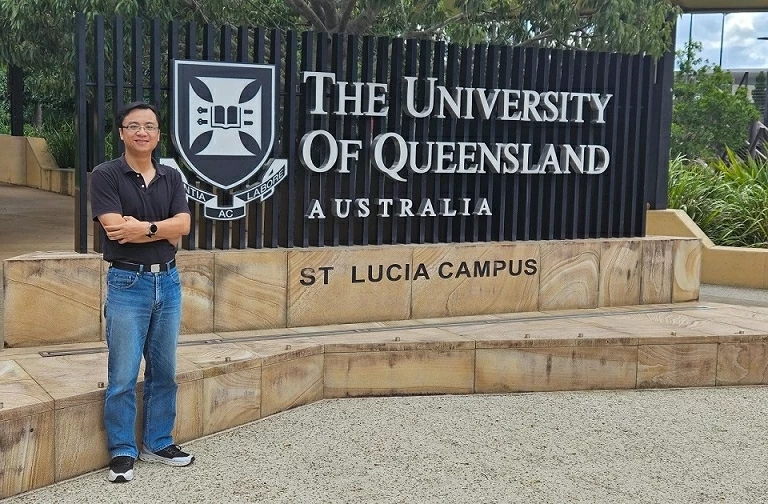 |
| From 2025, Dr. Nguyen Pham Nhat Thien Minh will be teaching at the University of Queensland, Australia. (Photo courtesy of the interviewee) |
Based on your learning and research experience, what message would you like to convey to young Vietnamese people, especially those pursuing careers in science, technology, and innovation?
My message to young people who want to pursue science and technology is to focus on three key elements: passion, direction, and networking.
First , passion is the root of success, and it must come from within each individual. No one can force themselves to be passionate about a particular field, but I want to encourage you that scientific research is a "rewarding passion," because it allows us to discover new knowledge and contribute to society.
Secondly , there's the matter of orientation. This can be achieved by proactively monitoring trends and prominent works at leading scientific conferences and journals, or through academic social networks.
A very simple way is to use LinkedIn to connect with and follow leading researchers in your field. From there, you can understand what the scientific community is interested in and identify topics that are relevant to your situation.
Thirdly , there's the collaborative network. Currently, some research institutions in Vietnam have quite good facilities, approaching international standards. You can proactively participate in these environments and boldly contact Vietnamese and international scientists to seek collaboration opportunities. If you demonstrate seriousness, passion, and clear goals, I believe you will find people willing to support you.
Personally, I'm always ready to support young people. Science is a long journey, but if we build a community together and support each other, that path will be much shorter.
Source: https://baoquocte.vn/khat-vong-dong-gop-cho-khoa-hoc-nuoc-nha-373181.html


















![[Photo] Reception to welcome General Secretary and President To Lam and his wife on their State visit to the Philippines](https://vphoto.vietnam.vn/thumb/1200x675/vietnam/resource/IMAGE/2026/06/01/1780295488620_vna-potal-chieu-dai-chao-mung-tong-bi-thu-chu-tich-nuoc-to-lam-va-phu-nhan-tham-cap-nha-nuoc-toi-philippines-8798060-7855-jpg.webp)












































Comment (0)