

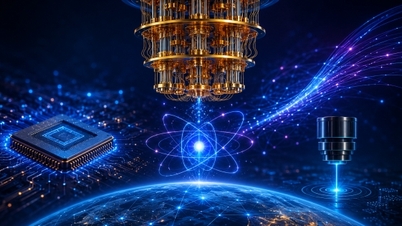
Scientists have officially achieved quantum teleportation technology, ushering in a new era for distributed quantum computing.
However, this technology doesn't involve the teleportation of objects or people as depicted in science fiction films, but rather the ability to share data between two quantum computers.
Scientists have long known about the possibility of "instantaneous transfer" of information through the phenomenon of quantum entanglement.
Recently, a report in the journal Nature published a groundbreaking study by a team of scientists at the University of Oxford (UK), in which they successfully sent a quantum algorithm wirelessly from one quantum processor to another.
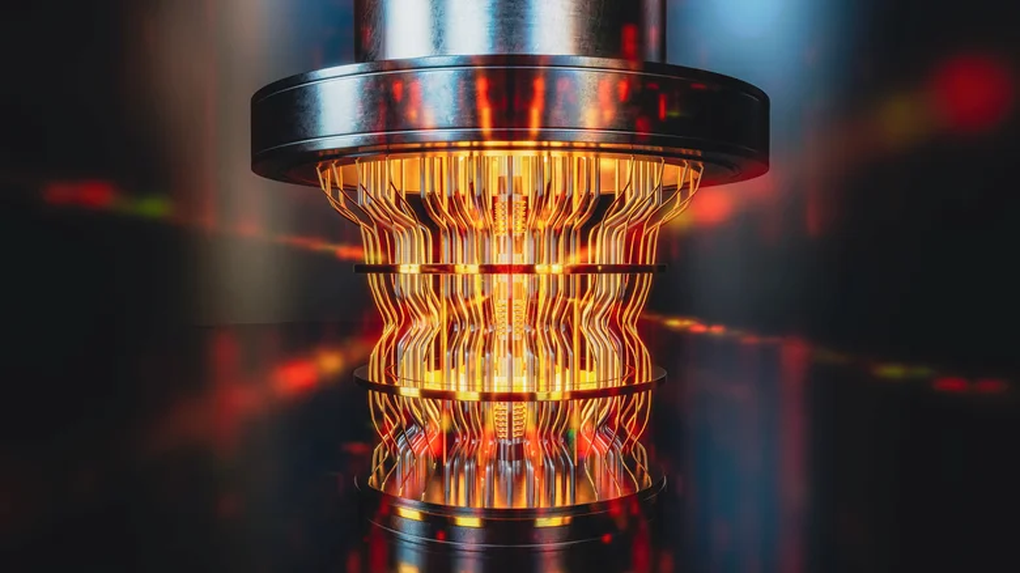
The primary goal of the research is to enable two extremely powerful quantum computers to work together as a supercomputer. This would enhance their ability to solve complex problems that neither computer alone could handle.
The fundamental principle of this technology is the instantaneous transmission of information through quantum entanglement. This phenomenon occurs when two particles, such as photons or electrons, remain connected or "entangled" with each other even when very far apart. In quantum computers, these particles are qubits (the basic unit representing quantum information).
However, in the experiment, no matter actually moved. The light particles (data) remained in their original positions while separated by a distance of two meters. Therefore, the instantaneous displacement here is not the same as the traditional concept of moving matter from one location to another.
Instead, quantum entanglement allows two computers to "see" each other's data, instantly sharing that information over long distances and merging resources.
This breakthrough will pave the way for distributed quantum computing, where multiple remote quantum processors can be combined into a single unified quantum computer.
Distributed quantum computing: Unparalleled power
Distributed quantum computing is a crucial concept, promising to deliver superior computing power. Quantum computers use qubits instead of binary bits (1 and 0) like standard computers.
A qubit can exist in multiple states simultaneously, allowing for the storage of an unlimited amount of information and the processing of data in entirely new ways.

Google once built a quantum supercomputer capable of solving problems that conventional computers would take decades to solve. With distributed quantum computing, this power will be multiplied many times over.
In a distributed configuration, individual quantum processors, even when far apart, can communicate to solve a "megaproblem" by pooling their resources.
Distributed quantum computing can be envisioned as a form of cloud computing in the quantum world . This breakthrough could also spur the development of the quantum internet, the next generation of internet connectivity, enabling quantum data exchange.
This promises to soon bring about computers with incredible computing power, opening up many new possibilities in science and technology.
Source: https://dantri.com.vn/khoa-hoc/khoa-hoc-da-dat-duoc-dich-chuyen-tuc-thoi-ve-chia-se-du-lieu-20251012235455606.htm


![[Photo] General Secretary and President To Lam presides over a meeting on preparations for the review of one year of operation of the three-tiered government system.](https://vphoto.vietnam.vn/thumb/1200x675/vietnam/resource/IMAGE/2026/06/02/1780391821195_a1-bnd-4595-9717-jpg.webp)





















































































Comment (0)