


Training high-quality human resources to stay ahead of scientific and technological development. Photo: NGUYET ANH
While in fields like AI, semiconductors, or cloud computing, technological standards and market ecosystems are largely shaped by giant corporations, with quantum technology, even superpowers are still in the testing phase.
This opens up a unique opportunity for countries that know how to act at the right time and have a long-term strategy.
Bridging the Quantum Technology Gap
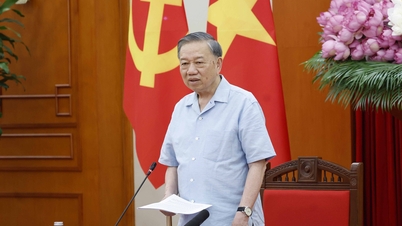
At a recent working session of the Standing Committee of the Central Steering Committee on Science and Technology Development, Innovation and Digital Transformation, General Secretary and President To Lam emphasized the need for further in-depth and systematic research to develop the project "Research, Application and Development of Quantum Technology to Serve Socio -Economic Development, National Defense and Security".
The message was very clear: this is a national strategic issue, linked to digital sovereignty , data security, competitiveness, and future national strength. According to General Secretary and President To Lam, Vietnam must "follow behind but not be slow"; it must "follow early in awareness, build a solid foundation, and focus on the areas that can create real capacity and real value."
From an international perspective, the current quantum race has not yet entered the stage of full commercialization. Technological standards are still being developed, and many fundamental problems remain unsolved.
Rossy Nhung Nguyen, CEO and co-founder of Quanova (the first quantum technology and innovation organization in Vietnam), believes that if Vietnam invests seriously now, it will not have to "chase" but can "run alongside" other countries on the same track. When Vietnam participates in software or AI, the standards have already been established, and the role of a latecomer is almost predetermined. But in quantum technology, even pioneering countries are still experimenting, and no one truly holds an absolute advantage.
This view also coincides with the assessment of domestic scientists. Professor Tran Hong Thai, Director of the Vietnam Academy of Science and Technology, believes that quantum technology is a difficult field, but not beyond Vietnam's reach if a suitable strategy is in place.
According to him, the most important thing now is to build three core foundations: a human resources foundation, a research infrastructure foundation, and an institutional foundation.
In this context, the human factor plays a decisive role. Quantum technology is a deeply interdisciplinary field, requiring the combination of physics, mathematics, computer science, photonics, semiconductors, and artificial intelligence. Vietnam needs to quickly establish master's, doctoral, and engineering programs specializing in quantum technology; and at the same time, strengthen the sending of research students to leading centers around the world.
One advantage frequently mentioned by experts is Vietnam's strong foundation in mathematics and theoretical physics, a tradition passed down through generations. This is a crucial prerequisite because quantum physics is a field that demands a very high level of abstract thinking.
In addition, the community of Vietnamese scientists working at major research centers around the world is also considered a "strategic asset" that helps Vietnam connect quickly with the global flow of technology.
Professor Tran Hong Thai believes that the gap between potential and actual capacity remains a major challenge. Without a unified coordination mechanism at the national level, resources will be dispersed, investments will overlap, and it will be difficult to develop core competencies.
"The Vietnam Academy of Science and Technology has proposed establishing a National Quantum Technology Center based on the 'hub-and-node' model, meaning a nuclear center connecting universities, research institutes, businesses, and defense and security units," Mr. Thai said.
Following this direction, instead of fragmented investment across different locations, Vietnam will focus on building key laboratories, shared equipment systems, and outstanding research groups capable of competing internationally.
From research to national capacity
In the ongoing development plan for quantum technology, five priority areas have been identified. Notably, the top priority currently is post-quantum cryptography and quantum communication. According to experts, when sufficiently powerful quantum computers emerge in the future, many traditional encryption systems could be breached. This poses unprecedented risks to data security, financial security, and national security.
The direction of focusing on quantum algorithms and software is considered more suitable to Vietnam's strengths than investing comprehensively in quantum hardware – which requires enormous financial resources.
Professor Tran Hong Thai believes that Vietnam can fully participate deeply in the quantum value chain through the development of algorithms, material simulation, logistics optimization, or quantum artificial intelligence.
On May 15, 2025, Vietnam National University, Hanoi officially established the Institute of Quantum Technology with the aim of mastering several core technologies and training highly specialized personnel.
Dr. Nguyen Quoc Hung, Director of the Institute of Quantum Technology, shared that the Institute aims to collaborate with the International University, Vietnam National University, Hanoi, to launch a Master's program in Quantum Communication in 2026, the first intensive postgraduate program in this field in Vietnam.
From a business perspective, the formation of a quantum technology ecosystem is also being considered. Large corporations in the fields of telecommunications, semiconductors, AI, and cybersecurity, such as Viettel, VNPT, and FPT, are expected to become the core force of the quantum ecosystem in the future.
However, for quantum technology to truly become a strategic technological platform, the biggest challenge remains the mechanism.
Quantum technology has a long investment cycle, high risks, and its effectiveness is difficult to measure in the short term. Applying traditional management thinking with pressure for results and rigid financial mechanisms makes it very difficult to create genuine breakthroughs.
General Secretary and President To Lam has called for a reform of scientific evaluation methods, acceptance of controlled risks, and a clear distinction between honest scientific failure and wasteful or superficial practices.
This is considered a crucial condition for scientists to dare to pursue difficult and long-term problems.
According to Ms. Rossy Nhung Nguyen, the inclusion of quantum computing and communication in the national strategic technology list under Decision 1131/QD-TTg also demonstrates the government's strong policy commitment.
"If investment is systematic, focused on two to three priority areas, and sustained for 10-15 years, Vietnam can absolutely become a regional quantum technology hub." Most importantly, according to her, it's crucial to seize the right "window of opportunity" while the game is still at the starting line.
The history of technological development has witnessed many missed opportunities when developing countries lacked the determination or strategic vision. But with quantum technology, Vietnam is facing a different opportunity: the chance to participate in shaping the future of global technology from the very beginning.
According to Nhandan.vn
Source: https://baoangiang.com.vn/tan-dung-dung-cua-so-co-hoi-trong-cuoc-dua-luong-tu-a487572.html


![[Photo] General Secretary and President To Lam presides over a meeting on preparations for the review of one year of operation of the three-tiered government system.](https://vphoto.vietnam.vn/thumb/1200x675/vietnam/resource/IMAGE/2026/06/02/1780391821195_a1-bnd-4595-9717-jpg.webp)

















































































Comment (0)