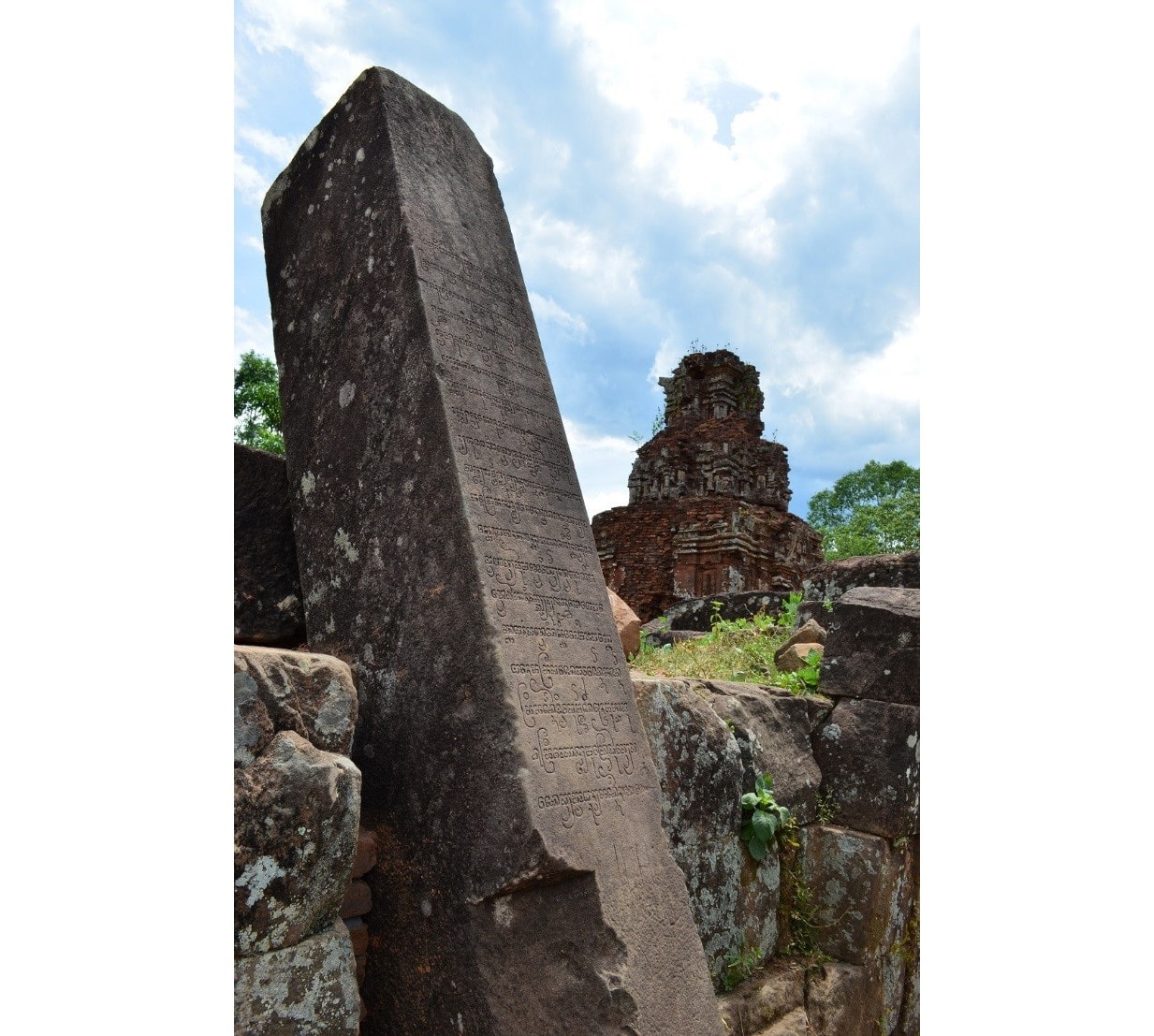
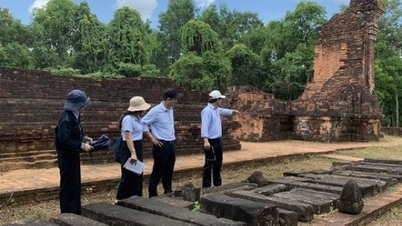
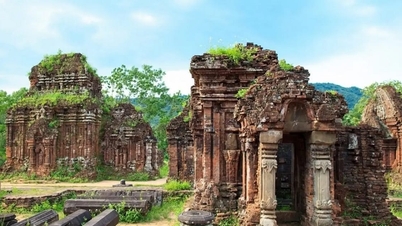
An inscribed stone pillar still stands at the My Son Sanctuary. Photo: VVT
Founding monument
This is a stele found in the area of tower group A, My Son Sanctuary (currently preserved at the National Museum of History). The stele is 2m high and 1m wide, inscribed with Sanskrit characters on both sides; side A has 11 lines, side B has 10 lines, some of which are chipped or broken.
The inscription on the stele (marked C 72) states that King Bhadravarman offered the land and the temple to the god Bhadravreśvara (a title for the god Siva). Based on the French translation by Louis Finot (1902) and the English translation by RC Majumdar (1927), we have translated it into Vietnamese as follows:
Side A: (1) Reverence. Reverence to Mahesvra and Uma… (2) Bhrama and Visnu. Reverence to earth, wind in space, water (3) and fifth, fire. With the witness of the gods, I have a vow to say to those who understand: (4-5) in order to repent of sins, perform meritorious deeds, and be aware of the fate of human life, King Bhadravarman, kneeling at the feet of the god Bhadresvarasvami, expresses reverence and entrusts the eternal fund to the supreme god Bhadresvara (6) the boundaries of Mount Sulaha in the east, Mount Great in the south, Mount Kucaka in the west and the Great River in the north, (7) the land and its inhabitants are offered.
One-sixth of the harvest belongs to the royal family (8), but the king reduces it to one-tenth, which is offered to the gods. Whoever does not do what has been said (9) will have all their merits from birth attributed to Bhadravarman. If anyone steals or destroys (10), that person will bear the full burden of the sins of others that are exempted. To the king, who understands the four Vedas, (11) and to the officials and the people, I declare: For the love of me, do not destroy what I offer.
Side B: (1) If you destroy it, all your merits from past lives will become mine (2) and all my sins will be transferred to you. Conversely, if you keep it well (the offering) (3-8), all the merit will belong to you. Once again I declare… (9) the one who keeps it will receive the merit. Whoever does not keep it but destroys it, he himself will be destroyed… (10) Bhadresvarasvami, witness.
Continuing the vow
Another stele found near stele C 72, measuring 1.08m high and 0.7m wide, has a broken corner. Side A contains 24 lines of Sanskrit text (currently preserved at the National Museum of History). The inscription (labeled C 73A) refers to a king named Rudravarman and his successor Śambhuvarman.
The final section of the text states that King Śambhuvarman erected a temple to the god Śambhu-Bhadresvara (combining the king's name and a title of the god Shiva) and reiterates the entrustment to Shiva of the land as King Bhadravarman recorded in the aforementioned inscription C 72, meaning within the area "to the east is Mount Sulaha, to the south is Mount Lon, to the west is Mount Kucaka..."; and simultaneously prays to the supreme deity to bring happiness to the Champa Kingdom.
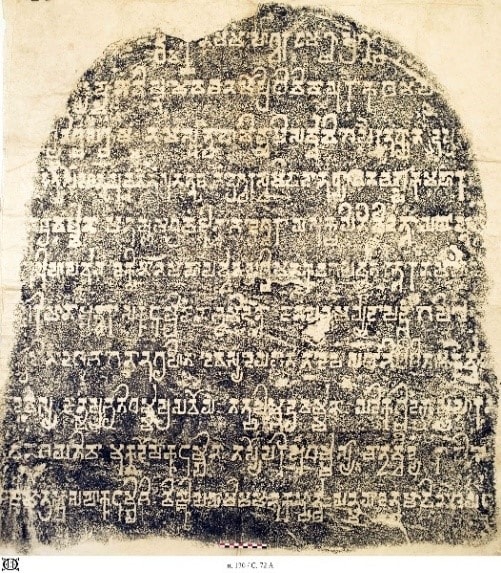
Reprint of inscription C 72. Source: EFEO
In particular, this inscription contains a line related to the date, some of the characters are worn and faded, which translates as follows: “During the reign of King Rudravarman, in the year 4 (...) (...), the temple of the supreme god was burned down…”. Based on the remaining digit “4” in the three-digit sequence indicating the year, Louis Finot (1903) determined that the time of the fire was within the 100 years from 401 to 499 of the Saka calendar, which translates to 479 to 577 in the Gregorian calendar; this also means that it was before King Śambhuvarman rebuilt the new temple to replace the one that was burned down.
Sacred land entrusted to the god Shiva.
Connecting the information about the king's title and the scope of the entrusted land in inscriptions C 72 and C 73A, we can envision the origins of the My Son temple complex. Around the 5th century, the Champa king, whose name in Sanskrit was Bhadravarman, erected a temple to the god Siva, vowing to offer a region of land as a perpetual entrusted fund (akṣaya nīvī) to the god to ensure the long-term happiness of the kingdom.
A fire during the reign of King Rudravarman destroyed the temple, which was then rebuilt by King Śambhuvarman around the 6th century. This king not only continued the tradition of worshipping the god Shiva (combining the king's name with the god's title) but also upheld the vow to dedicate the land as originally offered by King Bhadravarman.
The content of two inscriptions from the 5th and 6th centuries reveals that the Champa kings of this period had the support of the Brahmin priestly class in conducting coronation ceremonies, worshipping deities, applying the Saka calendar, and using Sanskrit to convey the contents of the ancient Vedas.
These are two of the earliest inscriptions at My Son, serving as key clues to connect and understand many later inscriptions, such as inscription C 96, which records the genealogy of Champa kings, including the reigns of kings Rudravarman and Śambhuvarman (Quang Nam Newspaper online, February 5, 2023); or inscription C 147 on a stone slab on the bank of the Thu Bon River, which records boundary areas coinciding with the boundaries of the land that King Bhadravarman entrusted to the god Siva.
The name Bhadravarman also provides a clue to deciphering a title in a 6th-century Chinese text. Could "Bhadravarman" be King "Pham Ho Dat/Pham Tu Dat," the king whose virtues were "praised by the Di people" in an ancient stele on the banks of the Hoai River, as recorded in the Chinese book "Shui Jing Zhu"?
Source: https://baodanang.vn/khoi-nguon-dat-thieng-my-son-3026455.html


![[Image] Pleasant weather helps students enter the 10th grade entrance exam with confidence.](https://vphoto.vietnam.vn/thumb/1200x675/vietnam/resource/IMAGE/2026/05/29/1780034401612_ngay-1-thi-lop-10-minh-duy-8-5009-jpg.webp)

![[Photo] Ba Lang An Lighthouse - the "eye of the sea" amidst the "rock museum" of Quang Ngai province.](https://vphoto.vietnam.vn/thumb/1200x675/vietnam/resource/IMAGE/2026/05/29/1780038698840_anh-man-hinh-2026-05-29-luc-14-10-42.png)




































































Comment (0)