

According to information from the Customs Department, the agency has recently received feedback from several associations, businesses, and media outlets regarding the requirement to declare chemical composition during import procedures. Based on this, the Customs Department has issued official information to clarify and standardize the understanding during implementation.
The Customs Department stated that there is currently no regulation requiring a 100% detailed declaration of chemical composition in all cases.
According to the Customs Department, customs procedures for imported and exported chemicals are currently implemented in a coordinated manner based on customs law and chemical law. This legal framework is specifically stipulated in the 2014 Customs Law, Decree No. 08/2015/ND-CP (amended and supplemented by Decree No. 167/2025/ND-CP), along with the 2025 Chemical Law and related guiding decrees, namely Decree No. 24/2026/ND-CP and Decree No. 26/2026/ND-CP.
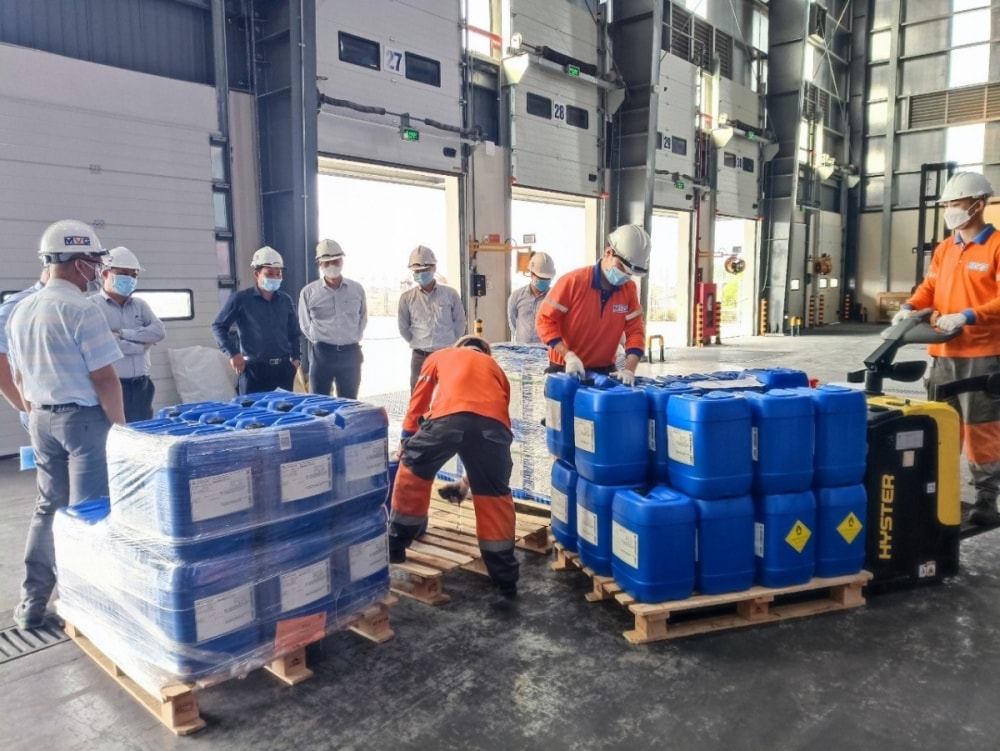
Since these new regulations came into effect, the Customs agency has not issued any further separate guidance documents that create additional procedures. All specialized inspection and supervision activities are conducted continuously according to the risk management principle to provide maximum convenience for businesses that comply well with the law.
Regarding the obligation to declare and provide documents, customs declarants comply with general regulations and are not required to submit additional documents beyond the standardized customs dossier. However, based on the information criteria in Circular No. 121/2025/TT-BTC, businesses are responsible for clearly describing the name of the goods, their composition, content, and physical and chemical properties on the declaration form to determine the tax code and apply specialized management policies.
For declarations classified under the Yellow and Red channels, if the information is inaccurate, incomplete, or inconsistent during document review or physical inspection, customs officers have the right to request the declarant to provide additional technical documents as stipulated in the Customs Law.
The measure requiring clarification of composition and content is applied in cases where the documentation does not clearly show the structure, or there is insufficient basis for comparison with the list of prohibited chemicals, chemicals subject to conditions, or chemicals requiring special control.
Due to the highly specialized nature of chemicals, clearly determining the concentration is mandatory for Customs authorities to apply exemption thresholds for granting licenses or certificates according to specialized regulations, for example, limits of less than 0.1%, 1%, or 5%.
In cases where supplementary documents from the business are still insufficient to legally identify the true nature of the goods, the Customs authority will then proceed with analysis, classification, or expert assessment to establish a basis for making a customs clearance decision.
To minimize delays, the Customs agency requested that associations coordinate efforts to promote awareness and encourage businesses to proactively declare all technical specifications from the outset. Regarding businesses' concerns about the risk of trade secret leaks, the regulatory agency will directly refer to the 2025 Chemical Law to clarify the scope of information confidentiality.
The basic identifying data found on the Material Safety Data Sheet (MSDS/SDS), including the CAS number, UN number, purity of the mixture, and the hazard level of additives or impurities, are all publicly available information and are not classified.
The Customs agency's request for this identifying information for state management purposes is within its authority and does not violate the principles of protecting the manufacturer's trade secrets. In practice, shipments where businesses cooperate and provide clear information are processed quickly through customs.
In order to standardize the practical implementation process, the Customs Department has proactively compiled the arising difficulties and submitted them to the Department of Chemicals under the Ministry of Industry and Trade for an official response as soon as possible, to serve as a basis for consistent guidance for border gate units in the future.
The Customs Department requests that associations and businesses strengthen coordination and enhance responsibility in fully declaring goods information, contributing to both ensuring smooth customs clearance and improving the effectiveness of state management of chemical products, a field with unique characteristics and requiring strict management.
Source: https://daibieunhandan.vn/khong-bat-buoc-khai-bao-100-thanh-phan-hoa-chat-khi-nhap-khau-10417533.html
![[Image] Pleasant weather helps students enter the 10th grade entrance exam with confidence.](https://vphoto.vietnam.vn/thumb/1200x675/vietnam/resource/IMAGE/2026/05/29/1780034401612_ngay-1-thi-lop-10-minh-duy-8-5009-jpg.webp)




![[Photo] Ba Lang An Lighthouse - the "eye of the sea" amidst the "rock museum" of Quang Ngai province.](https://vphoto.vietnam.vn/thumb/1200x675/vietnam/resource/IMAGE/2026/05/29/1780038698840_anh-man-hinh-2026-05-29-luc-14-10-42.png)


















































































Comment (0)