

French President Emmanuel Macron and Russian President Vladimir Putin visited Kazakhstan; while Turkish President Recep Tayyip Erdogan and Iranian President Ebrahim Raisi attended a high-level meeting of the regional economic cooperation organization. Prior to this, the US and EU also increased their diplomatic activity in the region. As a result, Central Asia's geostrategic position has significantly improved.
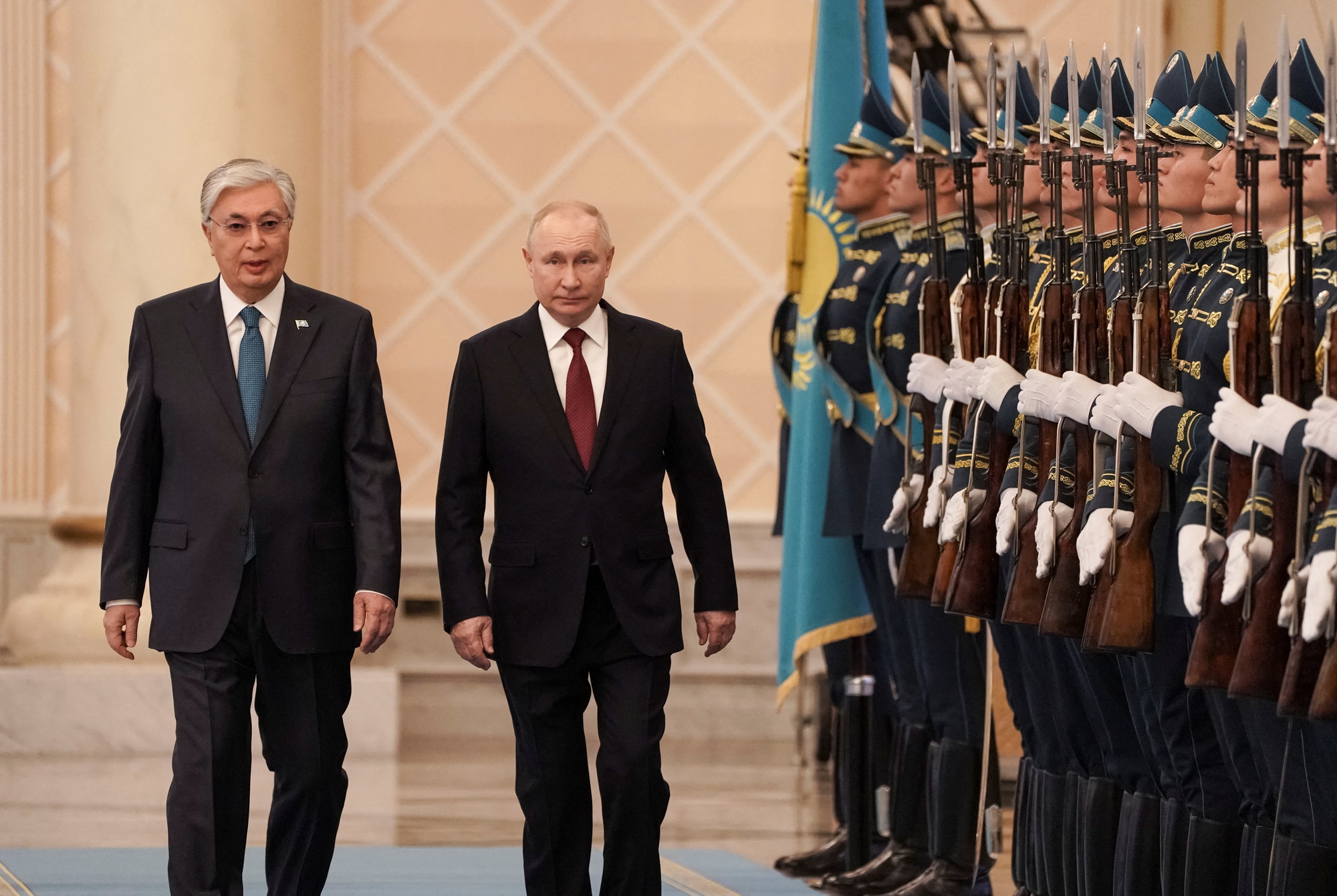
Russian President Vladimir Putin and Kazakh President Kassym-Jomart Tokayev (left) at the official welcoming ceremony on November 9.
Russia has long held a dominant influence in this region. However, since the outbreak of the conflict in Ukraine and the intense confrontation with the US, EU, NATO, and other Western countries, Russia's interest and influence in the region have diminished. Countries in the region are seeking new allies and partners, while external partners have found favorable opportunities to build their own influence, competing with Russia and with each other in the region.
The conflict between Hamas and Israel in the Middle East, as well as the most recent developments between Armenia and Azerbaijan regarding the Nagorno-Karabakh region, have also significantly contributed to the dramatic increase in Central Asia's geostrategic importance.
Russia, Iran, Türkiye, the EU, and the US all have significant and practical strategic interests in preventing Central Asia from becoming a new hotspot of insecurity and instability, given the ongoing conflict in Ukraine, uncertainty in the Middle East, and the unresolved conflict between Armenia and Azerbaijan. Therefore, despite their competition for influence, these partners will be compelled to cooperate to prevent the region from becoming increasingly unstable.
Source link
















![[Photo] Prime Minister Pham Minh Chinh attends the Conference on the Implementation of Tasks for 2026 of the Industry and Trade Sector](/_next/image?url=https%3A%2F%2Fvphoto.vietnam.vn%2Fthumb%2F1200x675%2Fvietnam%2Fresource%2FIMAGE%2F2025%2F12%2F19%2F1766159500458_ndo_br_shared31-jpg.webp&w=3840&q=75)














































Comment (0)