

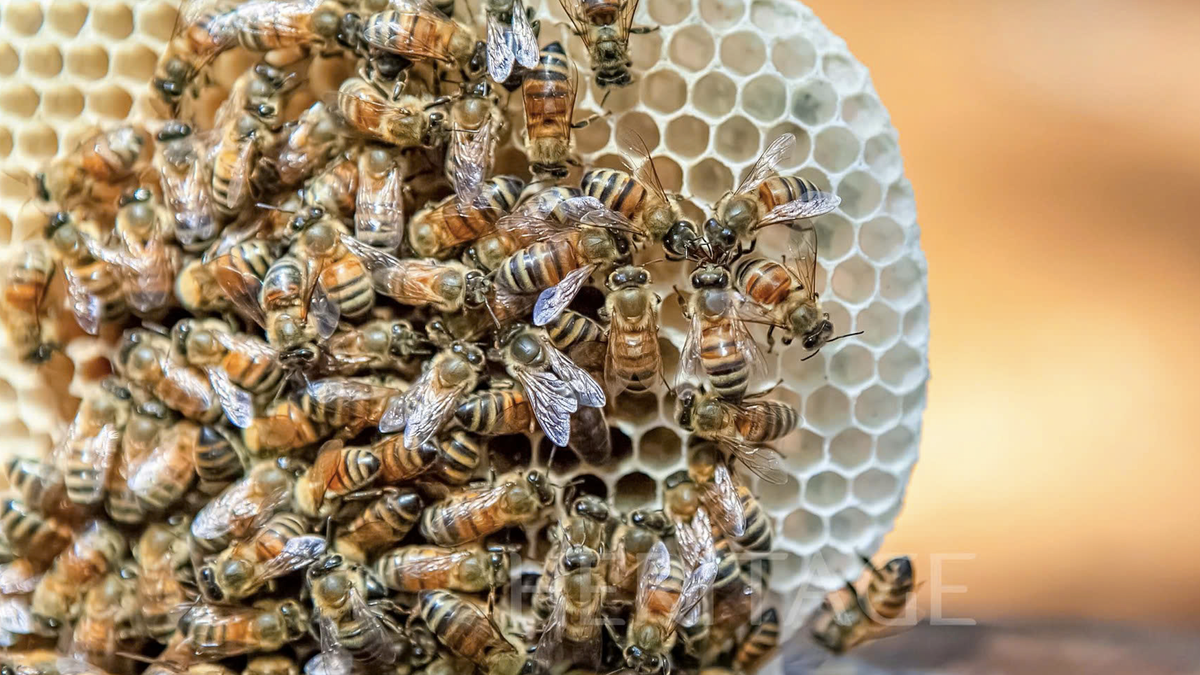
By looking at the bees, you can tell the hive.
After missing our appointment more than three times due to rain, I finally met Mr. Tho (born in 1993 in Muoi Bong village, Xuan Dai commune, Phu Tho province) on what he called a "beautiful sunny day." According to him, a beautiful sunny day doesn't mean a gentle sun, but rather a bright, clear blue sky with no wind.
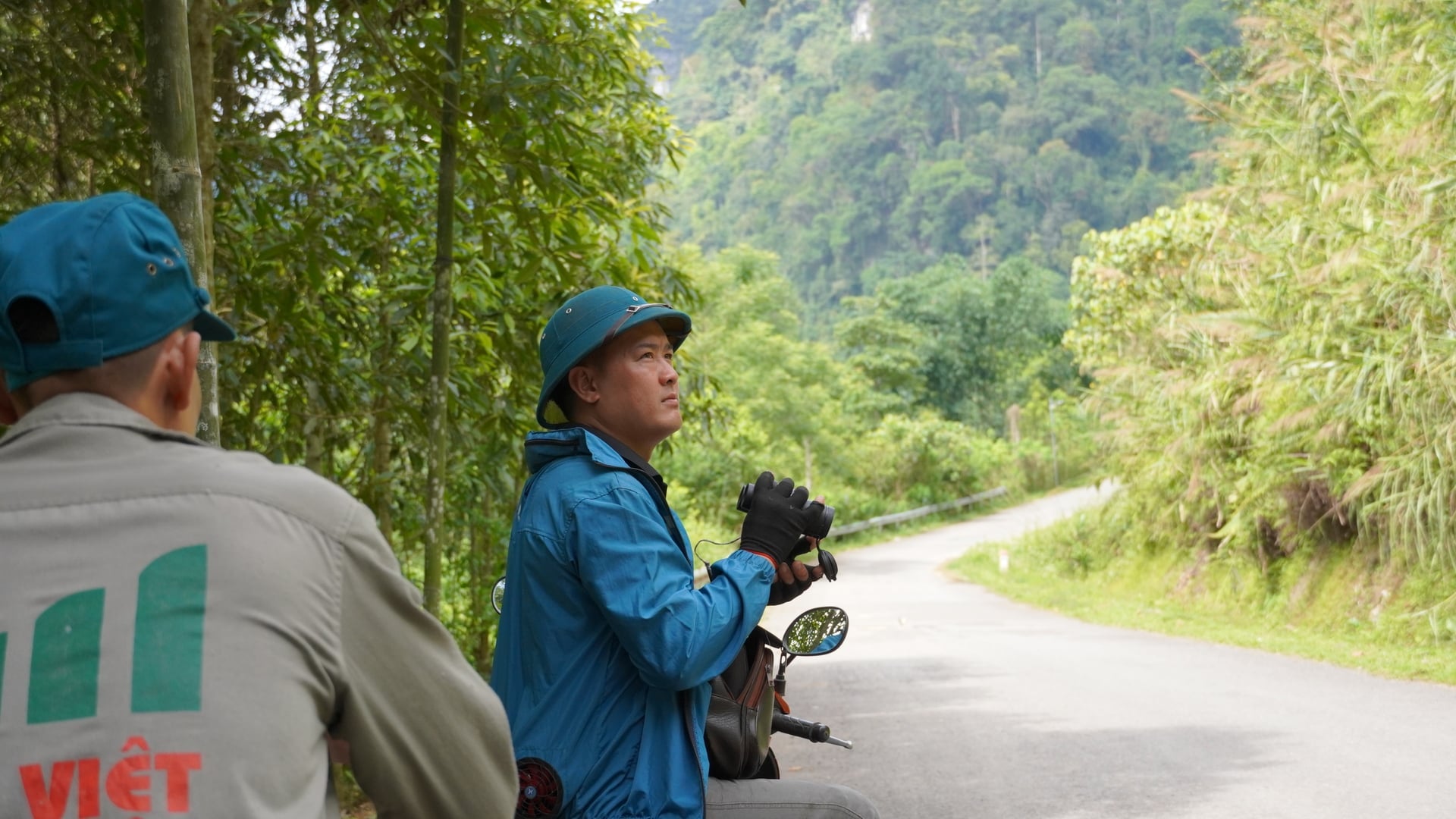
With binoculars in hand, Mr. Tho scrutinized every spot where he suspected bees might be. Photo: Minh Toan.
Mrs. Tran Thi Kieu, Tho's mother, recounted that when their house was on the hill, they had a wooden cupboard for storing rice, and honeybees would build a nest inside. Each time they cut it open, they could get dozens of liters of honey. That beehive lasted for five years. Later, when they moved to the foot of the hill, they couldn't take the cupboard with them and had to sell it, which Mrs. Kieu regretted ever since. "Then the villagers told Tho about some wild bee colonies in the village, and he went to collect honey, gradually making it his profession without even realizing it," Mrs. Kieu said.
Thọ's profession began there, without any formal training. Nine years in the forest accumulated all sorts of experience that no book could teach. He knew how to observe bees gathering water to determine the direction of their nest, and how to tell if a nest was old or young, exposed or hidden, by the color of its back.
"A large, healthy wild bee with a stable water source will have a very large hive, and its golden back is due to the hive being in a sunny location. For wild bees, the water source and the location of the hive are only a few hundred meters apart at most," he explained eloquently.
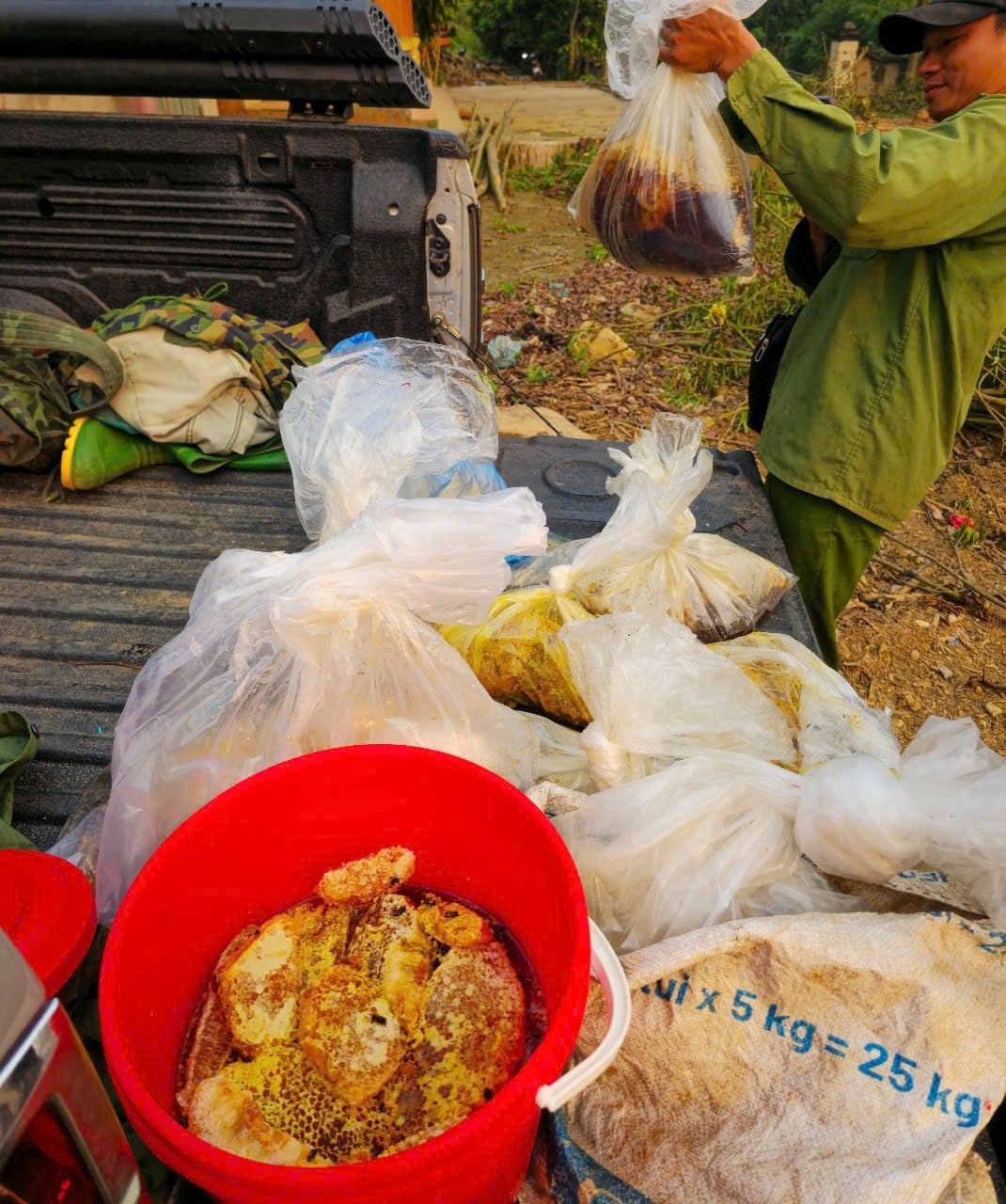
He might forget his knife, he might forget his protective gear, but Mr. Tho never forgets to bring a plastic bag to hold the honey. Photo: Provided by the interviewee.
While I was chatting, Mr. Tho quickly rearranged his tool bag and then handed me a pair of boots, saying there were many leeches in the forest. At 9 a.m., Mr. Dang Quoc Quan (born in 1989, Tho Van commune, Phu Tho province) - Mr. Tho's regular travel companion - arrived from Tam Nong (formerly). We began our journey.
Upon entering Xuan Son National Park, there are no winding mountain passes like Tam Dao or Ba Vi, only steep slopes where, as you descend, your eyes must be glued to the road surface directly beneath the wheels. The slopes are so steep that even Thọ and Quân – frequent forest trekkers – had to get off their motorbikes, maintain a steady speed, and walk up each section.
Along the way, whenever Thọ saw a patch of flowers or a small stream, he would stop to look. "Bees often go to collect flowers and water, so we have to observe carefully which direction they fly to guess the location of their nest," he said. Quân told Thọ not to miss any beehive, so the others who went with him were determined to find one as well.
A day without a meal.
The deeper they went into the mountains, the stronger the wind became. Thọ shook his head in frustration: "With this kind of wind, we can't see anything, the bees can't fly away to find anything." Then a phone call came from a friend: there were a lot of bees gathering water inside. The whole group immediately turned onto the trail leading to Lai Đồng commune to search for the bees.
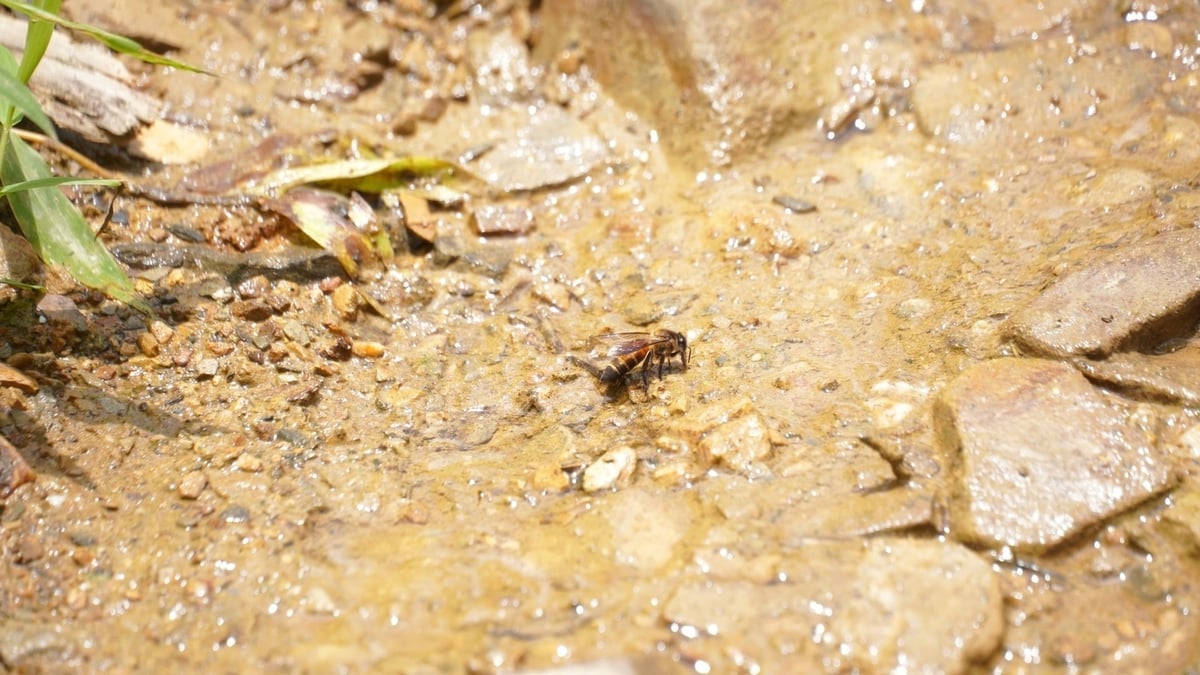
Based on his experience, Mr. Tho can determine the direction and size of the hive... through the characteristics of the bees that go to fetch water. Photo: Minh Toan.
After nearly an hour of traversing the trail, we stopped before a small stream. Three or four giant hornets swooped down to drink. Thọ's face lit up with joy: "This nest must be huge, and it's exposed too." Following the stream deeper in, we found more and more hornets.
Reaching a watering point about a kilometer from the trail, Thọ clearly assigned tasks: “Quân, stay here. When the bees fly up, let me know, and I’ll go inside to get a better look.” As we went further, Thọ and I saw more and more fresh footprints, sometimes a few banana trees that had been cut down to make it easier to look up.
After rejoining the team, Quân looked at the footprints and remarked, "These are very fresh; someone must have taken this nest." But Thọ didn't think so; they probably hadn't seen this nest before. The group continued on their way.
The sun was high in the sky. Quân and I were starting to feel weak from hunger when we heard Thọ shout, "Here it is!" Quân seemed to snap out of his daze, all his fatigue gone.
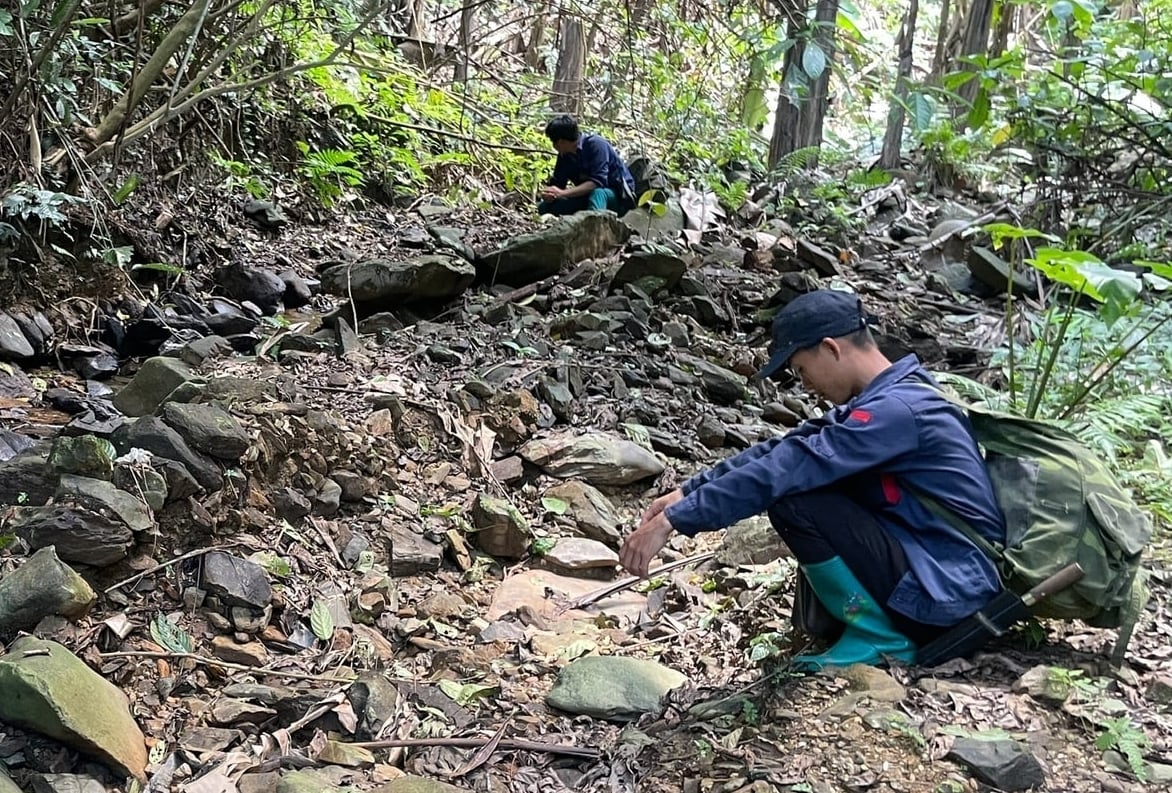
Encountering other beekeeping teams in the forest is not uncommon for beekeepers harvesting honey this season. Photo: Minh Toan.
We were waiting for Quân's signal when a voice came from the stream: "Go home, we've got this nest." About five minutes later, two figures vaguely emerged, chuckling.
Mr. Tho asked directly, "So, have you guys taken it yet?" The two men shook their heads. It turned out they were also searching, targeting the same beehive. Their saying, "Go home, we've already taken it," was just a way to reserve the spot and scare others away. Fighting over beehives in the forest is no longer uncommon; beekeepers are becoming more numerous while the forest is shrinking.
One man sat down to rest with me and Mr. Tho, while the other, named Dinh, was as quick as a squirrel as he darted into the bamboo thickets. I followed, but only halfway before losing sight of him. The bamboo surrounded us on all sides, making it impossible to tell which way we had entered, so I had to return to where Mr. Tho was waiting.
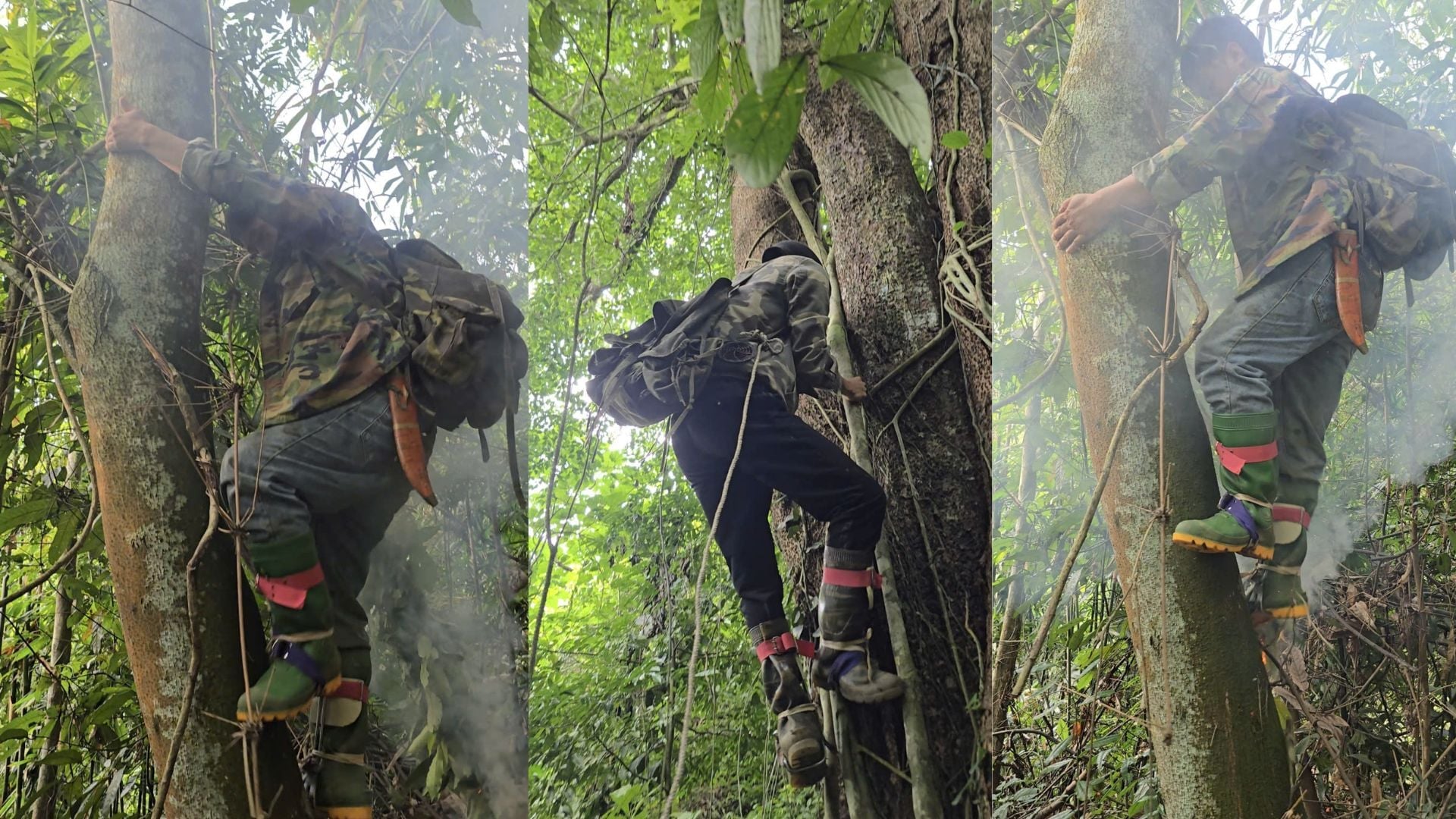
Beekeepers climb trees to collect honey. Photo: Provided by the interviewee.
Nearly an hour later, Quân returned, breathless, reporting that he had gotten lost in the dense thicket of bamboo and couldn't find the beehive. Ten minutes later, Đính also returned empty-handed. The beehive was right there; Thọ had seen it clearly through binoculars, but no one could find the path to it. The forest was impassable; to get there, one had to crawl, slither, and forge their own way through the bamboo thickets.
Only Dinh stayed behind to rest, while I and the three other beekeepers started over. I stayed close to Quan. Upon reaching the base of the tree, Tho quickly climbed up without any protective equipment. He created smoke to drive away the bees, cut off the honey and pollen, leaving the larvae for the bees to continue their colony. Having finished, he extinguished the smoke, put away his tools, packed the honey into his backpack, and descended.
But, as the forest often teases, the old beehive, with its beautiful bees, only yielded about 1.5 kg of honey. No one was happy. To lighten the mood, Quân joked, "We're broke again today. There are days when we don't have enough people to carry the honey, but there are also days like this when we're empty-handed."
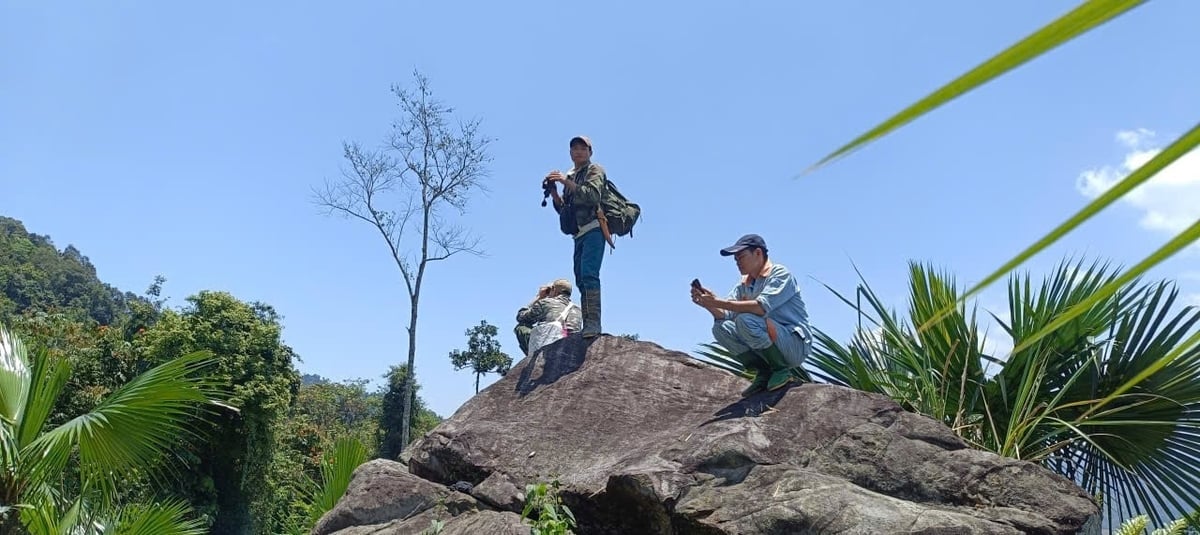
Beekeepers use their eyes to observe and determine the location of beehives. Photo: Provided by the interviewee.
On such "unproductive" days, Thọ's team would often take advantage of the opportunity to pick wild bananas or other mountain specialties to save on gasoline costs, and then continue searching for streams, flowers, and bees. But that day seemed unlucky; the next few locations also had no bees.
As dusk fell, Thọ led us to a spot near his house, a place he kept as a precaution for bad days. But the beehive there had already been taken by another group. We said goodbye when it was completely dark.
For every liter of honey he harvests, Mr. Tho earns 300,000 - 400,000 VND. But he knows better than anyone that this profession is dwindling. The forest area has decreased significantly compared to nine years ago when he first started, and the number of bees has also decreased accordingly.
He's raising snails, pigs, chickens, ducks, etc., both to supplement his income and to keep himself going to the forest to find bees. He doesn't know how much longer the forest will be able to support beekeepers, but for Thọ, giving up bees would mean giving up a part of his remaining childhood.
Source: https://nongnghiepmoitruong.vn/ky-nghe-san-ong-d812971.html


![[Photo] First session of the 14th Congress of the Vietnam Trade Union](https://vphoto.vietnam.vn/thumb/1200x675/vietnam/resource/IMAGE/2026/06/03/1780465947883_ndo_br_img-3852-jpg.webp)
















































![[Video] Sunset at Lap An Lagoon – Where the sun sets over the fishing nets](https://vphoto.vietnam.vn/thumb/1200x675/vietnam/resource/IMAGE/2026/05/31/1780192137701_beach-landscape-sea-water-nature-grass-745871-pxhere-com.jpeg)





































Comment (0)