

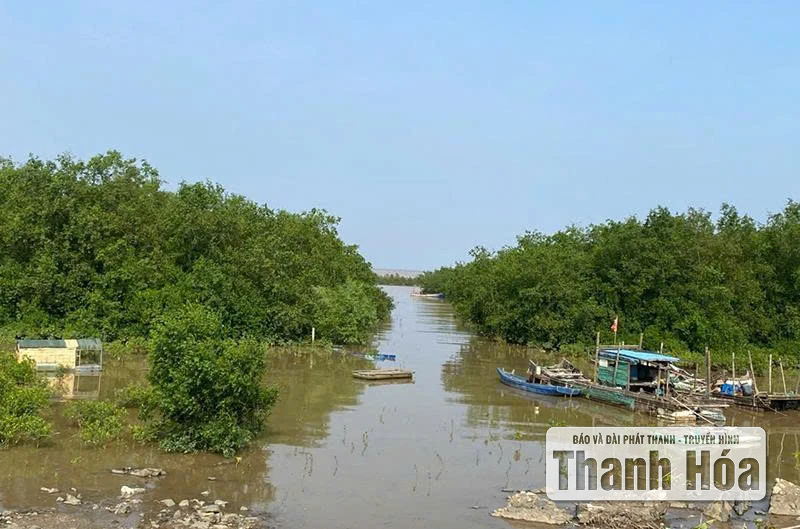
The coastal protection forest in Van Loc commune is likened to a "green shield" protecting the mainland from sea waves.
Van Loc commune has 600 hectares of coastal protection forest, the largest in Thanh Hoa province. These coastal protection forests not only help mitigate natural disasters but also create livelihoods for the community. According to Le Ngoc Hung, Chairman of the Van Loc Commune People's Committee: "Previously, people were very worried every time the rainy and stormy season arrived. I remember in 2005, people had to flee the storm because the tidal surge overflowed the dike. That year, Typhoon No. 7 arrived quickly, the dike broke, and seawater flooded in, causing significant damage to people and property. However, more than 100 meters of the dike, protected by the mangrove forest, remained intact. Immediately after the storm, the coastal dike was reinforced. From the story of the dike remaining after the storm, the local people decided that they must develop coastal protection forests. They rely on the coastal protection forest to prevent tidal surges, protect the dike, and protect the villagers."
Mangrove forests help prevent erosion and protect the coastline from the impact of sea waves. Depending on the season, coastal residents go into the mangrove forests to catch seafood, maintaining their income. In particular, under the canopy of the coastal mangrove forests in Van Loc commune, there is a species of climbing fish (locally known as "ca choi"), which fetches a price of 200,000 - 300,000 VND/kg. Besides direct exploitation, people also utilize the natural environment of the coastal protection forest to create income-generating livelihood models, such as beekeeping, raising ducks, crabs, tiger prawns, mullet, and gobies. In addition to the seafood resources, the potential for ecotourism from these coastal protection forests is enormous. In the local tourism development plan, the commune government focuses on building tourist routes through the casuarina, mangrove, and Avicennia forests.
With a coastline stretching 102km, Thanh Hoa province is heavily impacted by climate change. Extreme weather events such as storms, floods, droughts, and landslides make forecasting and response more difficult and complex. This causes serious impacts on the lives and production of people and on coastal infrastructure. To address this situation, since the 1990s, the Department of Agriculture and Environment (ARD) has directed the Forest Protection Sub-Department to coordinate with relevant sectors and coastal localities to promote the planting, management, and protection of forests, aiming to increase forest cover, enhance protective functions, and contribute to responding to climate change and sea level rise. Since then, more than 800 hectares of coastal protection forests have been developed, not only contributing to the restoration of the marine environment, mitigating natural disaster risks, and limiting coastal erosion, but also creating livelihoods for coastal people.
Furthermore, as the core force in forest protection and development, the Forest Protection Department has regularly organized training courses on forest management and protection for officials and people in coastal localities over the years. Simultaneously, they distribute leaflets and erect signs to raise awareness about protecting the biodiversity of mangrove forests and the role and function of coastal protection forests. As a result, people's awareness of the role of coastal protection forests has been enhanced. The illegal encroachment on forest land for aquaculture is gradually being controlled, and the biodiversity of the forests is being protected and developing.
On the other hand, the Forest Protection Department also coordinates with organizations, localities, and people to restore and develop coastal protection forest areas through reforestation and regeneration programs. From 2020 to the present, the entire province has planted 256.37 hectares of new coastal protection forests and restored 138.66 hectares of degraded forests. In addition, Thanh Hoa province also plants millions of scattered trees each year to contribute to increasing forest cover, combating desertification and coastal erosion.
To improve afforestation efforts in response to climate change and create livelihoods for people living under the forest canopy, the Department of Agriculture and Environment continues to implement land allocation linked to forest allocation; build agro-forestry models to improve livelihoods and create jobs for people directly involved in protecting and developing forests. At the same time, it calls on businesses to invest in developing ecotourism in mangrove forests to create more jobs and increase income for coastal residents.
Text and photos: Tang Thuy
Source: https://baothanhhoa.vn/la-chan-xanh-chong-bao-lu-259788.htm




























![[Infographics] Criteria and procedures for evaluating and classifying OCOP products](https://vphoto.vietnam.vn/thumb/402x226/vietnam/resource/IMAGE/2026/06/01/1780307493571_infographics-bo-w1200t0-di2622d199d1164352t11358l1-ocop-023.webp)


![[Photo] Reception to welcome General Secretary and President To Lam and his wife on their State visit to the Philippines](https://vphoto.vietnam.vn/thumb/1200x675/vietnam/resource/IMAGE/2026/06/01/1780295488620_vna-potal-chieu-dai-chao-mung-tong-bi-thu-chu-tich-nuoc-to-lam-va-phu-nhan-tham-cap-nha-nuoc-toi-philippines-8798060-7855-jpg.webp)






























































Comment (0)