

The issue of requiring borrowers to purchase insurance when taking out bank loans has once again become a hot topic in recent days as the State Bank of Vietnam is drafting Decree 88 on administrative penalties for violations in the monetary and banking sector.
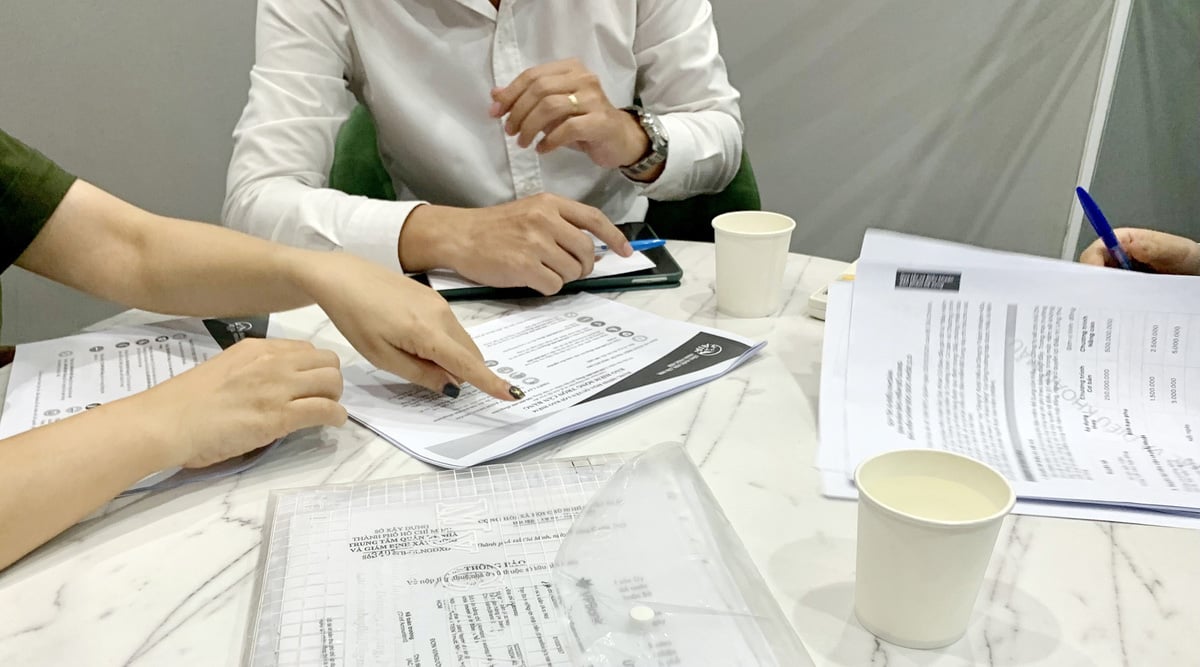
A bank employee advises a customer on purchasing a life insurance and health insurance package at a bank in Ho Chi Minh City - Photo: TTD
Specifically, the regulations stipulate a fine of 400-500 million VND if banks link non-mandatory insurance products to the provision of products or services in any form.
Notably, this is not the first time the issue of being forced to buy insurance when taking out loans has been raised. In 2023, this issue escalated when a series of customers accused banks of "setting them up" to buy life insurance, causing the actual cost of borrowing to increase.
Subsequently, authorities intervened with a series of actions, such as the State Bank of Vietnam and the Insurance Supervision and Management Department establishing a hotline to receive and handle complaints related to insurance sales activities at banks.
Next, the Ministry of Finance issued Circular 67, prohibiting banks from selling investment-linked insurance policies before and after 60 days from the date of full loan disbursement to customers.
The National Assembly also voted to pass the Law on Credit Institutions (amended), which stipulates that banks are prohibited from linking the sale of non-compulsory insurance with the provision of banking products and services in any form.
However, as reported by Tuoi Tre newspaper in recent days, people are still being "forced" to buy insurance through various tactics that they consider more sophisticated, such as citing reasons to avoid disbursement, pleading, "asking for assistance," or having relatives register the policy in their names to circumvent the law.
Furthermore, some banks even require borrowers to pay insurance premiums for two consecutive years, not just the first year.
In fact, according to Tuoi Tre newspaper's investigation, although the regulation imposing a fine of 400-500 million VND if banks link non-mandatory insurance products to their service offerings has not yet been implemented, many banks have already prepared various countermeasures.
For example, when signing an insurance contract, the bank invites the customer into a room with audio and video recording to preserve evidence, and the customer also has to sign a commitment to voluntarily purchase insurance when borrowing money... to prevent the customer from accusing the bank of forcing them to buy insurance after disbursement, demanding contract cancellation and a refund, as well as to avoid the bank being fined by the regulatory authority for forcing borrowers to buy insurance.
So, what is the most feasible way to solve this difficult problem? Of course, a perfect solution is difficult to find, but we should start by ensuring proper consultation.
Buyers must be fully informed of both the advantages and disadvantages of the contract, and banks must have tools to monitor the process afterward, and even impose sanctions if there is any situation where advice is given merely for the sake of appearances or if borrowers are forced to purchase insurance.
Banks should even publicly disclose lending interest rates for borrowers who purchase and do not purchase insurance, listing them on their websites so that borrowers can calculate and consider their options.
This will ensure transparency and help banks avoid complaints from borrowers about being forced to buy insurance when taking out loans, as has happened in the past.
Source: https://tuoitre.vn/lai-noi-ve-chuyen-bi-ep-mua-bao-hiem-2024120908140628.htm
![[Photo] General Secretary and President To Lam presides over a meeting with the Central Organizing Committee.](https://vphoto.vietnam.vn/thumb/1200x675/vietnam/resource/IMAGE/2026/06/03/1780482764658_a1-bnd-4741-3342-jpg.webp)
![[Photo] First session of the 14th Congress of the Vietnam Trade Union](https://vphoto.vietnam.vn/thumb/1200x675/vietnam/resource/IMAGE/2026/06/03/1780465947883_ndo_br_img-3852-jpg.webp)


![[Photo] Secretary of the National Assembly Party Committee, Chairman of the National Assembly presides over the meeting of the Standing Committee and Executive Committee of the National Assembly Party Committee.](https://vphoto.vietnam.vn/thumb/1200x675/vietnam/resource/IMAGE/2026/06/03/1780480353201_ndo_br_bnd-2585-jpg.webp)
























































![[Video] Sunset at Lap An Lagoon – Where the sun sets over the fishing nets](https://vphoto.vietnam.vn/thumb/1200x675/vietnam/resource/IMAGE/2026/05/31/1780192137701_beach-landscape-sea-water-nature-grass-745871-pxhere-com.jpeg)
































Comment (0)