

The Fed's preferred measure of inflation rose in April, increasing the likelihood of a rate hike at its upcoming meeting.
According to a report released on May 26th by the US Department of Commerce, the Personal Consumption Expenditures (PCE) index rose 4.4% in April compared to the same period last year. This increase was higher than the previous month's 4.2%. The acceleration in PCE was attributed to rising energy, goods, and services prices. Meanwhile, food prices declined slightly.
Core PCE (excluding volatile energy and food prices) also unexpectedly accelerated by 4.7%. In March, core PCE rose 4.6%. According to data firm Refinitiv, economists had predicted core PCE would remain stable.
PCE is the Federal Reserve's preferred measure of inflation. A high PCE is an indicator of Fed Chairman Jerome Powell's warning that the fight to keep prices down "will be very difficult." Yesterday's data also increased the likelihood of the Fed raising interest rates at its upcoming meeting.
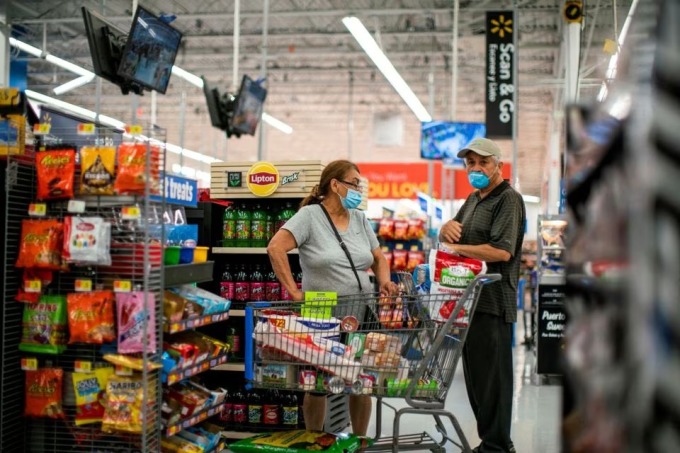
People wear face masks at a supermarket in New Jersey. Photo: Reuters
PCE is part of the personal income and expense report, providing an overview of price changes and how people react to them, as well as how they spend, earn, and save.
Consumer spending increased by 0.8% in April compared to March, double the forecasts of economists. However, household income only increased by 0.4%.
Inflation has peaked and is stabilizing, but it remains too high. Housing costs have leveled off, but healthcare costs are rising, indicating a continued shortage of healthcare workers and the prospect of rapid wage increases. "The key is for inflation to cool down further, otherwise the Fed will continue to raise interest rates. This could weaken the economy further and lead to a recession," Mark Zandi, an economist at Moody's Analytics, told CNN.
Since March last year, the Fed has raised its benchmark interest rate 10 times to curb inflation. At its meeting earlier this month, Fed officials signaled that they might halt rate hikes in June to assess the overall impact of the tightening process. In addition, US banks are also tightening lending as volatility in the sector increases.
Before the PCE index was released, the market predicted a 54% probability that the Fed would halt interest rate hikes in June. However, just an hour later, the situation shifted to a 58% probability that the Fed would raise interest rates by another 25 basis points (0.25%) next month.
Ha Thu (according to CNN)
Source link


![[Photo] General Secretary To Lam receives President of the European Council Antonio Costa](/_next/image?url=https%3A%2F%2Fvphoto.vietnam.vn%2Fthumb%2F1200x675%2Fvietnam%2Fresource%2FIMAGE%2F2026%2F01%2F29%2F1769697816651_a1-bnd-5216-9741-jpg.webp&w=3840&q=75)


![OCOP during Tet season: [Part 3] Ultra-thin rice paper takes off.](/_next/image?url=https%3A%2F%2Fvphoto.vietnam.vn%2Fthumb%2F402x226%2Fvietnam%2Fresource%2FIMAGE%2F2026%2F01%2F28%2F1769562783429_004-194121_651-081010.jpeg&w=3840&q=75)


![OCOP during Tet season: [Part 2] Hoa Thanh incense village glows red.](/_next/image?url=https%3A%2F%2Fvphoto.vietnam.vn%2Fthumb%2F402x226%2Fvietnam%2Fresource%2FIMAGE%2F2026%2F01%2F27%2F1769480573807_505139049_683408031333867_2820052735775418136_n-180643_808-092229.jpeg&w=3840&q=75)
![OCOP during Tet season: [Part 1] Ba Den custard apples in their 'golden season'](/_next/image?url=https%3A%2F%2Fvphoto.vietnam.vn%2Fthumb%2F402x226%2Fvietnam%2Fresource%2FIMAGE%2F2026%2F01%2F26%2F1769417540049_03-174213_554-154843.jpeg&w=3840&q=75)




Comment (0)