

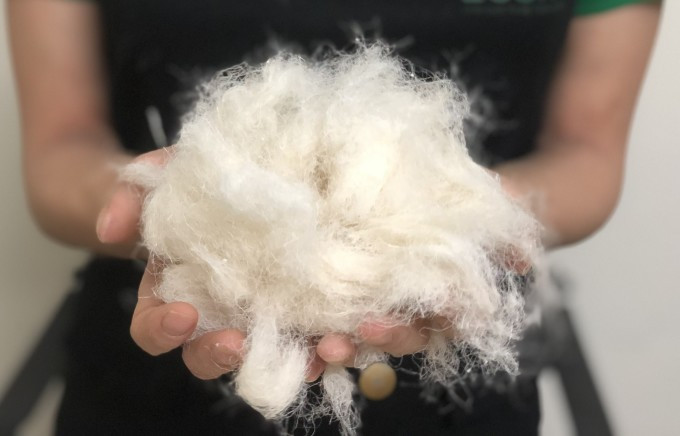
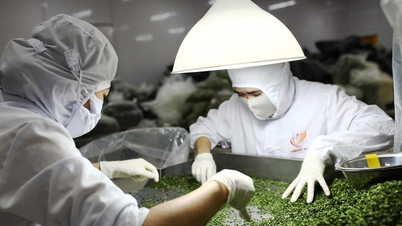
Collaborating with farmers and cooperatives in Dien Bien , Ninh Binh, Thanh Hoa, Nghe An, and Tien Giang provinces to harvest pineapple leaves and fruits, the startup Ecofa Vietnam transforms them into silk and yarn for the textile industry. This is the result of more than three years of research and experimentation by the company.
The process of producing raw pineapple fiber and processed pineapple leaf fiber involves 18 stages, but essentially includes separating raw pineapple fiber (of the same color and length) from the leaves, then spinning the raw fiber into yarn (ensuring uniform color, moisture content, length, and fineness). Only then is the pineapple yarn used for spinning and weaving.
Founder and engineer Dau Van Nam said that producing yarn from pineapple leaves and fruits is not new, but previously it was limited to traditional, small-scale methods. Manual spinning methods using long fibers could not produce enough yarn to meet the standards for textile factories. "We didn't want to miss the opportunity to be the first," he said.
Therefore, in mid-2021, he began experimenting with producing pineapple fiber using a machine he invented himself. "The large-scale production process of pineapple fiber using a machine was gradually perfected through many years of failed experiments," Nam admitted.
During this process, the startup found a like-minded partner in Bao Lan Textile, a company specializing in R&D of eco-friendly fabrics. They have been working together for the past three years to perfect the entire processing chain of post-harvest waste products, including pineapple leaves and fruit, into fabric suitable for clothing.
By the beginning of this year, Ecofa was able to supply 18 tons of pineapple cottonized fiber from over one million tons of harvested pineapple leaves each month. The company expects production to increase to 50 tons per month by the end of 2025.
Ecofa's raw materials will supply Bao Lan Textile to weave into fabrics for the textile, garment, fashion , and interior design industries, under the Ananas brand. Depending on the intended use, pineapple leaf silk is custom-blended with other eco-friendly fibers such as organic cotton, bamboo biocell (a type of young fiber produced using a close-loop system), silk, and wool.
From there, they can create materials such as denim, jersey, towels, woven fabrics, and knitted fabrics. "Pineapple fiber is a material that already exists, but we have developed it together as a new brand with an entrepreneurial spirit," said Dave Quách, Founder of Bảo Lân Textile.
The Ho Chi Minh City Textile Research Institute (VTRSI-TTC) and Nissenken Technical Testing & Analysis Organization (Japan) have certified four features of pineapple leaf-based fabric developed by these two startups, including: fabric durability, natural odor removal on fibers, natural antibacterial properties on fibers, and natural UV protection of up to 50+ UPF on silk.
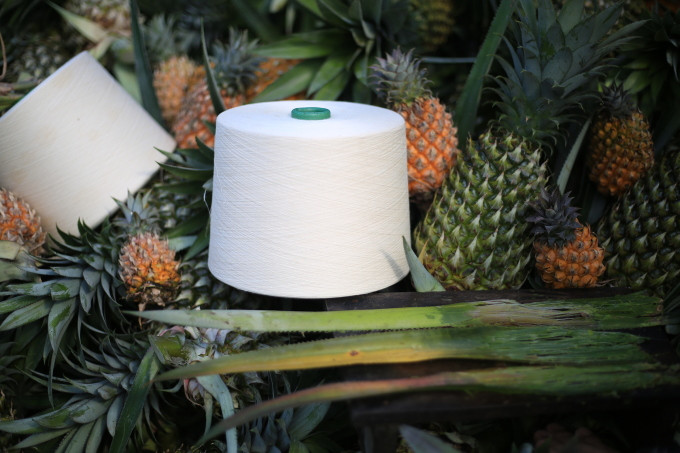
According to textile experts, pineapple fiber fabric was known around the 17th century, most notably in the Philippines. However, the entire fabric-making process was complex and required only rudimentary tools, resulting in low production, high prices, and limited use. This material was forgotten when cheaper industrial fabrics became popular after the 19th century.
However, the green consumption trend has fueled a wave of startups, helping to "recreate" pineapple leaf and fruit fibers for widespread application in modern life. Several countries, such as the Philippines, Costa Rica, and Bangladesh, have also successfully researched and commercialized pineapple fiber in recent years.
Ms. Nguyen Thi Tuyet Mai, Deputy General Secretary of the Vietnam Textile and Garment Association (VITAS), said that the types of yarn and fabric introduced by these two startups mark a turning point in connecting the pineapple farming industry with the global green fashion trend.
"In the context of the domestic and global textile industry lacking raw materials for green fashion production, the success of these two companies in researching and mass-producing high-quality pineapple fiber for garment fabrics has a positive impact on the demand and development of the industry, not only in Vietnam," Ms. Mai said.
According to forecasts by the UK-based market research firm The Business Research Company, the global natural fiber market will grow from $63.62 billion in 2021 to $77.12 billion in 2026. Founder Dave Quach stated that fabrics made from pineapple leaves and fruit have good export prospects. His company is currently in negotiations with several foreign purchasing partners, but further details cannot be disclosed at this time.
TH (according to VnExpress)Source: https://baohaiduong.vn/lan-dau-san-xuat-vai-tu-la-va-qua-dua-quy-mo-lon-393786.html









































































Comment (0)